
Your First Live Keyboard Auction Starts in Ten Minutes. Here's the Plan
The camera is framed on your Yamaha P-125. A ring light softens the glare on the fallboard. Three viewers are in the room, and one is typing "is that the upgraded model?" in the chat. You have a $900 price in your head, a buddy in the garage holding a local bidder's max on a handwritten card, and zero clue how you got here. Welcome to live selling. Follow a clean hybrid roadmap and you will actually enjoy your first stream.
The timing is in your favor. U.S. livestream commerce grew nearly 50% in 2025 to $14.64 billion, and eMarketer projects another 36% jump through 2026. Live streams convert between 9% and 30%, compared to 2% to 3% on standard e-commerce. Translation: your keyboard stands a better chance of moving on a live stream than on a classifieds page for six weeks. You just need a system.
Stage the Room Before You Touch the Keys
Your first job is to make the instrument look like the star it is. A digital piano loses roughly 15% to 20% of its retail value the moment it leaves the store, so your buyers already know they are shopping a used market. Your staging is what convinces them your $900 keyboard is the cleanest one on the feed. Wipe down the keys, dust the speakers, and check that every key triggers sound. Have the power adapter, sustain pedal, and original manual stacked next to it so the bundle reads as complete.
Lighting is where most beginners lose the bid. A single softbox lantern or two ring lights at 45 degree angles will kill ugly shadows on the keybed and make the finish pop on camera. Skip the overhead room light; it flattens everything. For audio, plug a Rode or Deity lavalier into your phone or camera, or run a small USB interface straight from the keyboard's line out so viewers hear the real tone. Bidders pay for what they can hear, and muddy audio kills a live keyboard auction faster than a scratched case.
Frame two shots if you can. One wide angle shows you at the bench, one close-up captures the keys and display. A cheap capture card plus OBS handles the switch, and the visual variety keeps new arrivals watching.
Demo Like You Are Teaching, Not Performing
Here is the mindset shift nobody tells first-time sellers: you are not auditioning. You are demonstrating. Your job is to show every feature a buyer would test in a store. Run the voice bank with three to five quick samples, grand piano, electric piano, strings, organ. Hit the metronome, tap transpose, plug in headphones on camera to prove the jack works. Call out the weighted action and play a slow scale so viewers see your fingers respond like they would on an acoustic.
Keep your energy high and your explanations plain. Community guides from Whatnot sellers point out that enthusiasm is contagious and that greeting viewers by name pulls lurkers into the chat. Ask questions the room can answer: "Anyone here upgrading from a 61-key? What are you coming from?" Buyers who type are buyers who bid.
Short auction windows outperform long ones. Instead of a 30 second countdown, try 10 seconds. Faster pacing builds urgency, pushes hesitant viewers off the fence, and packs more micro-auctions into the hour. If you run a single big lot for the keyboard, open the floor at $500 and let the room carry it up.
Fuse Your Online Chat With In-Person Bidders
The hybrid part is what separates a solid first stream from a chaotic one. You likely have neighbors, local musicians, or a Facebook group who want to see the keyboard in person before committing. Do not pretend they do not exist. Bring them into the show.
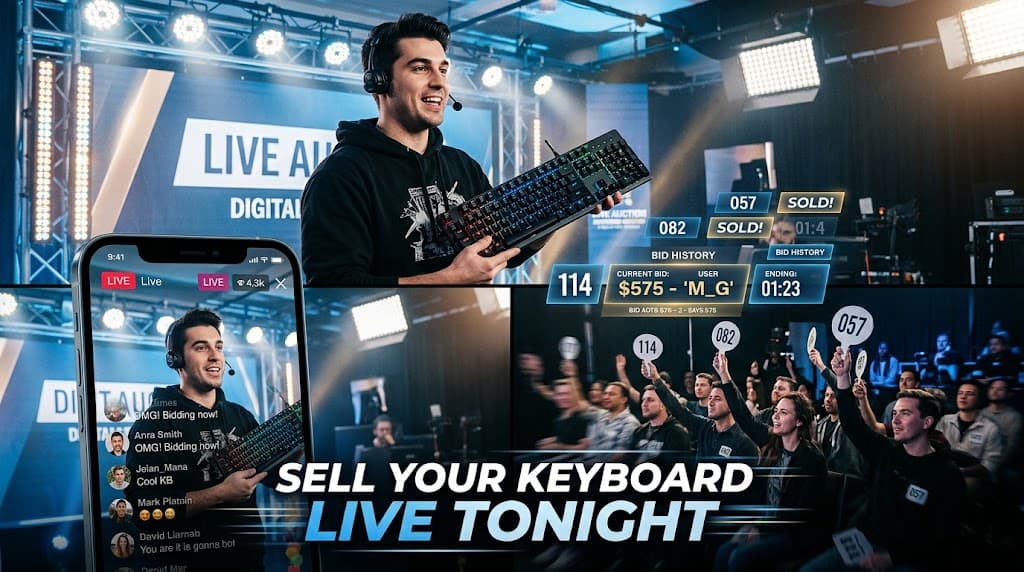
Give your in-person bidders a proxy. A friend on a second phone can relay their max bids into the chat under a clear username like "LocalBidder1," and you announce those bids out loud the same way you read a typed comment. Post the proxy rule on screen so nobody cries foul. If someone is physically in the room during the stream, hand them a paddle or a numbered card and call their bids on camera. The theater works; online viewers love seeing real humans competing.
Set one firm reserve number in your head and keep it off the air. If the live keyboard auction stalls below it, drop the starting price by $25 to create motion rather than closing the bid. Urgency beats stubbornness every time on stream.
Get Paid Without the Panic
The moment the hammer drops, your real risk begins. Going live on Facebook or TikTok with no payment protection means trusting a stranger to Venmo you $900 for a keyboard you already packed. Chargebacks, ghosted buyers, and "it arrived damaged" disputes all land on you. This is why built-in escrow changes the math for a first-time live keyboard auction.
A smart contract escrow approach locks the buyer's funds the second they commit. Funds sit in USDC on the BASE network, the seller pays 0%, and the buyer covers a tiered service fee that starts at 8% under $50 and scales down from there. Nothing releases until the buyer confirms delivery, the timer expires, or a trained Peacemaker volunteer resolves a dispute. You ship with a tracking number, the money is already locked, and you are not refreshing your banking app at 2 a.m. wondering if the transfer cleared.
On logistics, box the keyboard in double-walled cardboard, double-bag the power supply, and film a quick packing clip before you seal it. That 30 second video becomes your insurance if a buyer claims the stand arrived bent.
What's Coming Next for Hybrid Sellers
You are entering live commerce at the exact moment the tooling is catching up to the hype. Whatnot cleared over $75 million in Black Friday 2025 sales, and buyers now spend roughly 80 minutes a day inside live-stream apps. The next wave is not just more viewers; it is better protection baked into the stream itself. Smart contract escrow, wallet-to-wallet settlement in USDC, and community-led dispute resolution are pulling live selling out of the "hope it works" era.
Start small. Run one stream this weekend, tighten your demo, and ship one buyer with a clean payout. Every live session after that gets faster, cleaner, and louder. Your $900 keyboard is not just a sale. It is your rehearsal for everything else you are going to move from the garage. Fisheez is building the rails so the next time you go live, the only thing you are sweating is hitting the right reverb patch.