
The Stroller on the Porch
Sarah drove twenty minutes to drop off a stroller she'd never see again. She'd bought it three years earlier for just under four hundred dollars, used it hard through two kids, and now a stranger named Dana was waiting on a porch two towns over with a check for eighty bucks and a thank-you she genuinely meant. Sarah drove home feeling lighter than she'd expected, and Dana spent the next two years pushing her daughter through every farmers market and neighborhood loop she could find.
Neither of them would call it a community moment. They'd call it practical. But something passed between them on that porch that didn't show up on any receipt.
Why Parents Are Skipping the Baby Store
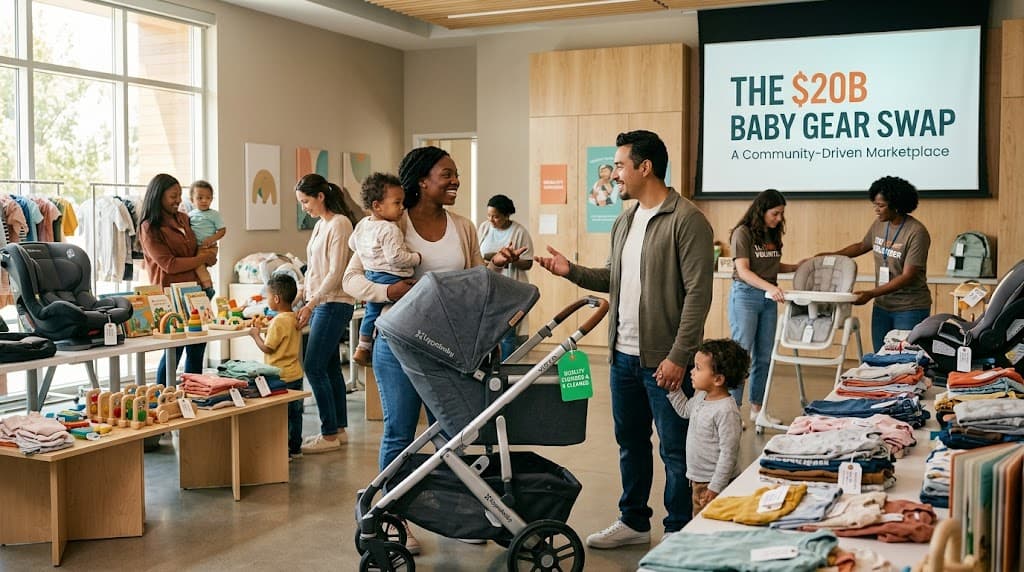
The secondhand baby gear market has quietly grown into something the industry can't ignore. It's now worth more than twenty billion dollars, dwarfing the two-point-eight-three billion dollar new stroller market. Roughly eighty percent of parents shop secondhand to save money, and grandparents account for about twenty percent, picking up items for grandchildren without paying full price for something outgrown in six months.
Tariffs have pushed new baby gear prices up twenty percent or more in recent years. When a brand-new jogging stroller costs six hundred dollars and a two-year-old version sits in someone's garage for a hundred and fifty, the math is simple. Secondhand gear now represents thirty-two percent of total value moving through the baby gear market, and that share keeps climbing.
The Safety Questions Nobody Wants to Skip
Goodwill and good deals don't cancel out real risk. Some categories carry safety stakes that deserve your full attention before money changes hands.
Car seats are the clearest example. Most expire six to nine years from the manufacture date because the plastic degrades in ways you cannot see. A car seat in any significant crash should be replaced, even if it looks fine. Consumer Reports safety researcher Emily A. Thomas has written extensively about how hard it is for even trained parents to install a car seat correctly. Buying one secondhand means trusting a stranger's account of its history, which is exactly why asking pointed questions isn't rudeness; it's your job.
Strollers manufactured after September 2015 are held to federal safety standards earlier models weren't. Joan Muratore of Consumer Reports recommends checking four things: seat recline function, brake responsiveness, frame integrity, and whether the stroller folds and locks correctly. If any of those four are off, walk away. Drop-side cribs are a firm no regardless of how pristine they look.
Where Stroller Swaps Actually Happen
The geography of secondhand baby gear is more varied than most new parents realize.
Buy Nothing groups have over seven million members and operate on a pure gift economy. The catch is neighborhood restriction: access depends heavily on your zip code. Researchers who study Buy Nothing have documented something instructive. Trust builds through small exchanges repeated over time, not through single large transactions.
Baby Gear Group operates differently. With ten locations across seven states, it functions more like a gear library than a resale shop, earning a spot on TIME's Best Inventions list for 2025. Families save between five hundred thirty and eight hundred dollars per year compared to buying new, and the organization has diverted twelve metric tons of packaging waste from landfills.
GoodBuy Gear has re-homed more than ten thousand car seats since 2022, along with over seventy thousand total items across twenty-six hundred brands. Their vetting process is part of what makes parents willing to trust them with higher-stakes purchases.
Brand-specific Facebook groups are underrated. Parents gather in communities that obsess over product details at a level no retailer can match, surfacing deals and inspection advice in the same breath.
For sellers thinking about fees, Fisheez is worth knowing about. Unlike eBay, where sellers pay thirteen-point-two-five percent per transaction, Fisheez charges sellers nothing, which means more of that eighty dollars actually stays in your pocket.
How to Do Your First Stroller Swap
Stroller swaps work best when you treat them like a negotiation between reasonable people, not a transaction you're trying to win.
Vet the listing before you contact anyone. Look for clear photos, a posted manufacture date, and an honest description of wear. Ask whether the item has been in an accident (for car seats), whether anything has been repaired, and how many children used it. When you meet, inspect in good light. Fold and unfold the stroller yourself, test every brake, check every buckle. Used strollers in good condition typically sell for forty to seventy percent below retail. For the handoff, a public location in daylight works for most transactions.
The Village You Didn't Know You Were Building
Something accumulates through these exchanges that doesn't show up in any savings calculation. People who start by giving away hand-me-down onesies often end up forming genuine friendships, sharing childcare tips, and showing up for each other in ways that have nothing to do with gear. The stroller swap is often just the beginning.
New parenthood is isolating in ways that blindside people who weren't warned. The village previous generations relied on has largely been replaced by individual household units with Amazon Prime. Stroller swaps are one of the small, practical ways people are rebuilding what was lost, not out of ideology but out of necessity that accidentally produces connection.
For parents who want to participate with less friction and more fairness, Fisheez was built for peer-to-peer transactions, which matters when you're selling a stroller for eighty dollars and don't want a meaningful chunk going to a platform. If you're curious how disputes get resolved in a community marketplace, Peacemakers and how they work is worth a read. Peacemakers are trained community volunteers who step in to mediate rather than leaving buyers and sellers to argue in comment threads, and it's a human approach to a human problem.
Fisheez also channels five percent of revenue into the Fishlanthropy Foundation, a legally separate nonprofit where NFT holders vote on how funds get allocated. Gear can circulate through a community. Money can too, and where it goes says something about what you're actually building.
Sarah didn't know any of this when she drove those twenty minutes. She just needed the stroller out of her garage, and Dana just needed a stroller. But somewhere in that ordinary handoff, a small thread of trust got laid down. That's how villages start.