
The Moment the $3,000 Was Gone
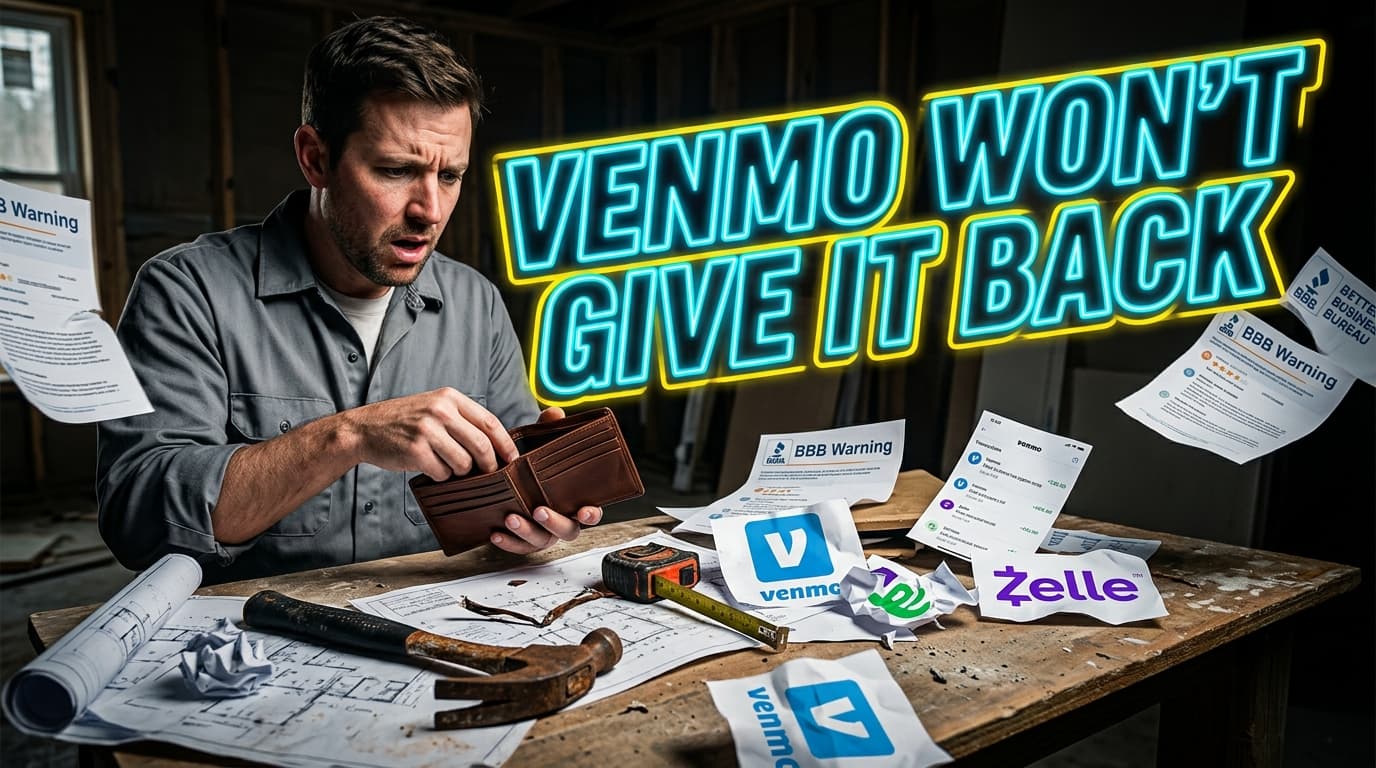
He hit send on Venmo and felt the familiar little buzz of confirmation. Three thousand dollars, transferred to a landscaper he'd met twice, for a backyard project that was supposed to start Monday. By Wednesday, the texts were going unanswered. By Friday, the number was disconnected. The money was gone the second he tapped that button, and somewhere in the back of his mind, he knew it even then.
This is not a rare story. According to the Better Business Bureau's 2024 Risk Report, 70.1% of people who encounter a home improvement scam lose money. That's not a typo. Seven out of ten. Losing money to a contractor who disappears is statistically the norm, not a freak accident. And the way most people pay, Venmo, Zelle, Cash App, a stack of bills at the kitchen table, is exactly why the money never comes back.
Why Your Bank Won't Save You
Here is the part that surprises almost everyone. When you call your bank after a contractor ghosts you, they will listen politely and then explain that there is nothing they can do. The reason is a legal distinction that sounds like fine print but has enormous consequences: you authorized the payment. You sent the money willingly. That means it is not fraud in the legal sense, and the Electronic Fund Transfer Act of 1978, the primary law governing digital payments, was never written to cover peer-to-peer platforms like Venmo.
As a March 2025 Center Forward policy brief put it, P2P payments are "like cash, quick and easy to exchange but difficult to get back once funds are sent." When a scam involves an authorized transaction, banks are not legally required to reimburse you. Senators Blumenthal and Warren, along with Representative Waters, introduced legislation in 2024 to update these protections, but as of 2026 it has not passed. The regulatory gap is real, and it is not closing anytime soon.
This Isn't Bad Luck, It's a Pattern
The $3,000 backyard story feels personal, but zoom out and the pattern is everywhere. Home improvement scams ranked the fifth riskiest scam type in the United States in 2024, with a median loss of $1,800. For context, the median loss on an online purchase scam is $75. That means hiring a contractor is, dollar for dollar, 24 times more financially dangerous than buying something sketchy on the internet.
The scale can also go the other direction. Kyle Allen of Gladwyne, Pennsylvania hired contractor Mike Monaghan to build his dream home for $1.2 million. Two years later, the house was unfinished. Allen estimates Monaghan took roughly 70% of the budget and delivered somewhere between 15 and 20% of the actual project. Plumbing, electrical, and HVAC all had to be ripped out for code violations. Another homeowner, David McIntyre, found Monaghan through a contracting platform online, the same way you might find a landscaper on any marketplace today. The platform connected them. It protected no one. And if you are thinking you would spot someone like Monaghan in person, the BBB data has a sobering answer: face-to-face contact had a 73.2% susceptibility rate in 2024. Meeting someone in person provides almost no additional protection.
The Fix the FTC Already Recommends (But Doesn't Enforce)
The Federal Trade Commission's guidance on home improvement scams is actually quite good. Never pay the full amount upfront. Never make the final payment until the work is done and you are satisfied with it. Watch out for contractors who only accept cash, pressure you for an immediate decision, or suggest you borrow money from a lender they happen to know. This is sensible, practical advice.
The problem is that none of it has any enforcement mechanism when you pay via Venmo. The FTC can tell you not to pay everything upfront, but once you do, the agency cannot get your money back. Escrow.com frames the underlying logic well: escrow gives a service provider "an incentive to carry the work out to their highest standard" because payment is contingent on satisfactory completion. That incentive structure is exactly what the FTC is describing. The FTC's advice is structurally correct. The payment tools most people use make it practically unenforceable.
How SmartShell Flipped the Power Dynamic
The same homeowner from the opening of this article tried again six months later. Different landscaper, same general project, but this time he used Fisheez to hire a landscaper through SmartShell escrow service. The moment he submitted payment, the funds locked into a smart contract on the BASE blockchain, held in USDC. Not in a company's bank account. Not in a holding fund that someone could theoretically access. In code, on a public blockchain, where neither party could touch it until the conditions were met.
The landscaper knew going in that the money existed, that it was real, and that it would be released when the work was done. That changes the dynamic entirely. Partway through the project, a minor dispute came up over the final cleanup phase. The funds stayed frozen while a Peacemaker, a trained community volunteer, reviewed the situation. Peacemakers on Fisheez are not paid per case; they are eligible for prize pools through participation, which means they have no financial incentive to favor either side. The dispute was resolved, the funds released, and the backyard got finished. Neither party had to simply trust the other. The structure did the work.
If the landscaper had gone silent entirely, SmartShell has a 72-hour auto-refund rule: if a seller does not acknowledge an order within 72 hours, the buyer is automatically refunded in full. No support ticket, no waiting, no argument. The code handles it.
What This Actually Costs (And Why Sellers Accept It)
The first objection most people raise is cost. Escrow sounds like something that adds fees on top of fees. On Fisheez, sellers pay 0%. Nothing. For a buyer, the fee is tiered based on transaction size, starting at 8% for very small transactions and scaling down significantly from there. On a $3,000 landscaping job, the buyer fee is a modest percentage of the total, and it is far below the 20% that platforms like Fiverr and Upwork charge freelancers, costs that get baked into every quote you receive anyway.
Legitimate contractors actually prefer this setup. SmartShell guarantees they get paid the moment the buyer confirms completion. No chasing invoices. No waiting 30 days for a check that may or may not arrive. The escrow structure protects the seller from non-payment just as much as it protects the buyer from non-delivery. For any contractor who plans to do the work, it is a better deal than Venmo.
Before You Hire the Next Contractor
Here is what to do before any money changes hands on your next project. Never pay the full amount upfront through Venmo, Zelle, or cash, regardless of how convincing the contractor seems. For any project with multiple phases, split the payments into milestones and treat each phase as its own transaction. Use a platform where funds are held by code, not by a company, so there is no custodian who can be pressured, hacked, or simply go out of business with your money in their account. And before you start, confirm exactly how disputes are handled and what happens if the seller goes silent.
When you hire a landscaper through Fisheez using SmartShell escrow service, those questions are already answered before you pay a dollar. The funds lock, the contractor works, the buyer confirms, the money releases. If something goes wrong, Peacemakers review with frozen funds. If the contractor disappears, the auto-refund runs on its own. In Canada, home improvement scams have an 83.9% susceptibility rate. This problem is not going away on its own, and no legislation has fixed it yet.
The homeowner's backyard looks good now. The landscaper got paid the same day the work was confirmed. Neither of them had to take the other's word for it. That is not a small thing. That is the entire point.