
The Handshake That Shouldn't Have Happened
Mike rode a stripped-down CBR600RR and had strong opinions about people who didn't. Dave toured on a fully loaded FJR1300 and had equally strong opinions about people who did. Their clubs had shared the same regional roads for years without sharing much else, right up until the moment their respective chapter presidents decided the drama was costing everyone good riding seasons. The merger happened quietly, sealed over a single motorcycle deal: one member selling a lightly used Ninja 650 for $6,800, another buying it, each from the opposite club. Neither man had done business with someone from the other side before. The handshake at the end of it became the thing people still talk about at Skylands SSTMC meetings.
That story sounds specific to one corner of New Jersey, but the dynamic it captures is playing out across the country. In the $6,000 to $8,000 price range, where sport and touring bikes genuinely overlap, something about the way a deal gets done has started to matter in ways that go beyond the transaction itself.
Two Markets, One Price Tag
The pandemic era inflated used motorcycle prices across every category, and the correction has been significant. RevZilla put it plainly when the unwinding began: the pandemic price premium has ended. Depending on the segment, used values have pulled back roughly 40% from their peaks. Sport bikes now trade reliably in the $5,000 to $10,000 window, while touring rigs cluster between $7,000 and $15,000. The overlap zone, that $6,000 to $8,000 band, is where a motivated sport rider and a downsizing touring rider can end up looking at the same listing.
Wholesale data tells the sharper story. Sport bike wholesale values dropped 11% in recent quarters, and cruisers fell even harder at 13%. For buyers, that's opportunity. For sellers, pricing discipline matters more than it did. Motorcycle deals in this range require both parties to do their homework, because the spread between an informed seller and an uninformed one can easily run $1,500 on the same machine.
Growing in the Same Direction
Here is the part that surprises people: both categories are growing. Sport bike registrations climbed 11.3% and touring registrations rose 14.7% in Q1 2024. The market is not contracting around a single type of rider; it is expanding in multiple directions at once. Adventure touring alone represents a $37.57 billion global market growing at an 8.7% annual clip, which suggests that the category blurring between "sport" and "touring" is a permanent feature rather than a trend.
The Motor Sports Touring Association understood this before the numbers confirmed it. Founded in 1982 as a Honda-only club, MSTA eventually dropped the brand restriction entirely and rebranded around a broader mission: bringing enthusiasts together regardless of what they ride. Their current membership reflects exactly the kind of cross-pollination that the Skylands story represents. When your organization's reason for existing is community rather than brand loyalty, the motorcycle deals that happen between members carry a different kind of weight.
The Scam That Keeps Riders Apart
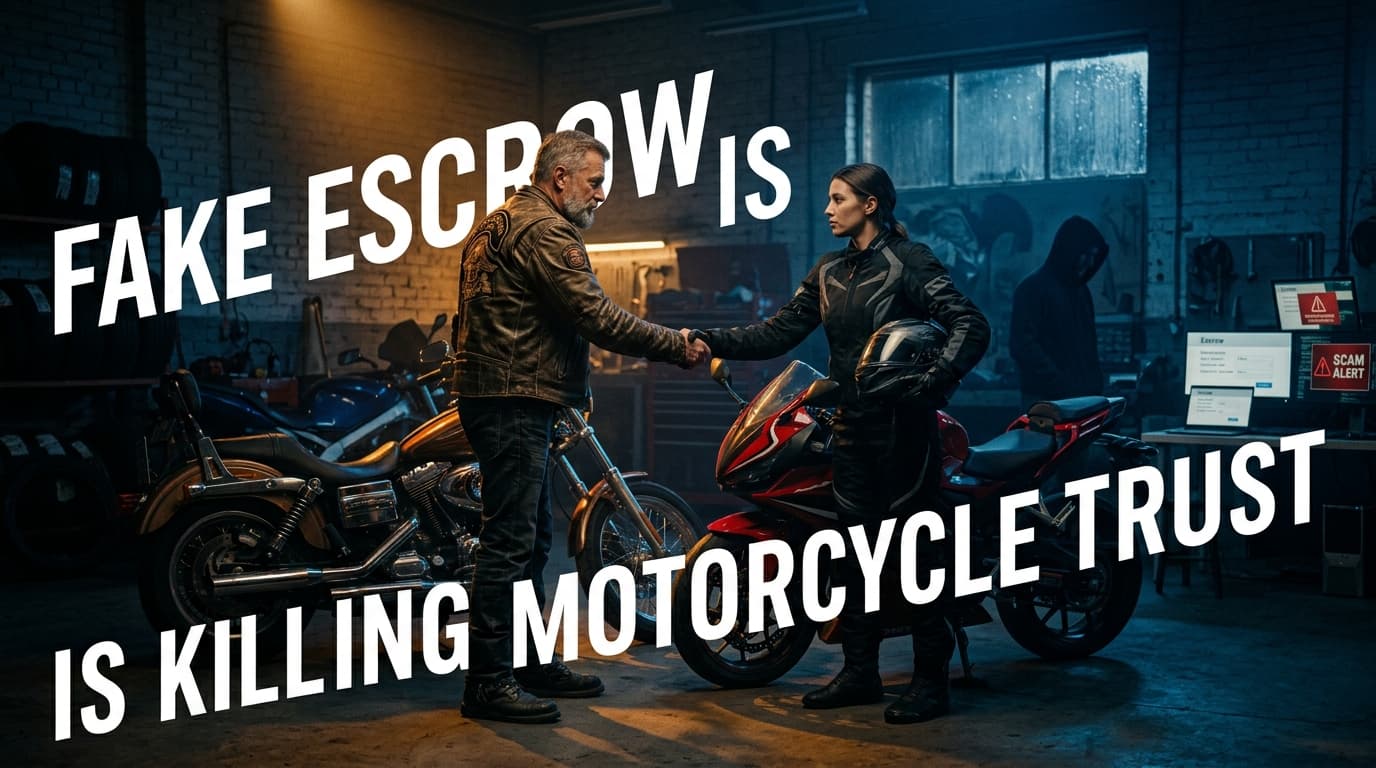
The trust problem in private party motorcycle sales is not abstract. Fake escrow fraud is currently the number one peer-to-peer scam in motorcycle transactions. The pattern is consistent: a seller proposes a third-party escrow service, the buyer wires funds, and the service and the bike both disappear. It hits hardest in the $6,000 to $8,000 range because that is where buyers are most likely to be stretching, most likely to be buying from a stranger, and most likely to feel the full weight of the loss.
Touring riders are particularly exposed. Rental data from Riders Share puts average touring bike daily rates at $130 with trips averaging 4.1 days, which reflects how seriously touring riders treat their machines as long-term investments. A buyer spending $7,500 on a used ST1300 is not careless. They are careful. The scam is designed to exploit the process, not naivety. This is the friction point where Fisheez addresses the core vulnerability directly: its SmartShell Escrow settles in USDC on the BASE blockchain, holding funds in a transparent smart contract rather than routing them through an entity a buyer has to trust blindly.
When Rides Become Something Bigger
CycleFish data shows that more than 30% of organized motorcycle events now include a charitable component. That figure has climbed steadily and reflects something anyone who has ridden in a charity run already understands: the community aspect of motorcycling channels naturally toward collective purpose.
The Distinguished Gentleman's Ride is the clearest large-scale example. In 2024, the event brought together 113,000 riders across 959 rides in 105 countries and raised $7.6 million for men's health research, contributing to a cumulative total now past $52 million. Kyle Petty's Charity Ride Across America has covered more than 2,100 miles annually over its run, raising $21 million cumulatively for children's healthcare. Organizations like BACA, the Punishers MC, and Combat Veterans MC run smaller but deeply rooted charitable operations within their regional communities. The pattern is consistent across size and geography: riders show up for each other.
What makes this relevant to motorcycle deals specifically is that trusted transactions are the entry point. Community cannot be built around commerce if the commerce itself is adversarial. Riders Share logged 13,890 bookings through its peer platform, which demonstrates that scale is achievable when the trust infrastructure is right. The charitable giving, the club mergers, the cross-category riding culture, all of it depends on the foundation of people being able to hand over money and feel confident in what happens next.
Fair Deals, Ripple Effects
Fisheez was built around the premise that fair motorcycle deals have ripple effects. The SmartShell Escrow system handles the trust layer so that neither a sport rider selling a Kawasaki Z650 nor a touring rider buying a BMW RT needs to take a leap of faith on the other person's good intentions. The escrow holds, the transaction closes, and both people walk away with something they can feel good about. Buyers pay a tiered fee that starts at 8% on transactions under $50 and steps down to 0.5% above $10,000. Sellers pay nothing.
The Peacemakers program extends that ethic into dispute resolution. These are community volunteers, not arbiters drawing fees from contested funds, which keeps the incentives aligned with resolution rather than prolonged disagreement. When a deal goes sideways, the goal is to get both parties to a fair outcome.
Fishlanthropy Foundation, Fisheez's 501(c)(3) arm, directs 5% of revenue toward causes that align with the community the platform serves. That is not an afterthought; it is structural. The same riders who show up for DGR and Kyle Petty runs and BACA events are the ones completing motorcycle deals on the platform, and the connection between those two things is intentional.
Mike and Dave both still ride. Mike picked up a Versys 1000 last spring and texts Dave about roads more than he probably expected to. The bike that started it all is three states away now, in good hands. The handshake held.