
The Costume in the Closet
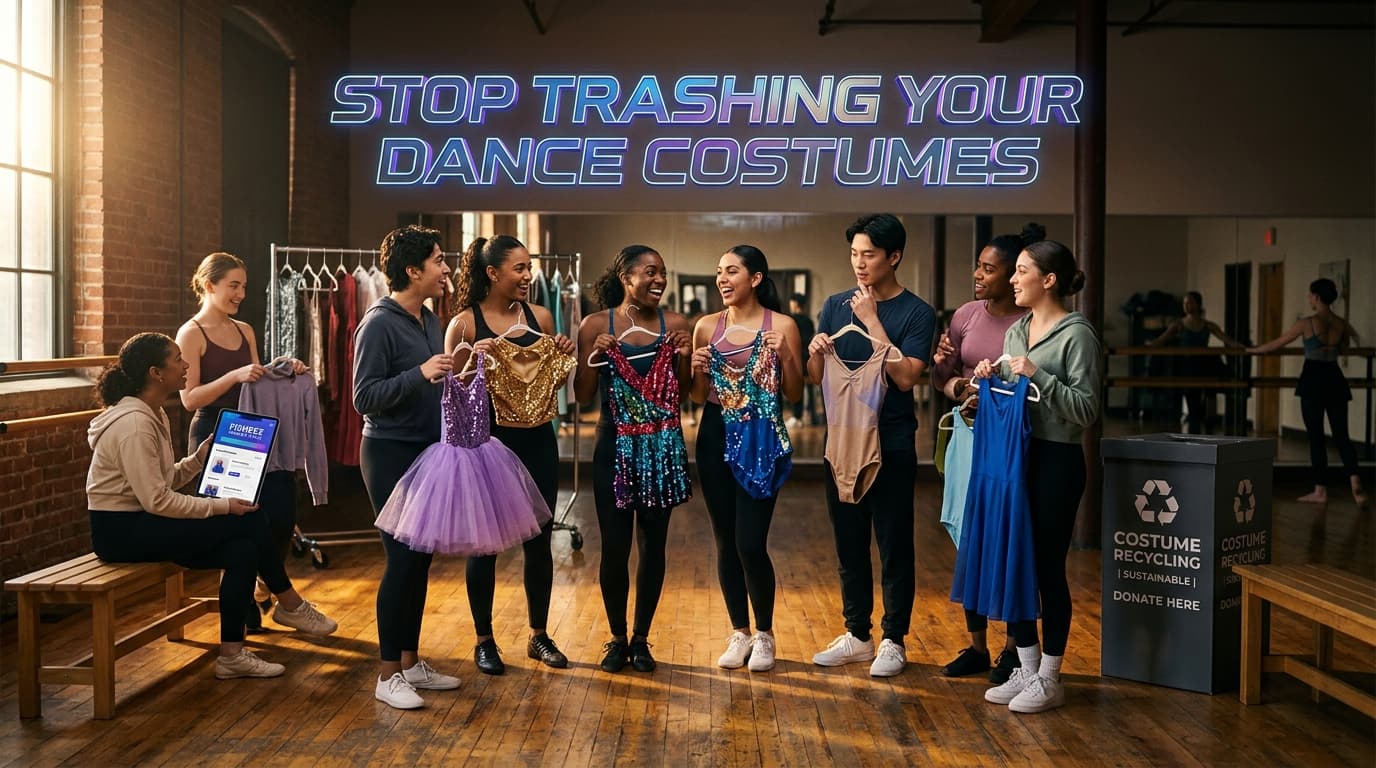
She's standing in the doorway of her daughter's bedroom, holding a $250 rhinestone-trimmed lyrical costume that was worn exactly twice. Once at the spring showcase, once at regionals. It still smells faintly of hairspray and adrenaline. Now it's headed for the closet shelf, where it will live in a garment bag until she runs out of patience and drops it in a donation bin, or worse, the trash. Polyester takes 200 years to decompose, which means that little purple costume could still be sitting in a landfill long after everyone who ever watched that performance is gone. There has to be a better way to close the loop.
That moment, repeated in households across the country every spring and fall, is where costume swaps quietly begin to matter. Not as a trend. Not as a budget hack. As a small, practical act with a longer reach than most parents realize.
The Myth That Resale Exploits the Art
Somewhere along the way, the dance world decided that selling a used costume was slightly undignified. The logic goes something like this: dance is an art, art deserves investment, and putting a price tag on a secondhand tutu cheapens the whole enterprise. Studio newsletters sometimes nudge parents to donate rather than sell, as though profit and generosity cannot coexist. That framing does not hold up when you look at how resale actually works in the broader economy.
Ninety-four percent of retail executives now say their customers already participate in resale. Not some customers; most customers. Forty-six percent of shoppers say they will not buy something new if they can find it secondhand, and that number climbs to 55% among younger generations. The behavior is mainstream. The stigma is a holdover. Costume swaps are not a sign that a family does not value the art; they are a sign that the family is paying attention to how systems can work smarter.
Where That $250 Actually Goes
When you sell through a specialty resale platform like Encore Dance Closet, you keep somewhere between 50% and 80% of the sale price, depending on the item. On eBay, the platform takes 13.25%. On Poshmark, the cut is 20%. These fees are not hidden; they are the cost of using an established marketplace with built-in buyers. What varies is how much of that original $250 finds its way back to your family, and how much ends up funding someone else's infrastructure.
Platforms built around peer-to-peer exchange are starting to change that math. Fisheez, a blockchain marketplace that runs on BASE and settles transactions in USDC through its SmartShell Escrow system, charges sellers nothing. Buyers pay a tiered fee based on transaction size, from 8% on purchases under $50 down to 0.5% on transactions over $10 million, but the seller's earnings stay fully intact. For families who have already spent heavily on lessons, recitals, and competition fees, that difference is real. Costume swaps should work for the people doing the swapping, not just for the platform hosting them.
What the Shortage Actually Looks Like
While dance parents debate the etiquette of resale, arts programs are being quietly hollowed out in schools across the country. The number of arts teachers fell 27% in the years following 2011. The share of students with access to arts education dropped from 14% to 6.8%. In the most economically deprived areas, only 6.6% of students have meaningful arts access, compared to 8.3% in slightly less deprived communities. That gap is small in percentage terms and enormous in human terms.
Sally Bacon, of the Cultural Learning Alliance, has put it plainly: "Children growing up in poverty are the least likely to access arts education." This is not an abstract equity problem. It is a pipeline problem. Kids who never get to move to music, never put on a costume and feel what it is like to perform, are being filtered out of something that could change their relationship to learning, confidence, and community. The costume sitting in your closet is connected to that problem, even if the connection is not obvious yet.
The Model That Closes the Gap
In New York City, two teenage sisters named Ava and Sophia Paley decided to do something about the disconnect between dance families who had too much and kids who had nothing. They started Donate2Dance, and their first collection bin overflowed within a week. That was not a fluke; it was proof that dance parents were waiting for a way to give that felt direct and meaningful. Since then, Donate2Dance has served more than 60,000 dancers through 300 or more partner organizations. Costumes have shipped to Rosie's Theater Kids, to Debbie Allen's Dance Academy, to Miami City Ballet, and to PS 157 in Brooklyn.
Ava Paley has described the impact with a simplicity that sticks: "A pair of ballet shoes can change a dancer's life." She is not speaking in hyperbole. Access to the physical tools of dance, the shoes, the costumes, the tights, is often the barrier that stands between a child and the stage. Costume swaps that keep inventory moving through the ecosystem, rather than into landfills, make models like Donate2Dance possible to sustain.
Tariffs Made the Case Louder
The economic argument for secondhand has been building for years, and recent trade policy has accelerated it. When new tariffs pushed retail prices higher, 59% of shoppers said they would turn to secondhand options as a direct response. Online resale grew 23% in 2024 alone, a pace five times faster than traditional retail. Analysts now project the global secondhand apparel market will reach $367 billion by 2029. These are not niche numbers; they represent a fundamental shift in how people think about ownership and value.
For dance families, that shift arrives with particular clarity. Competition costumes are expensive, heavily used for short periods, and then stored or discarded. The logic of costume swaps aligns perfectly with the direction consumer behavior is already moving. The question is not whether resale belongs in the dance world. The question is whether the dance world wants to lead that conversation or simply follow it.
The Ripple a Recital Creates
When a costume changes hands instead of heading to a landfill, several things happen at once. A seller recovers some of what they spent. A buyer gets access to something they might not have afforded new. A child somewhere down the chain gets to perform who would not have otherwise. That chain is longer than it looks, and the platforms that support it carry some responsibility for keeping it moving.
Fisheez is designed with that chain in mind. Its SmartShell Escrow holds funds in USDC until both parties confirm the transaction is complete, which removes the trust gap that makes peer-to-peer resale feel risky. When something goes wrong, community volunteers called Peacemakers step in to help resolve disputes. Peacemakers are eligible for prize pool recognition, but they are not paid per case, which keeps their judgment independent. Five percent of Fisheez revenue goes to the Fishlanthropy Foundation, a registered 501(c)(3), which directs funding toward causes that align with access and community. A portion of every costume swap conducted through the platform becomes part of something larger than the transaction itself.
The recital that matters most might not be the one your daughter just finished. It might be the one that happens three years from now, in a school gym in a city you have never visited, performed by a kid who found her costume through a chain of exchanges that started in your closet. Costume swaps are not just good economics. They are how communities build the infrastructure of belonging, one sequined dress at a time.