
The Chain You've Never Heard Of Just Beat Ethereum
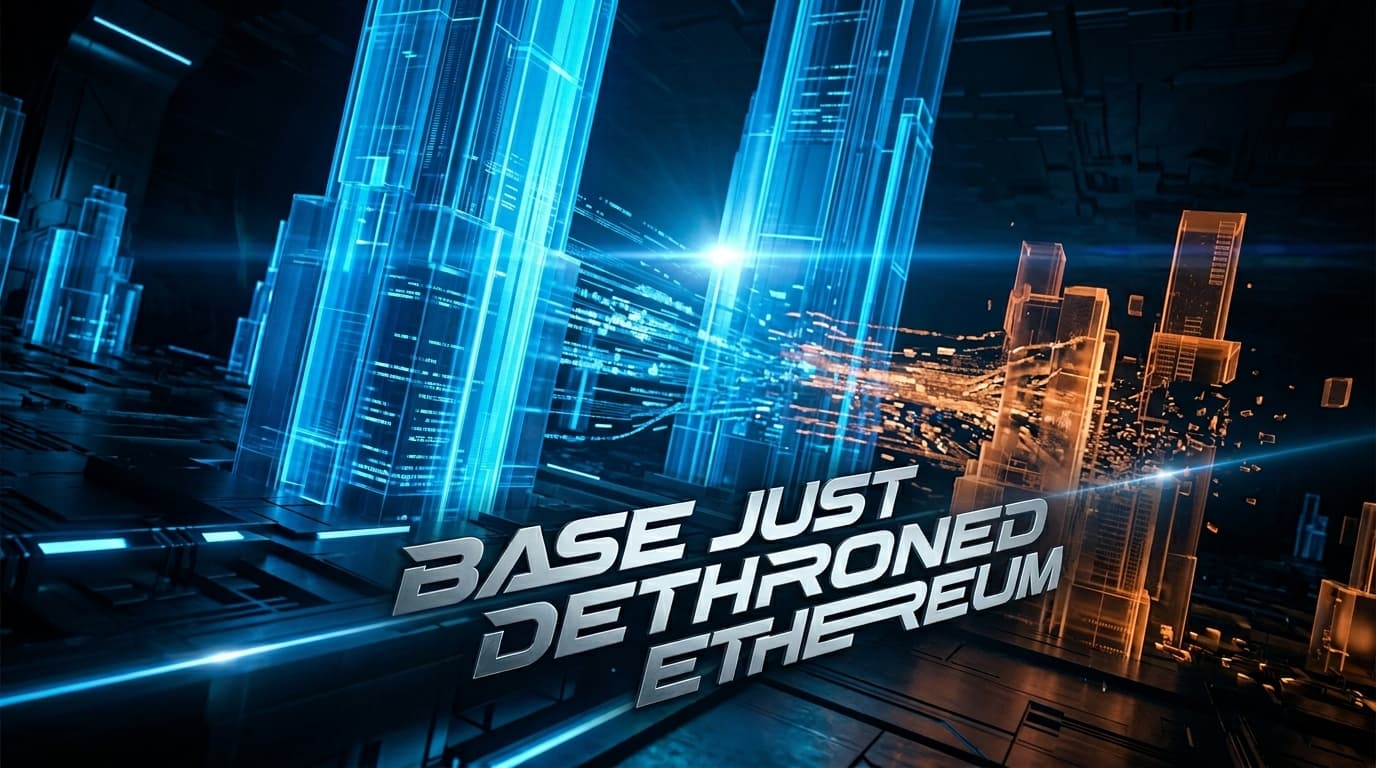
BASE blockchain, a Layer 2 network launched by Coinbase in 2023, quietly did something that almost nobody predicted: it outpaced Ethereum in high-activity users in 2024. According to Flipside Crypto's annual analysis, BASE attracted 15.1 million wallets executing 100 or more DeFi transactions, compared to Ethereum's 10.7 million. That's not a rounding error. That's 38.4% more committed, repeat users on a network most people outside crypto circles have never heard of.
Here's the contrast that makes this meaningful. Bitcoin hit $100,000 in 2024, the kind of milestone that generates breathless headlines and CNBC segments, and the average new monthly user count on BTC came in at 935,900. Flipside concluded that BASE "led the way, by far" in real on-chain activity, while Bitcoin's historic moment mostly recycled existing holders rather than onboarding new ones. Price hype and genuine utility are running in opposite directions, and BASE is on the utility side.
Why does any of this matter if you're a homeowner with a tree on your roof? Because tree service blockchain trends are no longer theoretical. The infrastructure that makes on-chain service hiring practical, fast, protected, and verifiable, is already running at scale. The question is whether you know how to use it before the next storm rolls through.
Why Storm Season Is the Worst Time to Trust a Stranger With a Chainsaw
The Better Business Bureau has documented the storm-chaser playbook in enough detail that it reads like a script. Contractors show up door to door within hours of a weather event, pressure you with a deal that expires the moment they leave your porch, and ask you to sign over your insurance check before a single branch hits the ground. The BBB is explicit: "Don't sign any documents that give the contractor rights to your insurance claims." That warning exists because enough homeowners have signed those documents, handed over the money, and watched the truck drive away for good.
The fraud patterns go further than the obvious grab-and-run. Some storm chasers deliberately create additional damage during inspections of roofs, attics, and crawl spaces, areas you cannot see from the ground, to generate more billable work. Others operate under the name of a legitimate local tree service, offering the real business a small payment to borrow their reputation, then collecting insurance money and disappearing while the actual company fields angry calls from customers they never served. That last tactic matters more than most people realize. A local name is not a safe signal. It can be rented.
What the BBB Tells You to Do (And Why You Won't)
The BBB's standard guidance for hiring storm contractors is correct and comprehensive. Check licensing. Get multiple bids. Verify references. Get the scope of work in writing before anything starts. Never pay the full amount upfront. Pay by credit card when possible. Don't sign over insurance rights. These eight recommendations would protect most homeowners if executed completely.
The honest problem is that almost nobody executes all eight after a storm. Granum's research on the landscape and tree care industry found that 49.4% of professionals cite training and implementation friction as their biggest barrier to adopting better processes, and that's in a calm business context. Now put a homeowner under the same pressure, with a damaged roof, a contractor at the door, and a storm system still on the radar. The friction multiplies. Good advice that requires manual effort and negotiation under stress is advice that gets skipped. That's not a character flaw. It's how humans work under pressure.
How a Smart Contract Does the Checklist for You
This is where the mechanics of tree service blockchain trends stop being abstract. Fisheez, a peer-to-peer marketplace built on BASE, uses a system called SmartShell escrow that encodes the BBB's most critical protections into a smart contract before the contractor ever picks up a chainsaw.
Here is how it works in practice. When you hire a tree service through the platform, your payment in USDC locks into a non-custodial smart contract on BASE. Fisheez never holds, routes, or transmits those funds. The contractor cannot access the money until the work is confirmed complete. For a large job like full storm cleanup or a multi-phase removal, milestone contracts allow each phase to be governed by its own separate escrow with its own release trigger, so you're not handing over the full project budget on day one. If a contractor takes your order and ghosts without acknowledging it within 72 hours, the contract automatically refunds you with no dispute filing, no phone calls, and no chasing.
The outcomes are binary by design: full release to the contractor or full refund to you. There's no partial settlement that leaves both parties dissatisfied. That structure forces scope clarity before funds are ever locked, which is exactly what the BBB's "get it in writing" recommendation is trying to achieve, except here the contract enforces it rather than relying on your ability to negotiate under pressure. If the platform itself ever goes offline, you can interact directly with the SmartShell contract through Etherscan. The funds exist on-chain independently of any company's uptime.
On-Chain Reputation: Why a Blockchain Portfolio Is Harder to Fake Than a Google Review
Traditional contractor vetting runs through centralized platforms where the incentives are misaligned. Google reviews can be purchased. Angi leads are self-reported. Yelp ratings are filtered through an algorithm no one fully understands. None of these systems produce a record that is independently verifiable without trusting the platform itself.
On-chain reputation works differently at a structural level. Every completed job, credential, and endorsement is recorded as a permanent, tamper-proof entry on the blockchain, tied to a verified identity. As the Endless Domains team frames it, "anyone can verify the authenticity of this record without relying on a middleman or centralized platform." Fake recommendations are not just against the rules; they are structurally impossible to fabricate within the system because each endorsement is cryptographically linked to the wallet that issued it.
Connect that back to the BBB's name-hijacking finding. A storm chaser can borrow a local business name. They cannot borrow a blockchain identity. An on-chain portfolio of completed jobs, verified credentials, and client endorsements is specific to one wallet, one contractor, one history. Granum's research frames early digitization adopters as compounding their advantage over time, and the same logic applies here: tree services building on-chain history now are accumulating a verifiable record that late movers cannot quickly replicate. That gap is what makes tree service blockchain trends meaningful rather than cosmetic.
The Practical Upside: What This Costs and How to Start
The fee structure on Fisheez is worth understanding because it inverts the model you're used to. Sellers, meaning the tree service you're hiring, pay zero. Buyers pay a tiered fee starting at 8% on transactions under $50 and scaling down to 0.5% on amounts over $10 million. For a typical residential tree job in the $800 to $2,500 range, the buyer fee lands well below the 8% ceiling. Compare that to Fiverr and Upwork, which take 20% from the service provider, a cost that gets priced into what you pay anyway.
The honest caveat on tree service blockchain trends is that adoption is early. Granum's finding that 49.4% of industry professionals struggle with implementation friction explains why this hasn't already swept the sector. The homeowner side of the transaction requires a wallet and USDC, which is a real onboarding step for someone who has never touched crypto. That barrier is shrinking as BASE's user base scales and fiat on-ramp tools make wallet setup faster. The 41% digitization gap Granum documents between early adopters and the broader industry shows that the professionals who move first build advantages that compound. The same is true for the homeowners who know how to find them.
After the Storm: A Smarter Hire Starts On-Chain
The scenario the BBB is warning you about, a stranger with a chainsaw, an urgent pitch, and your insurance check in their sights, is precisely the moment when having protections encoded into the transaction structure matters most. You are not going to calmly work through an eight-item checklist with a tree on your roof. You can, however, use a platform where the most critical items on that checklist are enforced by default before you ever shake hands.
BASE's growth to 15.1 million high-activity users, surpassing Ethereum itself, is the signal that this infrastructure is real and scaling. It is not a speculative experiment. It is where serious on-chain economic activity has already migrated. For tree services and the homeowners who need them, that migration means the protections once available only to people with lawyers and time are now available to anyone with a wallet. The contractor gets paid when the work is done. Not before. That is the shift. Fisheez is where you can act on it today.