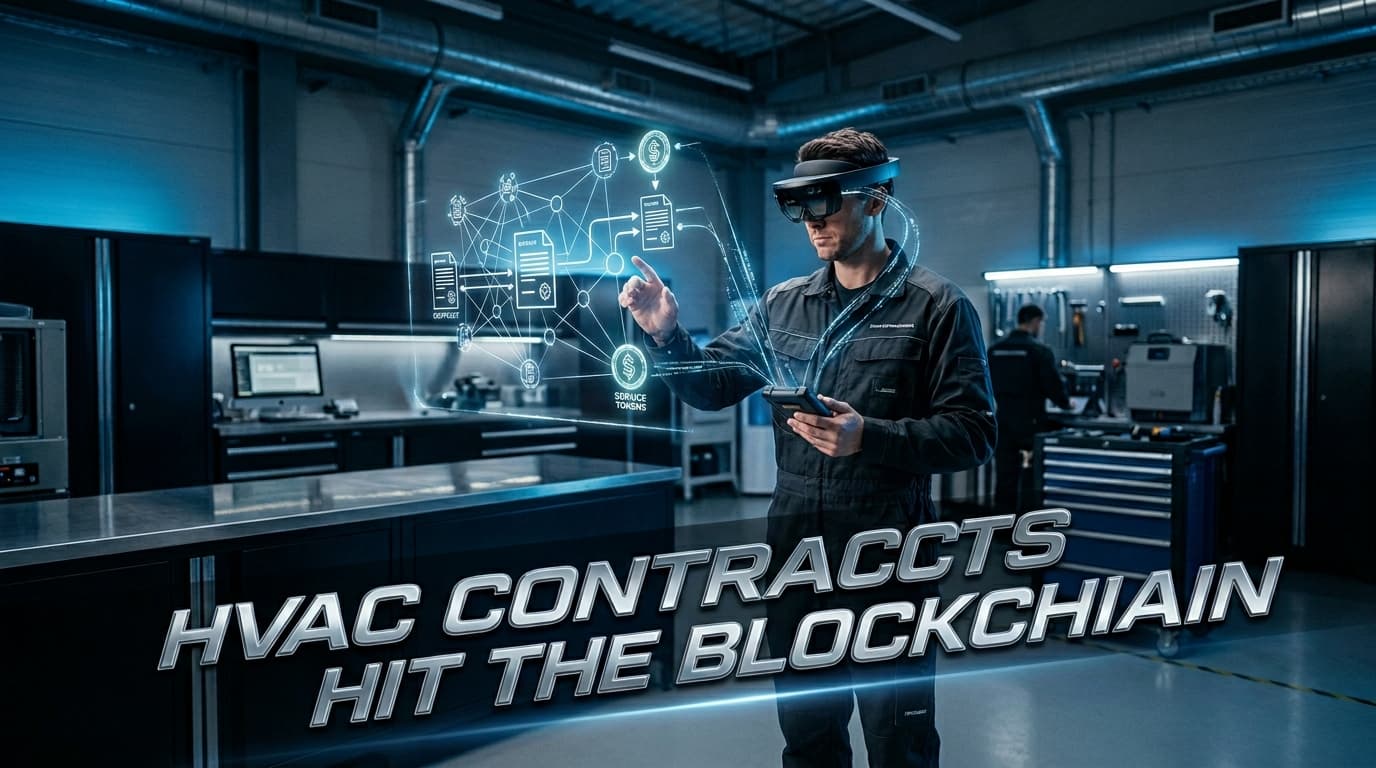

A Perfect Storm for Tokenized HVAC
The US HVAC contractor industry is sitting at $159.4 billion in 2026, spread across roughly 120,000 businesses competing for the same commercial and residential upgrade cycles. That number alone signals scale. But the more telling signal is what is forcing that spending: ASHRAE 90.1-2025, which arrived with 105 addenda tightening efficiency standards across commercial buildings. Property managers who have been delaying equipment upgrades are now staring at compliance deadlines that make delay more expensive than action.
Layer on top of that the trust problem. The Better Business Bureau logs more than 6,000 HVAC contractor complaints every year, ranging from incomplete work to payment disputes to contractors who vanish after collecting a deposit. BBB regional director Don O'Brien put the sourcing risk plainly: "Just don't take the first one you see on a Google search because what can happen there is those folks at the top of that Google search, they might not even be from here." That is not a fringe concern. It is the baseline experience for a property manager sourcing a $15,000 rooftop unit replacement under a compliance deadline.
The conditions are aligning: regulatory pressure forcing high-dollar upgrades, a fragmented contractor market with thin accountability infrastructure, and payment terms that protect nobody well. This is exactly the kind of structural problem that on-chain service tokens are designed to solve.
Why the Infrastructure Is Ready This Year
One year ago, the case for blockchain-based contractor payments was still theoretical for most commercial operators. That case is now empirical. Stablecoins processed $46 trillion in volume in 2024, a figure that is 20 times PayPal's annual volume and three times Visa's. Transactions settle in under one second at under a penny per transaction. This is not a pilot network. It is settlement infrastructure operating at a scale that exceeds legacy rails.
BASE, Coinbase's Layer 2 built on Ethereum, has become the execution environment that makes this practical for service contracts. BASE hit 34.58 million monthly active users in June 2025, representing 467x growth since its 2023 launch. In November 2025 alone, BASE processed 103 million transactions. The network's Flashblocks upgrade reduced transaction finality from two seconds to 200 milliseconds, which matters when milestone confirmations are tied to real-world inspection events.
As Jeremy Zhang of a16z framed it: "Workers can be paid in real time across borders. Merchants can accept global dollars without bank accounts." The infrastructure argument for on-chain service tokens is no longer about future capability. It is about present-tense deployment.
Real-world asset tokenization is moving in parallel. RWA tokenization sat at $24 billion at mid-2025, up 308% over three years, and is tracking toward $100 billion by the end of 2026. Standard Chartered projects the RWA market reaching $30 trillion by 2034. Service contracts, which are fundamentally agreements about future delivery tied to verifiable conditions, are a natural category for this migration. HVAC overhauls represent one of the cleanest entry points.
The $5K-$30K Service Contract Is the Perfect Test Case
Not every service category is equally suited for on-chain migration. Below $1,000, transaction overhead becomes disproportionate even at sub-cent gas costs. Above $100,000, regulatory complexity around payment structures introduces friction that slows adoption. The $5,000 to $30,000 range is structurally ideal, and HVAC overhauls land squarely in it.
Residential HVAC replacement averages $7,500, with a range of $5,000 to $12,500. Commercial systems for small office buildings between 2,000 and 5,000 square feet run $15,000 to $30,000. These are numbers large enough that a property manager has real exposure to contractor default, scope creep, or disputed completion, but not so large that they require complex financing structures that complicate escrow logic.
The milestone architecture for a standard HVAC overhaul maps cleanly to smart contract logic. Three release events cover most projects: mobilization and equipment procurement, equipment installation and pressure testing, and final commissioning with performance verification. Each milestone has a defined, observable output. USDC locked at contract execution eliminates the pricing risk that comes with 30-day net terms and currency exposure. The stablecoin peg is the hedge.
Chainlink oracle integration extends this further. Off-chain completion data, whether from a third-party inspection report, a building management system reading, or a signed delivery confirmation, can trigger milestone releases without requiring either party to initiate a manual transaction. The contractor does not wait on a check. The property manager does not release funds on contractor say-so alone. On-chain service tokens structured this way are not just a payment mechanism. They are a dispute-prevention architecture.
What Property Managers Should Watch For in 2026
The adoption signal to watch is not which blockchain a platform uses. It is which specific features a platform has actually deployed for the commercial service contract workflow. Four capabilities separate meaningful infrastructure from marketing copy.
First, KYC-verified contractor profiles. On-chain bid records mean nothing if the identity behind them is unverified. Licensing status, insurance verification, and business registration should be anchored to the contractor's on-chain identity before any bid is submitted.
Second, on-chain bid records. When a contractor submits a proposal, that bid and its terms should be immutable. Scope changes, pricing revisions, and approval events should all be recorded and timestamped in a way neither party can alter after the fact.
Third, smart contract milestone release tied to verifiable completion data. This is the core feature that replaces the phone call asking where the check is.
Fourth, dispute resolution that does not route through a vendor call center. Community-based review processes, where community judges evaluate documented evidence from both parties, are structurally more neutral than resolution systems operated by the platform taking a transaction fee.
Fisheez is one early example of this infrastructure already deployed. It is a peer-to-peer marketplace built on BASE using SmartShell Escrow, settling in USDC for goods and services transactions, with a fee structure that charges 0% on the seller side and a tiered 0.5 to 8% on the buyer side. It is not an HVAC-specific platform, but it demonstrates that the escrow and settlement mechanics described above are not hypothetical. They are running in production on the network that property managers would use.
The shift to watch in 2026 is whether platforms purpose-built for the trade-services vertical deploy these same mechanics at the category level, with contractor licensing integrations and inspection-tied milestone logic built in from the start.
The Year That Changes Contractor Payment
The 2026 prediction is specific: at least one regional or national property management firm will formally pilot on-chain HVAC contracting before the year ends. The conditions are too aligned for it not to happen. Compliance deadlines are forcing upgrade cycles. The payment infrastructure operates at Visa-scale volume. The smart contract tooling for milestone-based escrow is deployed and tested. The economic case for locking in pricing before work starts, rather than absorbing 30-day net-terms exposure on a $20,000 commercial job, is straightforward.
The broader implication is what makes this worth watching beyond HVAC specifically. If milestone-based escrow proves out for commercial HVAC overhauls, it does not stay in that category. The same contract structure, the same KYC-anchored contractor identity, the same stablecoin settlement logic, applies to every segment of the $159 billion trade-services market. Electrical, plumbing, roofing, fire suppression, elevator maintenance: all of them share the same structural problems of deposit risk, scope disputes, and slow payment cycles that on-chain service tokens are built to address.
HVAC is the test case because the upgrade cycle is being forced right now. The platforms that get the HVAC workflow right in 2026 will have the template for the rest of the market.