
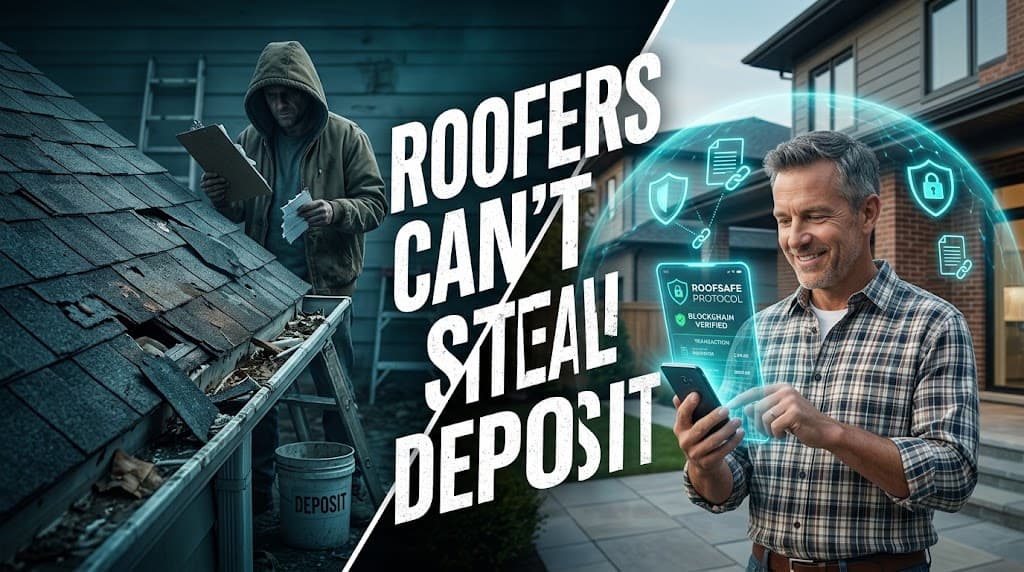

The $33,000 Roof That Never Got Built
In March 2024, a homeowner handed over a deposit to two roofers who promised to replace their storm-damaged roof. Seven months later, the work had never started. In July 2025, authorities arrested both contractors after the victim had lost $33,000. The story is not unusual. The Federal Trade Commission received 81,925 home improvement scam reports in 2024 alone, and the Better Business Bureau estimates each incident costs victims an average of $1,800. For roofing specifically, the numbers are grimmer: 15% of all home improvement fraud complaints filed with the BBB involve roofing contractors, making it the single most fraud-prone trade category in residential services.
The advice you usually get about this problem is informational. Check their license. Read the reviews. Get three quotes. Ask for references. All of that is reasonable, and none of it protects your money once you have handed it over. A contractor can be licensed, reviewed, and referenced on Tuesday and disappear with your deposit by Thursday. The fraud is structural, not informational. The money moves before the work is verified, and traditional payment systems have no mechanism to fix that. Blockchain escrow does.
Why Smart Contract Escrow Changes the Equation
A smart contract escrow works on a simple premise: funds lock the moment you pay, and they stay locked until the agreed conditions are met. No contractor can access your money early. No bank holds it as a favor. No attorney charges 2% to manage the account. The contract itself, deployed on a blockchain, is the custodian, and the code is publicly verifiable.
When you pay through a smart contract escrow on a network like BASE, your dollars convert to USDC, a stablecoin pegged one-to-one to the dollar. There is no crypto volatility here. The $12,000 you lock today is still $12,000 when the job wraps up. The contractor receives USDC the moment the release conditions trigger, and the settlement happens in seconds rather than the three-to-seven days a traditional title escrow company would take. Traditional escrow services charge between 1% and 3% of the transaction value. Smart contract escrow typically runs under 0.1%. On a $12,000 roofing job, that difference is real money.
The security architecture is also fundamentally different. With traditional escrow, a company holds your funds. You are trusting that company's solvency, honesty, and operational security. With a smart contract, the code holds the funds, and every action taken on it is permanently recorded on-chain. Neither party can alter the terms after the contract deploys. If a dispute arises, the on-chain record shows exactly what happened and when. Dispute resolution through smart contract platforms typically resolves within seven days, compared to the weeks or months a traditional escrow dispute drags on.
Setting Up Your $12K Roofing Job in Three Milestones
The most powerful feature of blockchain escrow for home services is milestone structuring. Rather than paying one lump sum that disappears into a contractor's account, you break the job into verified stages. Each stage gets its own escrow contract. Each payment releases only when that stage is confirmed complete.
For a $12,000 roofing job, a reasonable three-milestone structure looks like this. The first milestone covers the deposit and contract signing: somewhere between 10% and 20% of the total, or $1,200 to $2,400. This gives the contractor funds to schedule the crew and order materials, while keeping your exposure minimal. The second milestone triggers at a mid-point verification: materials delivered, old roofing torn off, and deck work complete. This tranche might represent 40-50% of the contract value. The final milestone releases the balance on completion, after you or an inspector signs off on the finished roof. The FTC's own guidance suggests homeowners should limit upfront payments to 10% or $1,000, whichever is less, for home improvement work. Milestone escrow is the mechanism that finally makes that advice enforceable.
Platforms built on BASE that use milestone escrow, like SmartShell Escrow on Fisheez, allow you to define each milestone's conditions before the contract locks. If the contractor completes a stage, they mark it done in the system and a buyer review window opens. You confirm the work, and the funds release. If you do not respond within the window, an auto-release timer kicks in. If there is a dispute, the on-chain record of what was agreed and what was delivered goes to resolution.
Vetting Contractors on BASE: What to Look For
Working with blockchain escrow introduces a natural screening mechanism: contractors who refuse to use it are telling you something. A roofer with a legitimate track record and no intention of ghosting has no reason to demand cash upfront outside any protective structure. The contractors most resistant to verifiable payment frameworks are frequently the ones with the most to hide.
When vetting a contractor for a BASE-based escrow transaction, you are looking for the same fundamentals as any hire, with one addition: a wallet address and willingness to participate in the escrow structure. Verify their contractor license through your state's licensing board. Confirm their insurance covers workers' compensation and general liability. Ask for references on jobs comparable to yours in scope. Then ask directly: are you willing to work under milestone-based escrow? The answer tells you more than any review.
USDC's stability removes one of the contractor's legitimate objections to crypto payment. They are not being paid in a volatile asset. The $6,000 that releases at mid-point completion is worth $6,000 when they receive it, the same as a wire transfer. If a contractor cites crypto risk as a reason to refuse, that objection does not hold with USDC. What it may reveal instead is a preference for payment structures that carry no accountability.
What Stablecoin Settlement Means for the Home Services Market
The infrastructure for paying contractors in USDC at scale already exists. Stablecoin transactions hit $33 trillion in 2025, a 72% increase over the prior year. USDC led with $18.3 trillion in on-chain flows. BASE, Coinbase's layer-2 network, processed $5.3 trillion in USDC volume in January 2026 alone, with daily high-value transfers exploding from under 50,000 per day to peaks of 450,000. The regulatory foundation solidified in July 2025 when the GENIUS Act established federal clarity for US stablecoin operations, accelerating institutional confidence in the payment rails that make on-chain escrow viable.
The implication for the home services market is straightforward. The technology that protects a $500,000 supply chain transaction through verifiable milestone releases is the same technology that can protect your $12,000 roofing job. The scale difference is cosmetic. What changes is who has access to it, and that gap is closing fast as consumer-facing platforms on BASE make smart escrow as simple as generating a payment link. The contractor ghosting problem is not going away through better advice. It goes away when the payment structure itself makes ghosting impossible.