
Golf's $6.5 Billion Fraud Problem
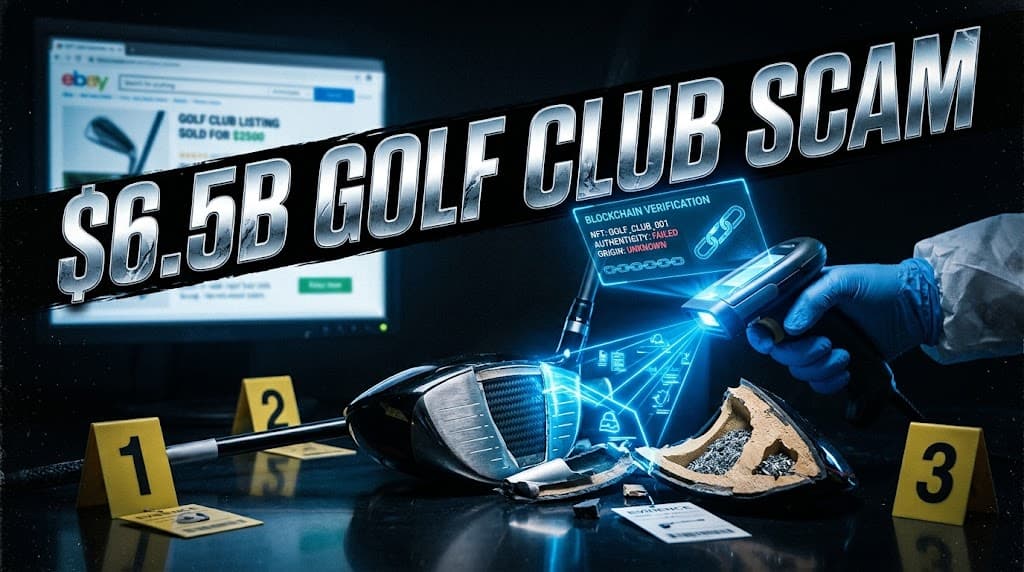
The counterfeit golf equipment industry costs manufacturers and buyers roughly $6.5 billion every year. That number sounds abstract until you realize it funds sophisticated fake factories in Asia producing clubs that look, feel, and even smell like the real thing. Serial numbers match. Paint finishes match. The only thing that doesn't match is the performance, and you won't know that until you've already handed over your money.
Beginners take the hardest hits. An experienced player who has swung a genuine Titleist driver a thousand times knows something is off within three swings. Someone buying their first premium club has no baseline. They see a $900 driver listed for $380 and think they found a deal. A criminal ring on eBay ran exactly this playbook for five years, defrauding golf equipment buyers out of $3 million before they were caught. It was one of the largest fraud cases the platform had ever prosecuted.
The problem extends beyond eBay. Sites like Edangolf.com and Golfclubs365.com built entire storefronts around selling counterfeit clubs to buyers who had no idea. The clubs shipped from overseas, looked professional in photos, and arrived looking almost right. Almost. Buyer protection on most platforms is reactive, not preventive. You have to discover you've been scammed before anything kicks in, and by then your money is long gone.
Why Premium Drivers Cost What They Do
The global golf equipment market reached $8 billion in 2025 and is on track to hit $15.3 billion by 2035, according to Global Market Insights. Golf clubs alone hold 33.2% of that market, the single largest product category. When you look at where growth is concentrated, the mid-price segment is moving fastest at a 7.5% compound annual growth rate, driven primarily by recreational players who are upgrading from starter sets and entering the premium tier for the first time.
That context matters because it tells you who the fraud targets most: the upgrader, the enthusiast who has been playing for a year and wants to invest in real equipment, the beginner who has decided golf is worth taking seriously. Premium drivers from major brands routinely push $600 to $900 for current flagship models. That price point puts buyers in a range where the savings on a fake feel significant enough to rationalize skipping verification steps. And counterfeiters know it.
Buying through an unverified P2P seller without protection at that price range is genuinely risky, not because P2P markets are bad but because the authentication burden falls entirely on the buyer. Most beginners aren't equipped to carry it.
How Traditional Escrow Already Protects Golf Buyers
The concept of using escrow for golf equipment purchases isn't new. Escrow.com has offered a dedicated golf clubs service for years, providing exactly what you'd expect: a neutral third party holds the buyer's funds after payment, the seller ships, the buyer receives and inspects the equipment, and only then are funds released to the seller. If the clubs are counterfeit or never arrive, the buyer has leverage.
It's a sensible system and it works. The problem is friction. Traditional escrow involves account creation, identity verification, processing times, fees to both parties, and a human-managed dispute process that can stretch over days or weeks. For a $900 transaction between two individuals who found each other on a forum, the overhead can feel disproportionate. So buyers skip it, and that's exactly when fraud wins.
Smart contract escrow solves the friction problem. The protection logic is identical: funds lock at payment, release after confirmation, dispute resolution exists. But instead of a human intermediary managing the process, it runs in code on a public blockchain. No forms, no waiting for a customer service rep, no counterparty who can be corrupted or go offline.
Smart Contracts: The Same Protection, Built Into Code
The infrastructure behind blockchain escrow is more established than most golf buyers realize. USDC, the dollar-pegged stablecoin used in most on-chain commerce, processed $27 trillion in annual transaction volume in 2025 according to McKinsey research. Its circulation grew 78% year-over-year, and 87 million unique wallet addresses held USDC by Q1 2025. That's not a niche experiment running on venture capital faith. It's payment infrastructure operating at a scale that rivals traditional banking systems.
The stability question matters for beginners, too. USDC isn't Bitcoin. It doesn't fluctuate 15% overnight. Circle backs 98.9% of USDC reserves with short-dated U.S. Treasuries and cash equivalents, as CoinLaw's USDC statistics document. When you send $900 in USDC to a smart contract escrow for a driver, that $900 buys approximately $900 in goods when it reaches the seller, not $750 because the market moved. The major banks noticed: JPMorgan, Bank of America, Wells Fargo, and Citigroup all announced in 2025 that they were exploring a jointly operated stablecoin. Visa and Mastercard have both integrated USDC into their payment networks. This is the financial establishment catching up to infrastructure that P2P blockchain marketplaces were already using.
On BASE, Coinbase's Layer-2 network, smart contract escrow works simply. Funds lock when you pay. The seller ships. You confirm receipt. Funds release. If a dispute arises, it goes to community arbitration rather than a faceless customer service queue. The whole process is transparent, logged on a public ledger, and reversible only under the conditions both parties agreed to upfront.
Your First On-Chain Golf Purchase: What to Expect
Starting your first blockchain purchase for golf equipment requires three things: a crypto wallet, enough USDC to cover the purchase, and a platform that handles the smart contract layer. Wallets like Coinbase Wallet or MetaMask work on BASE and take about ten minutes to set up. Funding them with USDC can go through a fiat on-ramp, where you enter a card or bank account and receive USDC directly.
Once you find a listing and initiate a purchase, the smart contract locks your funds. The seller can see that payment is secured before they ship, which removes their risk too, and creates a genuine two-sided commitment. You're not wiring money to a stranger and hoping. The money exists in a transparent contract that neither party can touch until the deal resolves.
Platforms like Fisheez build this escrow layer directly into their marketplace on BASE, with buyer funds held in USDC through their SmartShell Escrow system until the buyer confirms the deal is done. If the driver doesn't arrive, or arrives clearly counterfeit, a dispute can be raised and community-trained Peacemakers review the case, with resolution determining how the locked funds are released. Sellers pay nothing. Buyers pay a tiered service fee that scales down as transaction size grows.
The verification steps that matter before any P2P golf purchase remain the same whether you're on a blockchain platform or not: request multiple photos, verify the serial number directly with the manufacturer, be skeptical of prices that feel too far below retail. Smart contracts don't authenticate clubs. They protect your money while you do the authentication.
What Blockchain Means for the P2P Equipment Market
Here's the story the numbers tell: stablecoins processed more than $300 billion in market cap and $27 trillion in transactions in 2025, yet still represent less than 1% of global daily money transfers, as PYMNTS reported. The infrastructure exists, operates at scale, and is backed by the largest financial institutions in the world. But everyday physical goods commerce, including P2P markets for sports equipment, is barely touched by it yet.
That gap is where the next phase of adoption happens. Golf equipment is a useful lens because the fraud problem is documented, the transaction sizes are meaningful, and the buyer protection need is obvious. When a beginner can make a $900 purchase on a blockchain platform with the same confidence they'd have buying from a major retailer, the argument for on-chain P2P commerce becomes practical rather than ideological.
The banks moving toward stablecoins, the card networks integrating USDC, the 87 million wallet holders who already hold and use dollar-pegged crypto: all of it points toward a market where buying a driver from a private seller on the BASE network isn't exotic. It's just how P2P equipment transactions work.