
The Blue Box Doesn't Hold Its Value — And Neither Does Most of What's In It
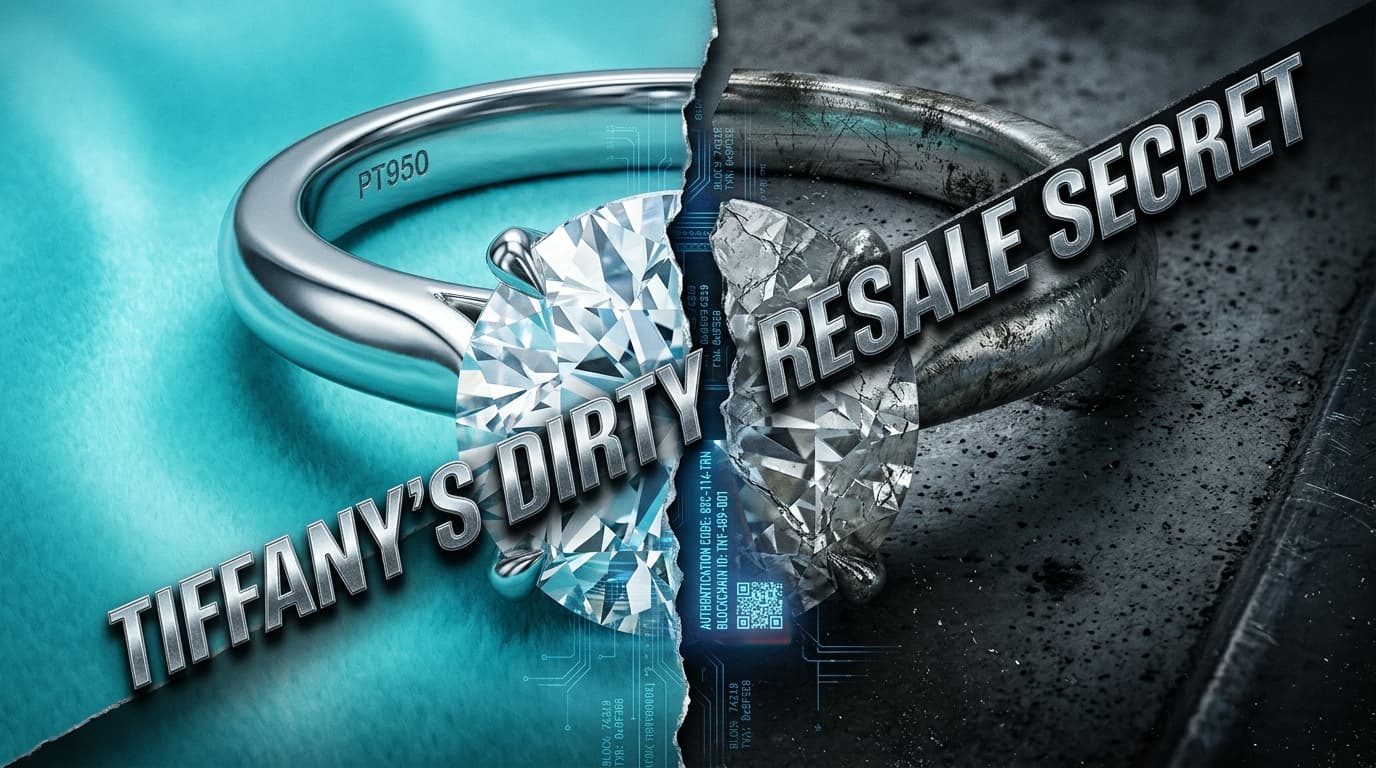
A 1.5-carat Tiffany Solitaire, purchased for $22,000, sold at Christie's for $9,500. That's 43 cents on the dollar, routed through one of the most prestigious auction houses in the world, on one of the most recognizable jewelry brands on the planet. If you assumed the blue box was a guarantee of lasting value, that number should stop you cold. Research from the Journal of Consumer Research puts the broader pattern plainly: Tiffany rings recover roughly 40% of retail on resale, while unbranded diamonds bought online actually do better, recovering around 60%. The central question for any couple spending serious money on an engagement ring isn't whether to buy something beautiful. It's what actually protects that investment once you walk out the store.
Why Physical Diamonds Are Structurally Built to Lose Value
The resale problem isn't bad luck or bad timing. It's built into the economics from day one. Brick-and-mortar retailers apply markups of 100 to 200% on diamonds, according to FTC data, which means the moment you leave the store, you're already underwater by a factor that no secondary market can easily absorb. Harvard Business School puts the average resale recovery for physical diamonds at 30 to 50% of retail, which translates to a $10,000 ring recovering somewhere between $3,000 and $5,000 in the real world.
The liquidity problem compounds this. Only about 15% of diamonds trade in any given year, per a Wharton School liquidity analysis, which means sellers are always competing in a buyer's market with thin demand. Layer on top of that the structural shift happening right now: lab-grown diamonds have captured 42% of the engagement market, and natural diamond prices have dropped 12% since 2022 as a result, according to MIT Technology Review. This isn't a temporary dip. The structural floor under physical diamond prices is actively being lowered, and the trend isn't reversing.
Not All Physical Diamonds Lose Equally: Grade, Cut, and Channel Matter
Before writing off physical diamonds entirely, the nuance matters. D through F colorless stones command 20 to 30% premiums on resale over lower color grades, per GIA data. Ideal-cut diamonds certified to AGS Triple Zero standards resell 15% faster than stones graded merely "Very Good." If you're buying physical, grade and cut are your best hedges against the structural value bleed described above.
The resale channel you choose matters just as much as the stone itself. Auction houses return 50 to 70% of retail, making them the best option for rare or collectible pieces, though Christie's fees eat into that number. Online marketplaces land in the 30 to 50% range and offer faster liquidity. Pawn shops sit at 20 to 35%, useful only for immediate cash needs. Even in the best-case scenario, a physical diamond through the best possible channel tops out around 70% recovery. That ceiling is where blockchain authentication starts to become genuinely interesting.
Blockchain Is Already Changing What a Diamond Is Worth
This isn't a future story. De Beers' Tracr blockchain traceability platform is already adding 5 to 10% premiums for conflict-free stones, documented in the Kimberley Process Annual Report. GIA's mine-to-market blockchain traceability is projected to add 15% premiums for ethically sourced stones as the infrastructure matures. These aren't theoretical projections built on hope. They're measurable price differentials happening in the current market.
The GCAL and Everledger partnership, announced in 2021, shows exactly how the technology works at the certification level. Their system combines blockchain with Gemprint optical fingerprint technology to create an immutable digital identity for each diamond, queryable on any device via API. Angelo Palmieri, COO of GCAL, described it directly: "Combining blockchain with the unique optical fingerprint produced by Gemprint creates significantly increased transparency, and an indisputable, unmistakable identity for each and every diamond." Scott Austin of Everledger put the underlying problem in sharp focus: "Access to authentic stories, validation of origin, and certification that demonstrate the uniqueness of each diamond has historically been difficult to prove over the lifecycle of the stone." Blockchain engagement rings solve exactly that problem. The NFT certificate isn't a crypto novelty; it's the GIA certificate's logical successor.
NFT-Certified Rings: What the Market Has Already Proven
Tiffany, the same brand losing 60% on physical ring resale, sold 250 NFT digital passes at 30 ETH each, roughly $50,000 per pass, redeemable for a custom gem-set pendant and a digital artwork. They sold out. That's not a speculative data point. That's documented, named-brand demand for blockchain-linked jewelry at a price point that dwarfs most engagement ring budgets.
HB Antwerp launched Signum, a metaverse diamond company offering NFTs with immutable proof of ownership, history, and authenticity for polished diamonds. Gemfields minted NFTs for the Chipembele emerald sale through Gübelin's Provenance Proof platform, extending the authentication model beyond diamonds to the broader high-value gemstone market. Jewelry designer Reena Ahluwalia, who created the first diamond art NFTs on OpenSea, described the trajectory simply: "NFTs are this digital innovation on a rocket ship that is going up and up." The infrastructure for blockchain engagement rings is not being built in a lab somewhere. It's operational and generating real transactions right now.
The Real Question: Physical vs. NFT-Certified, or Physical and NFT-Certified Together?
The data doesn't actually support a binary choice here. The strongest value-retention move isn't picking one over the other. It's combining both. A physical diamond with blockchain authentication, as demonstrated by De Beers' Tracr premium, outperforms either an untraced physical stone or a purely digital asset on resale. The physical-plus-blockchain combination is where the ceiling gets pushed meaningfully higher than that 70% auction-house maximum.
For lab-grown buyers, this calculus becomes even more urgent. With lab-grown diamonds already at 42% market share and prices projected to drop another 30% as production scales, the stone itself is heading toward near-zero resale value over time. Blockchain authentication becomes the primary differentiator in that scenario, the one element that can document provenance, ownership history, and unique characteristics in a market where the commodity value of the stone is eroding. Shai de Toledo of Signum framed the collaborative potential well: "This is a great chance to collaborate with our metadiamond NFT buyers, while at the same time contributing to the mining community." The physical and digital aren't competing. They're converging.
Selling a High-Value Ring Privately: How Escrow Closes the Safety Gap
If blockchain authentication is the value lever and peer-to-peer resale is the channel that avoids Christie's haircut, the practical gap that remains is transaction safety. Selling a $7,000 blockchain-authenticated ring privately means trusting a stranger with either the stone or the payment, and that's where most private sales fall apart or get abandoned in favor of a platform that takes a significant cut.
Fisheez SmartShell Escrow on the BASE network is built specifically for this problem. Buyer funds lock in a USDC smart contract at the moment of payment. Release triggers on timer expiry, early buyer release, or dispute outcome, with no bank or middleman in the chain. Sellers pay 0%, compared to eBay's 10 to 15% seller fee or the 30 to 50% haircut a Christie's auction represents on a mid-range stone. For a $7,500 ring transaction, that fee difference isn't trivial. Buyers pay a tiered fee that scales from 8% under $50 down to 0.5% over $10 million, so a $5,000 to $10,000 ring sale lands at a rate that reflects the transaction size. Buyers holding a TideTurner Whale NFT on the platform receive a 100% buyer fee discount, a detail that connects the article's central theme directly to platform economics: the same blockchain infrastructure that authenticates a ring can reduce the cost of selling it.
The broader shift here is what matters most for the industry. As blockchain engagement rings move from early-adopter novelty to standard certification practice, the peer-to-peer resale market for authenticated stones will need transaction infrastructure that matches the trust level of the stone's provenance record. Smart contract escrow on a public blockchain is that infrastructure. The GIA certificate made graded diamonds tradeable with confidence. Blockchain authentication makes that confidence portable across the entire lifecycle of the stone, and the transaction layer is finally catching up.