
The $800 Carrier Fee Is Not Mandatory
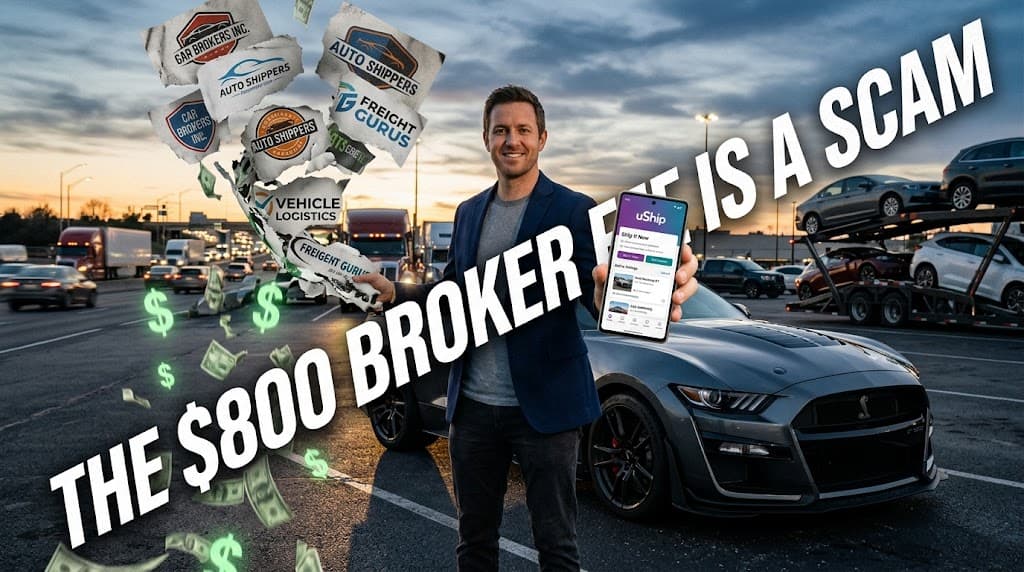
You sold the car. Price agreed, paperwork ready, buyer confirmed across two states. Then you get the shipping quote: $1,100 to $1,400 for a cross-country haul, with $300 to $800 of that going to a broker who will never touch your vehicle. That number is not a fixed cost of doing business. It is a structural inefficiency you can route around, and experienced sellers who ship regularly have already started doing exactly that.
The traditional auto transport model is built around broker aggregation. A broker takes your job, lists it on a load board, waits for carriers to bid, takes a cut of whatever rate closes, and emails you a confirmation. The actual driver may not be assigned until 48 hours before pickup. You have no direct relationship with the person transporting a vehicle worth $15,000 or $50,000. You are paying for a middleman's coordination service, and that service adds 20 to 30 percent to the underlying carrier rate on most routes.
Where Broker Fees Actually Go
The broker markup is not always visible on your quote, which makes it easy to accept as a cost of shipping. In practice, brokers post your job to a carrier dispatch board at one rate and bill you at another. The carrier who takes the job gets paid the lower amount; the broker keeps the spread. On a $1,200 quote for a 1,500-mile open transport, the actual driver fee might be $850 to $950. The remaining $250 to $350 covers the broker's operations, platform costs, and margin.
That structure is not fraudulent, but it does mean you are funding a logistics layer that adds no direct value to you as a seller. What brokers sell is access and abstraction: their carrier network and the coordination work around it. If you are willing to do that vetting yourself, or use a platform that handles it through a transparent marketplace, you eliminate the markup. This is exactly what P2P vehicle shipping is designed to solve.
What P2P Vehicle Shipping Actually Means
P2P vehicle shipping is not a gray-market workaround. Platforms like uShip operate as competitive carrier marketplaces where individual owner-operators and small fleet drivers bid directly on your job. You post the vehicle, route, and timeline. Licensed, insured carriers compete for the work. You review bids, carrier ratings, and reviews, then choose. The broker layer is replaced by a marketplace mechanism. uShip's own data shows bids on its platform average 10 to 30 percent lower than traditional broker quotes because the platform eliminates broker markups, which typically run 20 to 30 percent of total cost.
The key distinction is that you are hiring a specific, named carrier with a verifiable record, not a placeholder from a brokerage. The driver who wins the bid is the driver who picks up your car. That traceability changes the accountability dynamic entirely. You can read their history, check their FMCSA number, and communicate directly before accepting.
The Real Risks and How to Manage Them
The argument for traditional brokers is convenience: you outsource the vetting and get a packaged service. That has merit for infrequent shippers. For experienced sellers moving multiple vehicles per quarter, the math favors learning to use the marketplace directly.
The legitimate risks with P2P vehicle shipping are specific and manageable. First, carrier vetting requires attention. You should verify the carrier's active MC number through FMCSA's public database, confirm they carry cargo insurance with a minimum of $100,000 in coverage, and review at least five recent transactions before accepting a bid. Second, timing is less predictable on competitive routes. Owner-operators bidding on jobs are managing their own schedules, and a carrier with strong reviews may not always match a tight delivery window. Build lead time into cross-state deals where possible. Third, bait-and-switch pricing exists in the P2P carrier space just as it does in the traditional broker market. The best protection is a written agreement and a payment structure that does not release funds until delivery is confirmed.
Escrow as the Trust Layer
Payment protection is the deciding factor in whether P2P vehicle shipping is viable at scale. A deal with an individual carrier is only as safe as the payment mechanism behind it. If you wire the full amount upfront and the carrier disappears, your recourse is limited to small claims and FMCSA complaints, neither of which moves quickly.
Escrow-based payment structures solve this directly. When funds are held by a neutral party and released only upon confirmed delivery, neither side has the leverage to disappear with the money. Some platforms build this in natively; others leave payment terms to the parties. Platforms built on smart contract escrow, like Fisheez, lock buyer funds in a contract that releases on delivery confirmation, not on the carrier's say-so. That structure applies to service transactions generally, including transport arrangements where a seller is coordinating a shipper on behalf of a buyer. The underlying mechanic eliminates the most common failure mode in P2P logistics: carrier paid, vehicle never delivered.
A Practical Example: Chicago to Phoenix
Consider a standard cross-state deal: a 2019 Civic Hatchback, seller in Chicago, buyer in Phoenix, roughly 1,750 miles. A traditional broker quote on that route runs $900 to $1,200 for open transport. Through a P2P carrier marketplace, competitive bids for that same route typically come in at $700 to $950 from owner-operators with verified track records. On the mid-range estimate, you are looking at $250 to $300 saved on a single shipment. For a seller moving six to eight vehicles annually, that is $1,500 to $2,400 kept out of the broker layer and back into margin.
The buyer arranged payment through escrow. The seller coordinated the carrier directly. The car arrived in Phoenix on day four. No broker, no percentage owed to a company that never touched the vehicle, and both parties had documented payment protection throughout.
Stop Funding the Middleman
The infrastructure exists to run cross-state car deals without feeding a broker layer that adds cost but not accountability. P2P vehicle shipping through competitive carrier marketplaces gives you direct access to licensed, insured drivers, transparent bidding, and verifiable histories. The tradeoff is owning the vetting process, and for sellers moving inventory regularly, that is a skill worth building.
The other piece of the equation is making sure the deal structure protects you regardless of what the carrier does. If you are coordinating shipment as part of a sale, use escrow. Platforms like Fisheez are built specifically for peer-to-peer transactions with smart contract escrow in USDC, no seller fees, and a dispute process run by community arbitrators. You close the deal on your terms, the carrier delivers, funds release. No broker cut, no intermediary holding your money, no surprises on the invoice. That is how experienced sellers ship nationwide without watching $800 walk out the door on every transaction.