
The Saturday Morning That Changed Her Sale
Maria had been staring at the same driveway for three weeks. Green-black streaks of algae running down the concrete apron, siding the color of old dishwater, a front walkway that looked like it had given up. Her real estate agent kept saying "curb appeal home selling is everything in this market," and Maria kept nodding while quietly wondering how much damage she was actually doing to her own listing price.
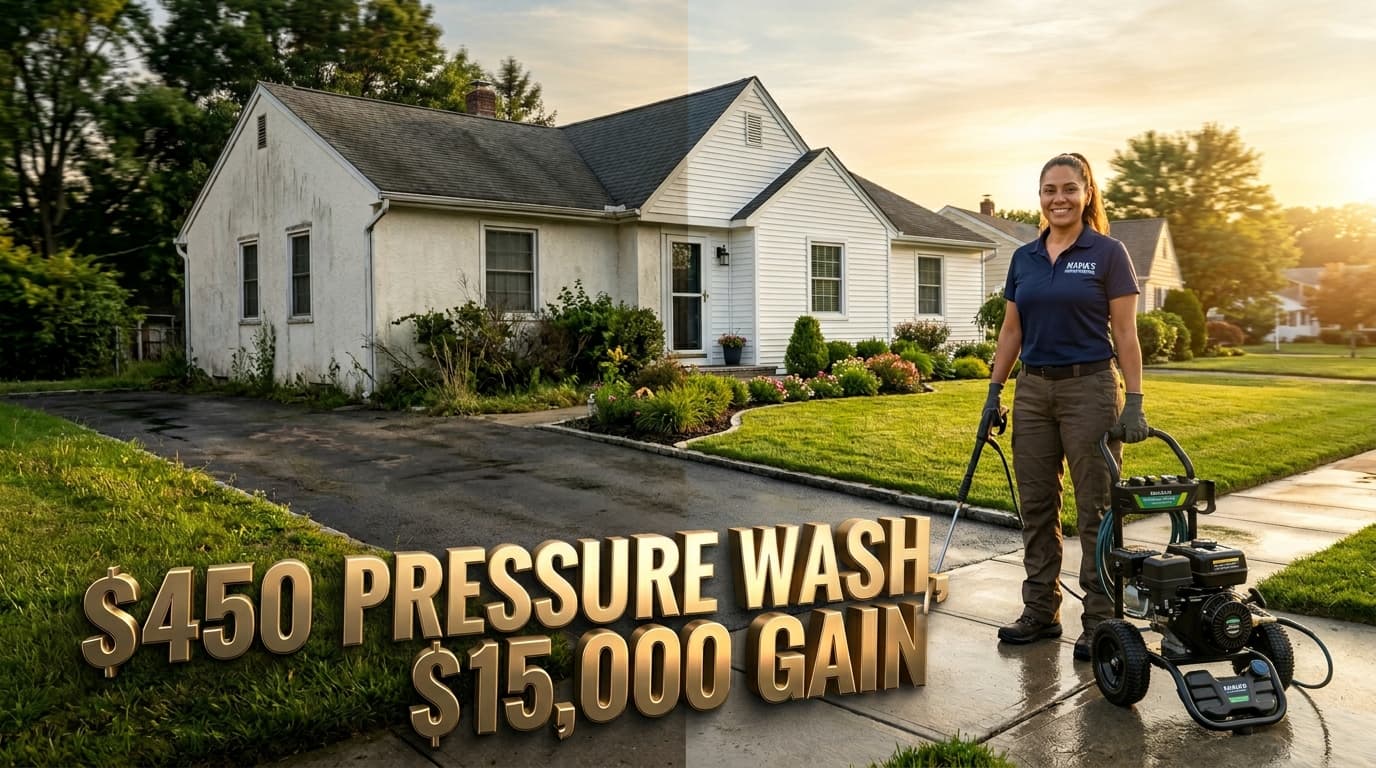
Then she called a guy with a pressure washer. Spent $450. And ultimately sold the house for $15,000 more than a nearly identical property two streets over.
That gap did not happen by accident. It happened because Maria understood something most sellers miss until it costs them: the exterior of your home is not just decoration. It is the first negotiating signal you send to every buyer who drives by.
What Curb Appeal Actually Does to Your Sale Price
Research from the University of Texas at Arlington found that curb appeal can account for up to 7% of a home's sale price. In slow markets, that number climbs to 14%. For a $250,000 home, 7% is $17,500. That is not a rounding error.
HomeLight data puts it even more concretely: investing roughly $3,500 in curb appeal improvements can generate about $12,000 in added value, a return of around 238%. Pressure washing alone is one of the highest-leverage items in that mix because the cost is low and the visible impact is immediate. A power washed home can sell for $10,000 to $15,000 more than a comparable home that skipped the step, according to industry data from companies that have serviced over 300,000 homes.
The National Association of Realtors backs the priority: 94% of real estate agents recommend curb appeal improvements before listing, and 77% say it is among the most impactful things a seller can do. When buyers are forming opinions in the first seconds of a drive-by, first impressions in curb appeal home selling scenarios carry disproportionate weight.
Why Sellers Still Get Burned
Here is the catch. The moment a house goes on the market, sellers become targets. Home improvement fraud is not rare. The FTC received 81,925 reports of home improvement scams in 2024 alone, with victims losing an average of $2,426. And those are just the reported cases.
The horror stories are worse. A Long Island family lost $96,200 when a contractor gutted their home and disappeared. In West Virginia, one contractor was charged with taking $48,200 from seven different homeowners for work that was never completed. These are not anomalies from a different era. They happened in 2025.
The pressure washing category is lower-risk than major renovation work, but the same bad patterns show up: vague verbal agreements, no written scope, full payment upfront, and no recourse when the job goes sideways. A seller under timeline pressure is especially vulnerable because the default move is to say yes to whoever shows up first.
How to Vet a Pressure Washing Contractor Before You Sign Anything
Maria got lucky partly because she was careful. Here is what careful looks like in practice.
Start with licensing and insurance. Most states require pressure washing contractors to be licensed, and you can verify this on your state licensing board's website in about three minutes. Insurance matters just as much. If a contractor damages your siding, cracks a window, or injures themselves on your property, you need them to have liability coverage. Ask for a certificate of insurance before any work starts, not after.
Get at least two written estimates. A real estimate is not a number texted to you. It lists the specific surfaces being cleaned, the cleaning method for each, the chemicals being used, the timeline, and the total cost. Any contractor who hands you a one-line quote and calls it an estimate is showing you exactly how they operate. A vague scope becomes a dispute when the job is half done.
Check reviews with skepticism, not just volume. Search the contractor's name plus words like "complaint" or "scam" alongside standard review platforms. The Better Business Bureau maintains complaint records even for small local operators. Call one or two references, not to hear the good story, but to ask a specific question: was the job completed on the day they said, and did the final price match the estimate?
Watch for red flags. Contractors who show up door-to-door claiming to be "already in the neighborhood," who push for full cash payment before starting, or who pressure you to decide same-day are operating from a playbook you do not want to be on the receiving end of.
Protecting Your Payment Before Work Begins
Even with a vetted contractor, the payment structure matters. The standard rule: never pay the full amount upfront. A reasonable deposit for a pressure washing job is 25 to 50 percent, enough to cover materials and scheduling. The balance should be paid only after you have walked the completed job and confirmed the work matches what was agreed in writing.
If you are dealing with a larger property service that involves multiple phases, like driveway sealing after pressure washing, or deck treatment as a follow-on, consider milestone payments tied to each completed phase. This keeps the contractor motivated and keeps your exposure limited if something goes wrong before the finish line. Research on construction escrow suggests milestone-based payment structures can reduce disputes and legal costs by over 30% compared to lump-sum payments.
Get the scope of work in writing before any money changes hands. That document is your only leverage if the job goes sideways. Verbal agreements are worth exactly what they cost.
The Platform Problem Nobody Talks About
This same payment risk shows up whenever you hire services as a seller: handymen, stagers, photographers, movers, cleaners. You are always one "deposit and disappear" situation away from losing money and losing time on a live listing.
Escrow-based payment platforms solve this directly. When funds are held in escrow and released only after work is confirmed complete, neither side has to operate on blind trust. Fisheez uses SmartShell Escrow, a smart contract that locks funds until both sides confirm delivery, and for service-based transactions with milestones, escrow can release in stages rather than all at once. The payment protection is built into the transaction itself, not bolted on as an afterthought. Sellers on Fisheez keep 100% of their listing price because the platform fee is paid by the buyer, which means every dollar you earn from prep work that lifts your home's value stays in your pocket.
For sellers hiring property prep contractors, the principle is simple: structure your payment so you hold the final release until the work is done to scope. Whether you use a formal escrow service or enforce it through your contract language, protecting that final payment is the single best leverage point you have.
What Maria Actually Did
She got three quotes. She chose the middle one from a contractor with verifiable reviews and a written scope. She paid 40% upfront and held 60% until she did a walkthrough. The job took four hours: driveway, walkway, front siding, back deck. Total cost, $450.
Her agent relisted photos the next morning. Within a week, curb appeal home selling assumptions had shifted for every buyer who pulled up the listing online. Multiple buyers commented on how well-maintained the property appeared. The final sale price came in $15,000 above the comparable down the street. That comparable had also been well-maintained inside. It just looked like nobody cared from the outside.
The $450 did not buy a pressure washing job. It bought the first impression that set the tone for every offer that followed.