


Most sellers running Google Ads and investing in SEO are operating with a mental model that's about two years out of date. They've got a paid team and an SEO team, and those teams barely talk to each other. One's optimizing for Quality Score, the other's chasing keyword rankings, and the gap between them is costing real money. I know this pattern well because I lived it, and I've watched Google quietly close the distance between those two worlds until they're basically the same thing.
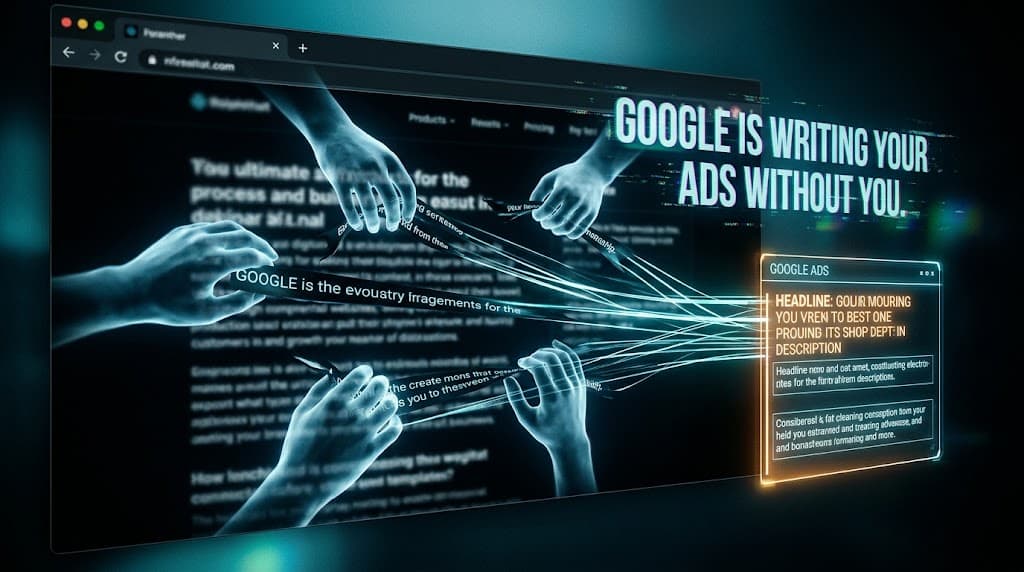
Here's what changed: Google's AI systems, specifically Performance Max and the newer AI Max, now pull directly from your website to build ad copy, choose landing pages, and determine relevance. Your website isn't just a destination anymore. It's source material. Every word on your product pages, every image in your gallery, every review you've collected, it's all being fed into a machine that decides how to represent your brand across YouTube, Display, Search, and Discover. If your site is weak, your ads are weak. And you're paying for both.
Your Website Is Now Writing Your Ads
This is the part that catches most sellers off guard. PMax doesn't ask you to write ad copy the way traditional Google Ads did. It reaches into your website, reads your headlines, pulls your title tags, and generates ads from that content automatically. If your copy is vague, keyword-stuffed, or written for an algorithm from 2018, that's what your ads are going to sound like. You're still getting charged every time someone clicks.
I spent years in the automatic bidding space. Part of the patent work I was involved with was around automated PPC systems, technology that the market eventually absorbed into what Google now calls Smart Bidding. I understand how these systems think. They're not reading your intent. They're reading your content and making probabilistic guesses. Feed them garbage, they'll serve garbage at scale.
The fix here is straightforward but it requires actually looking at your copy as if you've never seen your own website before. Your headlines need to say specifically what you sell, who it's for, and why it's worth buying. Not clever. Not abstract. Clear. Because Google's AI is going to lift those sentences and put them in front of someone who's never heard of you, and you've got about three seconds to earn a click.
While you're at it, read what we wrote about the three myths costing sellers real money. A lot of those myths live in this exact space, the assumptions sellers make about what Google is actually optimizing for.
Slow Pages Are a Paid Ads Problem, Not Just an SEO Problem
This one surprises people. Site speed has always been a ranking factor for organic search. Most sellers know that. What they don't know is that Smart Bidding uses conversion rate data as a signal, and a slow page converts worse. When your pages load slowly, your conversion rate drops, Google's AI reads that as a signal to deprioritize your pages for ad spend, and your Cost Per Acquisition goes up. You're not just losing organic traffic. You're paying more per click and getting less from it.
I watched this exact dynamic wreck campaigns when I was running a brand doing serious volume on Amazon. Amazon's algorithm worked the same way. If your listing wasn't converting, the algorithm buried it. You'd pump money into ads to compensate, but you were fighting the algorithm instead of fixing the listing. Google is doing the same thing now, and the sellers who don't see the connection are going to keep pouring budget into a leaky system.
Run your site through PageSpeed Insights today. Not next week. Today. If your mobile score is below 70, that's your first fix.
PMax Is Running Ads Under Your Name Right Now
If you're using Performance Max and you haven't uploaded quality images and video, Google is generating assets for you. It's doing this automatically. Those auto-generated assets are running under your brand name across YouTube, Display, and Discover, and they usually look exactly like what they are: AI filler. Blurry composites, generic lifestyle imagery, text overlaid on stock photos. That's your brand in front of a cold audience.
This isn't a hypothetical. It's happening to a lot of sellers who set up PMax campaigns, set a budget, and walked away. You have to go into your asset groups and look at what's actually running. Upload real product photography. Upload a video, even a simple one, even one you shot on your phone. Give the system something to work with. If you don't, it'll invent something, and it won't ask your permission first.
We covered a related blind spot in Google's Call Button Is Gone. The pattern is the same: Google makes a change, most sellers don't notice until the damage is done.
Trust Signals Are No Longer Just an SEO Play
E-E-A-T, which stands for Experience, Expertise, Authoritativeness, and Trustworthiness, started as Google's internal rubric for ranking web content. It's now baked into how the AI evaluates ad quality too. Real reviews, genuine authorship, credible product information. These signals build implicit trust that compounds across both channels over time.
For e-commerce sellers specifically, this connects directly to your Google Merchant Center product feed. If your feed is sparse, missing brand, color, size, materials, or has inconsistent data, your shopping ad relevance and quality scores suffer. The feed isn't separate from SEO. It's the same data ecosystem. Rich, accurate, complete product data helps organic discovery and paid placement at the same time.
Schema markup works the same way. It gives Google's AI explicit labels for what's on your page, and those labels can unlock richer ad extensions, star ratings, pricing, FAQs. Things that improve click-through rate without adding to your cost per click. It's free performance sitting on the table for any seller willing to implement it.
Check out the numbers that should change how you list for more on how the data behind your listings drives real commercial outcomes.
The Bigger Problem Nobody's Talking About
I've been watching platforms move the goalposts on sellers my entire career. Amazon changed their app in 2020 and I lost 40% of my revenue in a single quarter. Not because my products got worse. Not because my customers left. Because the platform changed the rules and I'd built my entire business on their infrastructure.
Google is doing the same thing here, just more slowly and with better PR. Every update that pulls more control into their AI systems, every change that makes your website content the raw material for ads you pay for, that's the platform expanding its leverage over your business. You can optimize for it. You should. But you should also notice what's happening.
That's a big part of why I built Fisheez. Sellers on Fisheez pay zero in platform fees on their listing price. SmartShell Escrow holds funds in USDC on the BASE network until the deal is done. No platform that can rewrite the rules on a Tuesday and take 45% of your margin before you figure out what happened. The tools I'm describing in this piece are worth implementing. But they're tools for someone else's platform. At some point, that has to factor into your strategy.
Fix your site speed. Audit your PMax assets. Clean up your copy. Add schema. Get your SEO and paid teams in the same room once a month. These are real fixes that will move real numbers. Just keep one eye on the scoreboard, because Google keeps changing the game.