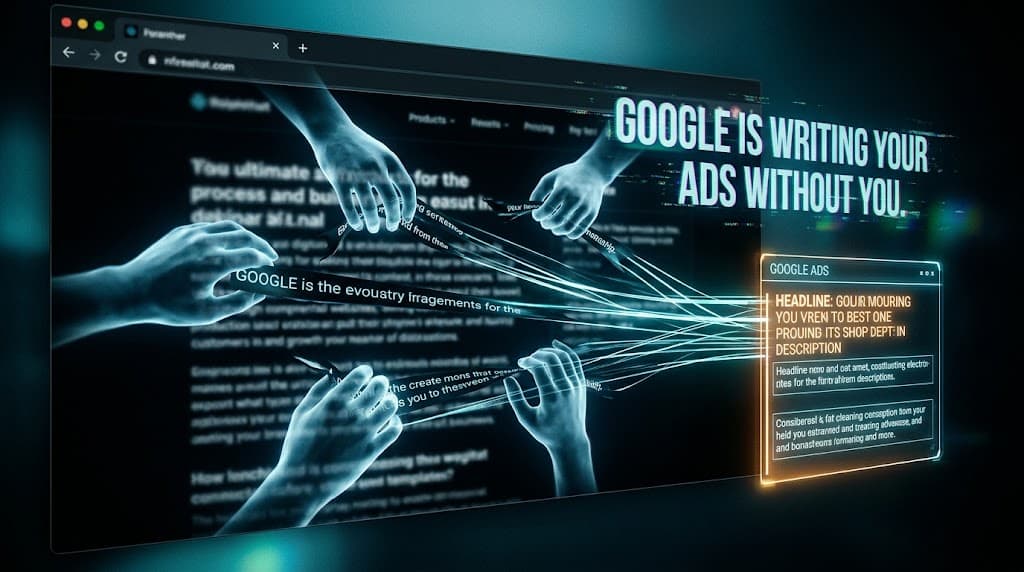



Google just quietly removed the call button from organic map pack listings. No announcement. No explanation. You now have to click into a business profile before you can even see a phone number. That single change is estimated to cut inbound call volume by 20-40% for local businesses who haven't adapted. If you run a service business — plumbing, roofing, landscaping, dental, anything where the phone rings and that's how you eat — this should stop you cold.
I've been through this before. Not with Google, but with Amazon. I spent eight years as the #1 brand on Amazon in women's headbands, ahead of Nike, Under Armour, Goody. In 2020, Amazon changed their app. No warning. Forty percent of my revenue disappeared overnight. That's not a bug. That's a feature. Platforms don't break things accidentally. They break them on purpose, incrementally, until the pain is bad enough that you pay to make it stop.
Google is running the same play.
The Playbook You've Already Seen Work on Them Once
This isn't speculation. Google did the exact same thing to organic shopping results. They were free, businesses showed up, customers clicked. Then slowly, deliberately, Google degraded those organic placements until the only way to be visible was to run Product Listing Ads. Today, shopping results are almost entirely pay-to-play. Google pocketed billions.
The call button removal follows the same logic. Remove the frictionless action from the free listing. Add a click. Watch call volume drop. Wait for local businesses to panic. Then offer the solution: Local Service Ads, sponsored map pack placements, whatever the paid product of the moment is. You'll pay for the calls you used to get for free, and you'll be grateful to have them back.
This isn't a conspiracy theory. It's documented business strategy from a company that generates $200+ billion a year in ad revenue. They're good at this.
The Second Threat Is Worse
Here's what's more alarming than the call button: AI Overviews are beginning to replace the traditional map pack entirely for local searches. And the overlap between who shows up in AI results and who ranks in the traditional map pack is only about 33%.
Read that again. You can rank #1 in the Google map pack and still be completely invisible when someone uses AI-powered search. These are two separate visibility games now, with different rules, and most local businesses don't know the second game exists yet.
The businesses showing up in AI Overviews share one thing in common: they have reviews spread across multiple platforms. Not just Google. Yelp, Facebook, Bing, Foursquare, industry-specific directories. Even Google's own AI is pulling signals from outside Google's walls. If your entire review strategy has been to collect five-star Google reviews and call it done, the AI systems don't have enough to work with. You're thin on signal.
And it's not just quantity. The quality of reviews matters in a way it never did before. A Yelp review that reads like a story, "I called at 7pm, the tech was there by 8:30, he found the leak in fifteen minutes and had it fixed before my wife got home," is worth more to an AI system than fifty Google reviews that say "Great service!" AI can extract rich signals from narrative. It can't do much with generic praise.
ChatGPT pulls local business data primarily from Bing and Foursquare, not from Google. If you're not listed accurately on those platforms, you don't exist to anyone asking ChatGPT for a local recommendation. That's a fast-growing slice of how people find services now, and it's only going to grow.
What Actually Fixes This
The answer to both the call button problem and the AI visibility problem is the same: you need a real profile strategy, not a Google-only strategy.
Get on Yelp and treat it seriously. Claim your listing, fill out every field, and ask your customers for detailed reviews, not just stars. Give them a prompt. "Tell them what the job was, how long it took, and what your experience was like." People will do it if you ask right. A handful of story-driven Yelp reviews is worth more than a hundred "Five stars, very professional" Google reviews in the world we're in now.
Make sure you're listed on Bing Places and Foursquare. These take twenty minutes. Most local businesses haven't done it. That's why the opportunity exists. Consistent NAP, name, address, phone, across all these platforms matters more than most people realize. Inconsistent information across directories is a trust signal killer for both AI systems and traditional search.
Fix your Google Business Profile while you still can. The businesses getting hit hardest by the call button removal are the ones with thin profiles: a few photos, a sparse description, minimal posts. Proximity alone used to carry lazy listings. It doesn't anymore. Upload photos regularly. Write actual descriptions. Use the posts feature. Make the profile worth clicking into, because now customers have to click.
I'd also tell you to think hard about your dependency on any single platform for customer acquisition. The market isn't dying, it's splitting, and the businesses that survive platform pivots are the ones with diversified reach. I learned that the hard way when Amazon rewrote the rules overnight. Don't learn it the same way with Google.
The Broader Pattern You Can't Afford to Ignore
I was also part of a decade-long patent case against two of the largest internet companies in the world. The technology at the center of it, automatic bidding for pay-per-click advertising, generated billions for someone else. We fought it in US and Canadian courts for over a decade. The legal system didn't deliver justice. I watched big tech do whatever it wanted with someone else's innovation, profit enormously from it, and face no meaningful consequence.
I'm not bitter about it. I'm informed by it. These companies operate at a scale where individual businesses, whether they're suing them or just trying to rank on their platform, are not a consideration. They're variables in a revenue equation. When Google removes a call button, they're not thinking about your plumbing business in Tulsa. They're optimizing for ad revenue at the margins of a $200 billion machine.
You can't fight that. But you can stop being fully dependent on it.
At Fisheez, I built the platform specifically because I know what it feels like when the ground shifts under your business and the platform changing the rules isn't losing any sleep over it. Sellers on Fisheez keep 100% of their listing price, no platform taking a cut of every transaction, no fees that quietly creep up, no rule changes that wipe out a revenue stream overnight. SmartShell Escrow holds funds in a smart contract until the deal is done, so neither side has to trust a third party that doesn't have their interests at heart.
That's not a pitch. That's just what I built when I got tired of building on sand. If you're a local service business and the Google call button news finally made you reconsider what platform dependency costs you, the numbers are worth looking at. The patterns are the same whether we're talking about Amazon margins or Google map pack visibility. Platforms give, and then they take, and then they charge you to get back what you had.