
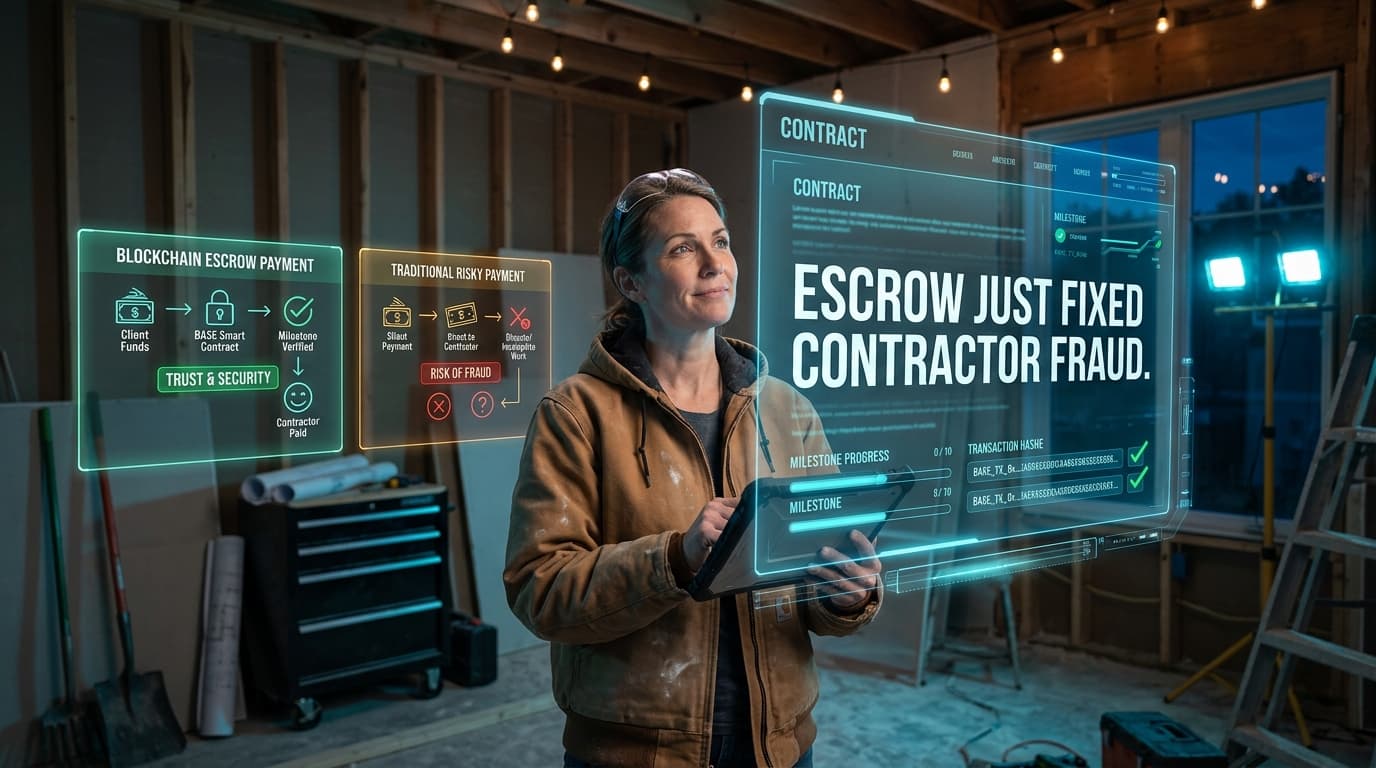

The $500 Lawn Job Has a Trust Problem, and Blockchain Is Starting to Solve It
Americans reported $12.5 billion in fraud losses in 2024, according to the FTC, and home improvement and contracting services consistently rank among the top complaint categories. The pattern is familiar: a crew shows up, takes a deposit, does partial work, and disappears before the mulch is spread. Online marketplaces have made it faster to find a landscaper, but not easier to verify one. Blockchain service payments are changing that calculus, turning what was once a handshake deal into a set of auditable, on-chain conditions nobody can fake.
If you're sourcing a landscaper through a crypto-native or BASE-powered service platform, these nine checks tell you whether the listing is worth your money before you commit a single dollar.
Check 1: Does the Provider Have a Verifiable On-Chain History?
A wallet address is a public record. Before agreeing to anything, ask for the provider's wallet address and look it up on a block explorer. A landscaper who has completed prior blockchain service payments will have a transaction history: completed escrow releases, resolved disputes, and no pattern of stuck contracts. A brand-new address with zero activity warrants real scrutiny. Treat it the way you'd treat a contractor with no verifiable work history.
Check 2: Is the Listing Tied to a Real Identity Layer?
Anonymous listings on-chain are fine for low-stakes trades. For a $500 service where someone arrives at your property, you want more. Reputable BASE-based service platforms link listings to verified identity markers, whether an email confirmation, a phone-verified account, or a credential badge tied to the wallet. If the platform offers no identity verification layer and the seller has no reviews, the on-chain escrow protects your funds but not your afternoon.
Check 3: Have They Completed Milestone-Based Contracts Before?
Milestone escrow is one of the most practical features blockchain service payments offer for home services. Instead of paying $500 upfront, a smart contract can split the job into stages: 30% on arrival and setup, 40% on completion of main work, and 30% on your final approval. The question to ask is whether the provider has accepted this structure before. A transaction history showing prior milestone completions is a strong signal. Someone who insists on a single lump-sum upfront release, on a platform that supports milestones, is telling you something.
Check 4: Are the Contract Terms Written Into the Smart Contract?
A verbal agreement, whether spoken or typed in a chat window, is not enforceable. On a blockchain-based platform, service terms should be embedded in the contract itself: scope of work, timeline, what constitutes a completed milestone, and what happens if a milestone is disputed. If the "contract" is just a description field and the actual terms are negotiated in direct messages, the on-chain escrow is protecting your funds but not your expectations. Get the terms on-chain.
Check 5: What Is the Dispute Resolution Mechanism?
Smart contracts are self-executing. They do exactly what they're coded to do, and they are not self-correcting. If something goes wrong, you need a defined path to resolution. Before paying, understand how the platform handles disputes. Some platforms use trained community arbitrators who review evidence and rule on contested releases. The critical question is whether that mechanism is defined before funds are committed, not improvised after the fact. Platforms with no dispute process are betting nothing goes wrong.
Check 6: Is the Payment Denominated in a Stablecoin?
If the platform settles in a volatile token, your $500 job could shrink to $340 by the time the escrow releases, or balloon depending on market movement. Blockchain service payments settled in USDC or another dollar-pegged stablecoin mean the number you agreed to is the number both parties receive. Visa launched a USDC stablecoin payout pilot for gig workers in late 2025 precisely because stablecoin settlement makes service agreements predictable. Look for platforms where USDC is the default currency.
Check 7: Who Controls the Release Trigger?
In a well-designed escrow, funds release when you confirm completion or when a timer expires after a defined period with no dispute raised. What to avoid: a setup where the seller triggers their own release without your confirmation, or where default release happens after 24 hours regardless of outcome. Read the platform's documentation on how releases work. The BASE network's low-fee infrastructure (under $0.01 per transaction) makes it economically viable to build in multiple confirmation steps without penalizing either party on fees.
Check 8: Is the Platform Transparent About Its Fee Structure?
Fee transparency is a useful proxy for platform integrity. Platforms that bury their take in fine print or charge both sides without disclosure tend to create misaligned incentives. For home services, the fee structure affects whether a $500 job actually pays the landscaper enough to show up motivated. Some platforms charge the seller; others charge the buyer; some use a tiered model that scales with transaction size. Know which model you're on, and what the landscaper actually nets, before you commit.
Check 9: Is There an On-Chain Record You Can Export?
When the job is done and escrow releases, you should be able to pull a transaction hash as proof of payment. This matters for tax records, insurance claims, and any future dispute about whether work was completed. Traditional payment apps can reverse, freeze, or lose records. An on-chain transaction on BASE is immutable and publicly verifiable. That sounds minor for a lawn job, until you need to prove to your HOA that you hired a licensed contractor and paid for completed work.
What These Nine Checks Actually Represent
The checklist above is not really about landscaping. It's about what happens when blockchain service payments migrate into everyday commerce. The smart contract market was valued at $2.14 billion in 2024 and is projected to reach $12.07 billion by 2032. BASE processed 13.39 million transactions in a single day in January 2025. The infrastructure is scaling to handle ordinary service transactions, not just crypto trading.
For homeowners, the pitch is practical: you're not buying into a financial instrument. You're making a hire with built-in accountability. Platforms like Fisheez, which runs SmartShell Escrow on BASE, are building exactly this kind of service layer, where milestone-based releases and community dispute resolution sit beneath an otherwise ordinary transaction.
The broader implication is that blockchain-native commerce is addressing problems traditional platforms have accepted as unavoidable. Contractor fraud, vanishing deposits, and verbal agreements that evaporate are the result of payment systems that transfer control before the work is done. On-chain escrow inverts that default, and the industry is starting to take note.