

The $150 Card Sitting in Your Cart
That Snapcaster Mage listing looks clean. The photo shows sharp edges, correct foiling, the seller has decent feedback. Your finger is hovering over the buy button and something is making you hesitate. That hesitation is not irrational, but it is probably based on the wrong fears. The myths circulating in the MTG community about fakes, grading, and value risk have scared a lot of seasoned buyers away from perfectly legitimate deals.
The counterfeit problem in Magic: The Gathering is real and documented. It is also survivable with the right knowledge. Rare MTG cards under $200 are absolutely attainable through the secondary market without getting burned, but only if you are testing for the right things.
Myth 1: The Light Test Proves a Card Is Real
For years, the standard advice was to hold a card up to an LED light and look for the distinctive blue tint coming through the center layer. Genuine cards have a blue adhesive layer in their construction, and this test caught fakes reliably for a long time. The problem is that counterfeit producers took note, and the light test is now widely documented as unreliable for detecting modern fakes.
Many current counterfeits are specifically engineered to pass the light test. The same is true of the bend test, which risks damaging a real card just to confirm what a more reliable test would show anyway. Both methods have been largely defeated by improved production techniques.
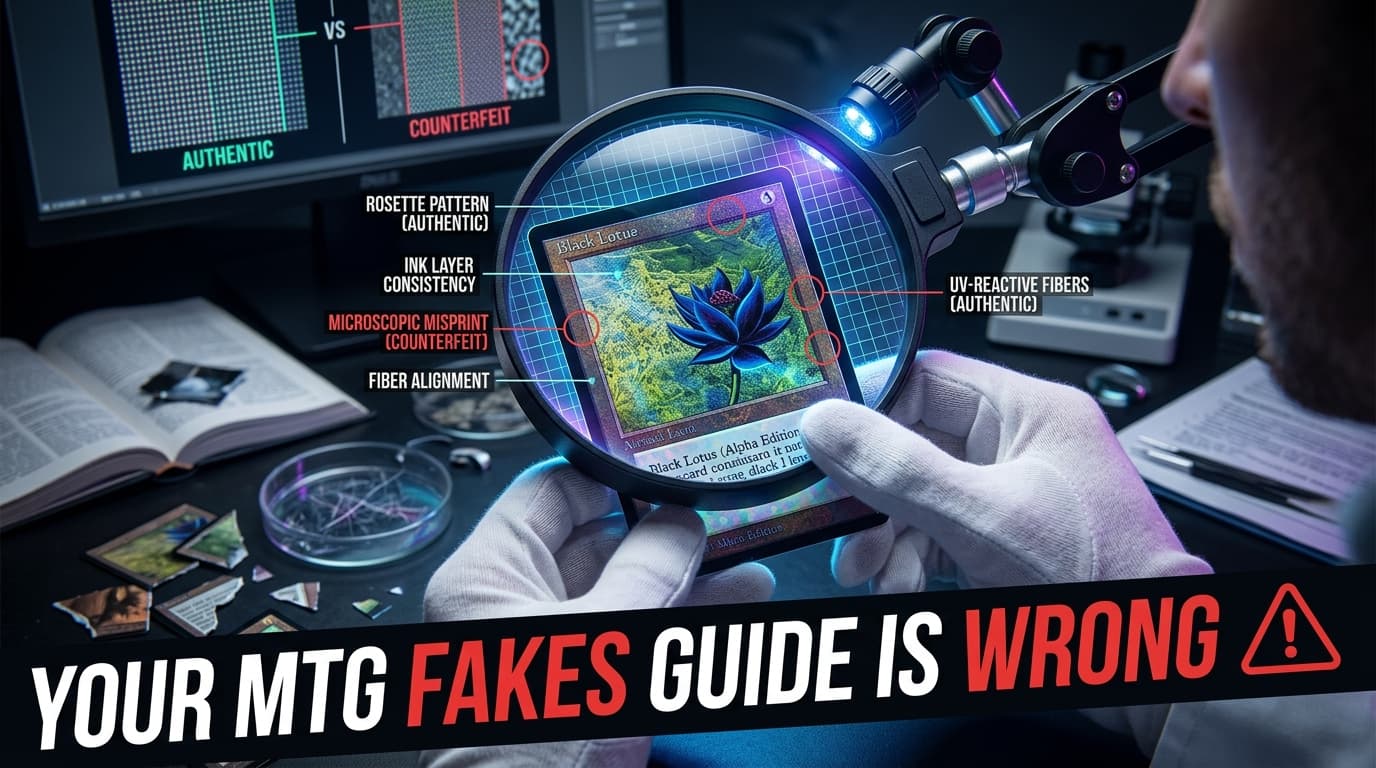
What replaced them is something more durable: the rosette pattern test. Genuine cards use offset printing that creates tiny overlapping dot clusters called rosettes, consistent across every card from the same print run. A $20 jeweler's loupe lets you see those dots clearly. Counterfeits made on different equipment produce irregular or ribbed patterns rather than the clean rosette grid of the real thing. No production shortcut has replicated this at scale.
Myth 2: Graded Cards Are Always Safe Buys
A PSA or BGS slab signals something important: whoever submitted that card believed it was worth the grading fee and the wait. That faith is meaningful. It is not, however, a guarantee of authenticity in every case. Grading services evaluate condition against a defined standard, but graders are human and inspection quality varies with submission volume.
The economics of grading for rare MTG cards under $200 also deserve scrutiny. Standard submissions to PSA start around $22; BGS and CGC run roughly similar. For a card valued at $80, that cost represents a significant percentage of the card's value. MTG also has a structural problem that does not apply to Pokemon or sports cards: a slabbed Magic card cannot be played. For cards in the $50 to $150 range, grading often reduces the pool of interested buyers rather than expanding it.
The exception is historically significant ultra-rarities. A CGC Pristine 10 Alpha Black Lotus sold for $3 million in 2024. At that tier, grading preserves something irreplaceable. For a Windswept Heath or a Dark Confidant, the math rarely works in your favor. Treat graded cards as one useful signal, not a substitute for your own authentication process.
Myth 3: Only Vintage Power Nine Cards Get Faked
This is the myth that creates the most real financial harm. The assumption goes like this: counterfeiters chase the highest returns, so a $140 fetch land or a $75 Commander staple is not worth faking. The documented evidence says otherwise.
One counterfeiting operation reported in collector community coverage was producing at a claimed daily capacity of 8.1 million cards. Their catalog included Snapcaster Mage, Aether Vial, fetch lands, Force of Will, and Demonic Tutor, along with cards valued as low as $15. One tracked counterfeiter expanded their product line by over 300% within four months. Fakes from this supply chain were distributed at US Grand Prix events as early as 2012 without being caught at the table.
The sweet spot for counterfeiters is not the Power Nine. It is the $50 to $200 range where supply is limited enough to keep prices elevated and scrutiny is low enough to slip past casual inspection. Rare MTG cards in this bracket deserve the same authentication discipline you would apply to any high-value collectible.
What Actually Works: Four Tests That Hold Up
Authentication is not a single test; it is a layered process.
The rosette comparison is the strongest method available without professional equipment. Pull an authenticated card from the same set, put both under a jeweler's loupe, and compare the dot patterns at the same location on each card. They should be identical. Differences in pattern structure, density, or regularity indicate a problem.
Mana symbol inspection catches lower-quality fakes quickly. Genuine cards use solid black ink in mana symbols and text. Counterfeits often print black using a rosette of colored ink dots rather than solid black, which looks fine from arm's length but reveals itself under magnification. Sharp, clean black edges are a good sign; fuzziness or visible color mixing is not.
Hologram verification applies to cards from Core Set 2015 onward. Rare and mythic rare cards carry an oval hologram sticker at the bottom center. The fine detail in genuine holograms is difficult to replicate convincingly; fakes either skip it or produce versions that appear damaged under magnification.
Direct comparison remains the gold standard. Hold a suspected card alongside a confirmed authentic copy and examine size, font spacing, texture, and card back reflectiveness together. Handle enough genuine rare MTG cards and the tactile difference of a fake becomes apparent before you even reach for the loupe. One additional note: non-foil cards are counterfeited far more frequently than foils, since foiling remains technically difficult to replicate at scale.
Where Protection Should Start Before Authentication
Authentication skills give you confidence in your judgment. What they cannot do is protect your money if a transaction goes wrong anyway, whether the card arrives damaged, misdescribed, or not at all. That risk exists on every platform where payment clears before you have the card in hand.
On Craigslist, you hand over cash and hope. On Facebook Marketplace, there is no structured protection. eBay offers chargebacks, but the process is slow, contested, and platform-dependent. None of these structures were built with a $150 MTG card in mind.
Fisheez approaches this differently. SmartShell Escrow holds your payment in a smart contract on the BASE network in USDC. The funds lock when you pay but do not release to the seller until you confirm the card arrived as described, or until a timer expires. If something is wrong, you open a dispute and a Peacemaker, a trained community volunteer eligible for platform prize pools, reviews the evidence. Your money is not gone the moment you click buy. It is held in escrow while you examine the card and run your tests.
For collectors hunting rare MTG cards in the under-$200 range, solid authentication technique paired with structural transaction protection is what makes the secondary market genuinely workable. The cards are there, the deals are real, and the tools to buy confidently exist. Now you know how to use them.