
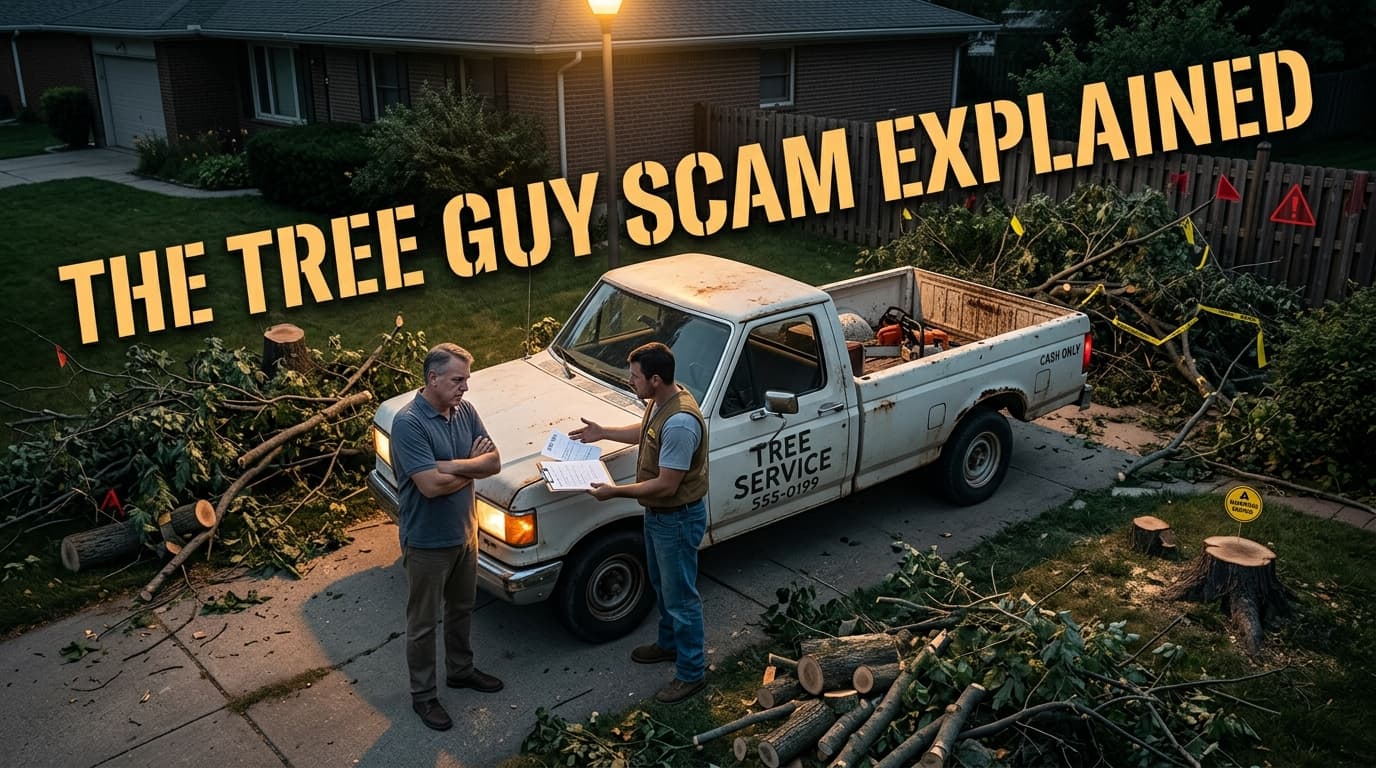

The $1,200 Stranger at Your Door
The guy shows up after the storm. He has a truck, a chainsaw, and a story about being in the neighborhood already. He'll take care of your oak for $800, cash only, and he needs half upfront to cover fuel and crew. Sounds reasonable enough.
That's how it starts for a lot of homeowners. The North Carolina Department of Justice has documented cases where out-of-state tree trimmers collected deposits from an entire neighborhood, then vanished before a single branch hit the ground. One homeowner profiled by TrustDALE lost $1,500 in cash to a company that turned out to have multiple active lawsuits, no valid license, and a policy of ignoring refund requests.
The problem is not that dangerous tree services are everywhere. Most people in the trade are legitimate. The problem is that the bad actors use the exact same pitch as the good ones, and you have no way to tell them apart at the door. This guide walks you through seven steps to hire tree service safely, so you know exactly who you are paying before any money leaves your hands.
Step 1: Know What a Fair Price Looks Like
Before you talk to anyone, understand the market rate. Nationally, tree removal averages around $630, with most jobs landing between $385 and $1,070 according to LawnStarter's pricing data. A $1,200 job is not outlandish. Larger trees like mature maples average around $1,150 to remove. Pine trees run closer to $925. Tight access, power line proximity, and difficult terrain can push costs 25 to 50 percent higher.
Knowing the range protects you in two directions. A quote of $300 for a 70-foot oak should make you suspicious. So should a quote of $3,000 for a small ornamental tree with clear access. Outliers in either direction are worth questioning before you commit anything to paper.
Stump removal typically costs $175 to $516 on top of the main removal fee. Make sure your estimate spells out whether debris hauling, chipping, and cleanup are included. A quote that looks competitive can grow fast when those line items show up as extras after the fact.
Step 2: Verify Credentials Before You Talk Price
The title "arborist" or "tree surgeon" carries no legal weight on its own. Anyone can use it. What matters is ISA certification. The International Society of Arboriculture maintains a searchable database of certified arborists, and the BBB recommends verifying ISA credentials directly before inviting any quote conversation.
Beyond certification, ask for two insurance documents before any work begins: a general liability policy and a workers' compensation policy. Your homeowner's insurance does not cover injuries that happen on your property during a contractor job. If a crew member falls from your tree without workers' comp, you could be on the hook for the medical bills.
Ask the company to have its insurer send certificates directly to you. A contractor who hands you a printed certificate can hand you a fake one. A document arriving from the insurer's office is harder to forge and easy to verify with a quick call.
Check the company's BBB profile and look for complaint history. Membership in organizations like the Tree Care Industry Association adds another layer of accountability, though it is not a guarantee on its own.
Step 3: Get Three Written Estimates
Getting three estimates is not just about finding the lowest price. It is about building a reference point that reveals outliers, spotting contractors who cannot or will not put specifics in writing, and making sure you understand exactly what each company plans to do.
A legitimate estimate should include the scope of work in plain language, the exact cost, start and completion dates, what happens to debris, and what protections go in place for surrounding property. If a contractor gives you a ballpark number verbally and says they will "figure out the rest on the day," that is a warning sign, not flexibility.
Require everything on company letterhead or a formal document you can keep. Text messages and handshake agreements give you nothing to stand on if the work comes in short or the crew disappears.
Step 4: Spot the Red Flags Before You Sign
Most tree service scams run the same playbook. Knowing it makes it easy to recognize.
Door-to-door solicitation is the most common setup. Legitimate tree companies rarely canvass neighborhoods cold. When someone knocks after a storm offering a deal, treat it as a prompt to do your homework, not a prompt to hand over a check.
Cash-only payment is a near-universal red flag. Reputable contractors accept checks and credit cards. A company that insists on cash is either avoiding paper trails or operating outside normal business structures; neither outcome benefits you.
Artificial urgency is another tell. "I can only hold this price until tomorrow" or "we're almost booked up for the month" are pressure tactics designed to stop you from doing the verification steps that would disqualify them. Any legitimate company will give you time to think.
Watch for vague or missing contracts, evasiveness about license numbers, and resistance to letting you verify insurance directly with the insurer. Any one of these is worth pausing over. More than one together means walk away.
Step 5: Negotiate Scope, Not Just Price
Once you have three estimates from verified contractors and a clear picture of the market rate, you are in a strong position to negotiate. Focus on scope, not just the bottom line: what is included, what is the timeline, what happens if additional hazards are discovered mid-job.
Ask about milestone-based payment terms. A reasonable structure for a $1,200 job might look like: nothing upfront, a partial payment after the main removal is complete, and the balance after cleanup and debris removal. This keeps the contractor motivated through to the final step and protects you from the deposit-and-disappear scenario.
If a contractor refuses any structure other than full payment upfront, that is useful information. It means either the company does not have operating capital to float even one job, or it has learned from experience that it is easier to collect before problems are visible. Neither explanation should make you comfortable.
Step 6: Inspect the Work Before You Release Final Payment
Do not hand over the final payment while the crew is still packing up. Walk the property first.
Check that the agreed scope was completed fully. If stump removal was included, confirm it is done. Verify all debris is cleared. Look at any areas where the crew worked near fencing, landscaping, or structures and document anything damaged during the job. Take photos before the crew leaves.
If something is wrong, address it on the spot. A reputable company will correct the issue or negotiate a fair adjustment before the final payment clears. Once a contractor is paid and gone, your leverage is essentially zero unless you paid by credit card and can pursue a chargeback.
Step 7: Build Escrow Protection Into the Deal From the Start
For anyone who wants to hire tree service through an online marketplace or with a provider you found without a personal referral, staging payments only gets you so far. The real gap is that once you hand over a deposit, recovering it if something goes wrong depends entirely on how cooperative the contractor feels.
Escrow protection removes that dependency. Fisheez is a peer-to-peer marketplace built for exactly this: SmartShell Escrow locks your funds in a smart contract on the BASE blockchain the moment you pay. The service provider cannot access the money until you confirm the work is done. If the job falls through, the funds auto-refund. There is no bank in the middle and no lengthy chargeback process to navigate.
This is the structural answer to the $1,500 cash story at the top of this article. That homeowner handed over money with nothing holding the contractor accountable. SmartShell flips that dynamic: funds are committed but not released until you confirm delivery.
Fisheez charges buyers a tiered service fee starting at 8 percent for small transactions, scaling down as the job size increases. Sellers pay nothing. Disputes go to Peacemakers, trained community volunteers who review both sides and resolve conflicts without any financial stake in the outcome.
On Facebook Marketplace or Craigslist, you are one bad decision away from losing your deposit with no recourse. On a platform where escrow protection is built in by default, the contractor has to earn the payment. That single difference changes the entire risk profile of hiring a stranger to work on your property.