
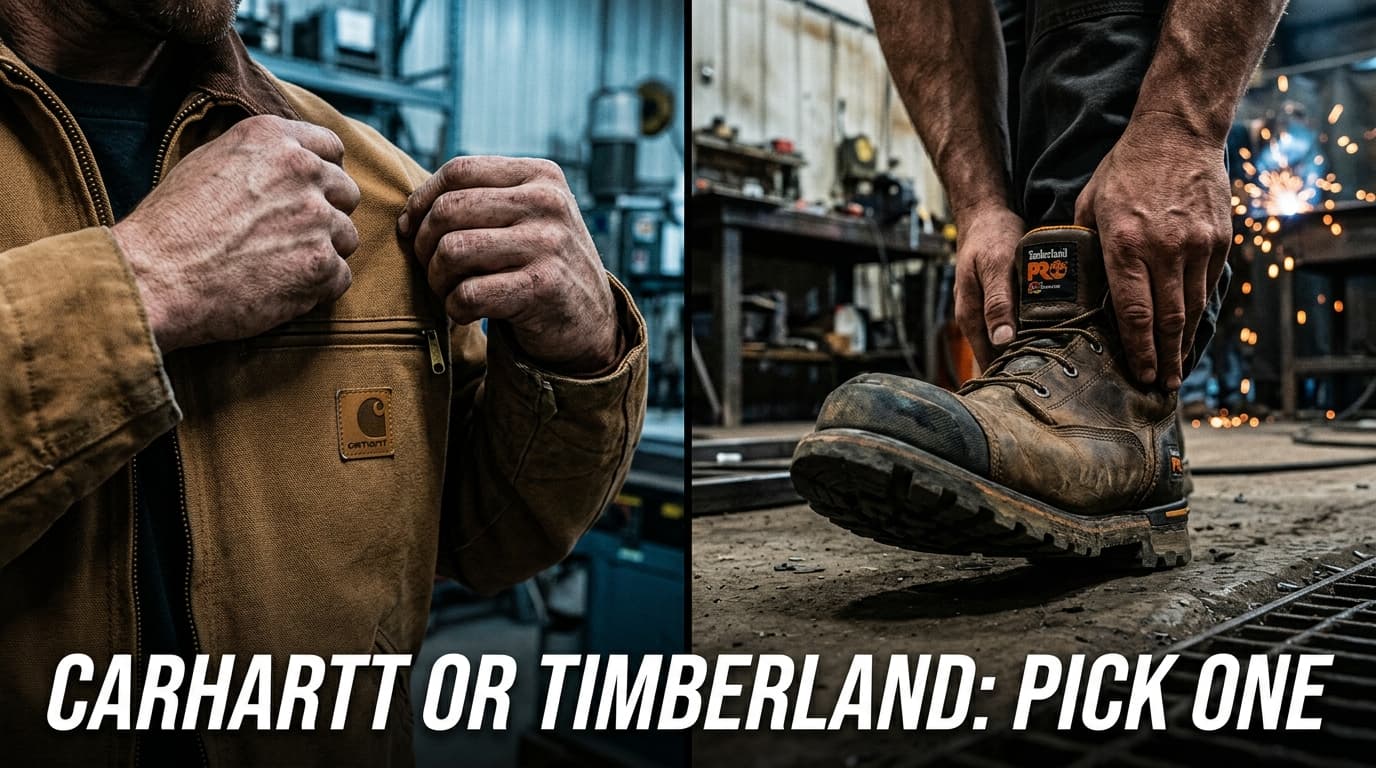

The $150 Question Every Tradesperson Faces
One hundred fifty dollars. That's roughly what a new Carhartt Detroit jacket costs. It's also roughly what a pair of Timberland PRO Boondock boots costs. Most guys can't swing both at once, so the question becomes: if you've got $150 burning a hole in your work budget, which one earns its keep longer?
This Carhartt vs Timberland comparison is worth having because these are not fashion items. For blue-collar workers putting in 10-hour days on concrete, in the elements, or around sparks and chemicals, these are tools. The wrong choice means cold mornings, wrecked feet, or money down the drain inside a year.
What You're Actually Buying: Materials and Construction
Carhartt's signature is duck canvas: a tightly woven cotton fabric that absorbs serious abuse before it shows wear. The Detroit Jacket, one of Carhartt's most popular workwear pieces in the $130-$150 range, uses 12-ounce duck with triple-stitched seams at every stress point. That matters on a jobsite, because loose seams catch on scaffolding and equipment. Carhartt engineers each fabric through more than 15 internal durability tests before it hits production. Rain Defender technology adds a durable water-repellent finish, and quilted flannel lining handles shoulder-season temperatures without adding bulk that slows you down.
Timberland PRO's Boondock boot, priced at $199 but frequently found closer to $150 on sale, is built around Ever-Guard chrome-tanned leather, a material specifically engineered for abrasion resistance on rough job sites. The outsole is TPU with a polyurethane midsole, paired with a 270-degree Goodyear welt construction. That welt matters: it is a repairable bond between upper and sole, meaning when the outsole wears out you are not necessarily buying a new boot. A rubber toe cap as thick as a standard boot outsole protects the front of the foot where most work boots take their hardest hits. Anti-Fatigue Technology in the insole compresses and rebounds underfoot to reduce strain during long shifts.
Durability on the Clock: How Long They Actually Last
Here's where the Carhartt vs Timberland math gets interesting. A well-maintained Carhartt duck jacket, particularly the Detroit or the Active Jac, can last a decade with regular use. Divide a $150 price tag across ten years and you're paying $15 per year for a jacket. Few purchases on a working person's budget beat that math. The fact that Carhartt launched a formal recommerce program, Carhartt Reworked, to handle the volume of used gear that still has life in it is proof of how long the product actually holds up.
Timberland PRO boots average four to five years of consistent daily wear before needing replacement, putting the annual cost at $30 to $37 at the $150 price point. One documented user wore a pair for two straight years at 8 to 10 hours per day before needing to replace them. The Boondock does have one limitation worth knowing: waterproofing holds up for about an hour or two in wet conditions but fails with extended immersion. For most trade environments that is a non-issue, but if you are doing wet utility work, it is worth noting.
On raw cost-per-year, the jacket wins. That comparison only holds, though, if you already have boots that work. Feet are where fatigue, injury, and safety failures start. No jacket solves that.
The Resale Math: Which Holds Its Value
Carhartt gear has genuine secondhand staying power. On eBay and Facebook Marketplace, used Carhartt jackets in good condition range from roughly $37 for well-worn pieces to $137 and above for cleaner examples. Vintage Carhartt from the 1990s fetches considerably more on specialty resale sites. The brand's own trade-in program, Carhartt Reworked, accepts items under ten years old with an original MSRP of at least $50 and returns store credit.
Timberland has its own sustainability take-back initiative called Timberloop, but the secondhand boot market is thinner. Boots are harder to resell than jackets because fit is non-negotiable in a way that outerwear is not. A jacket that runs slightly large can still be worn; boots that do not fit precisely are useless to the next buyer. Lightly worn Timberland PRO models do move on platforms like eBay, typically at 40 to 60 percent of retail, but the demand is narrower. The resale edge belongs to Carhartt, and that difference compounds the jacket's long-term value advantage.
Where to Find Both for Less Than $150
Factory seconds, end-of-season clearance, and the secondhand market are the three fastest ways to get either brand under $150. For Carhartt, the Reworked site, eBay, and Facebook Marketplace all carry legitimate inventory. For Timberland PRO, Zappos and Amazon frequently discount last-season models, and eBay has a solid supply of lightly used pairs.
The catch with secondhand workwear is the same catch you get with any peer-to-peer transaction: you are trusting a stranger. A cash handoff for a $140 pair of boots has zero recourse if they show up with a cracked outsole that was not in the photos. Facebook Marketplace has no buyer protection built in, and Craigslist is a cash-and-hope situation. Platforms like Fisheez approach this differently: SmartShell Escrow locks your payment in a smart contract on the BASE network and releases it only when the deal completes as described. If the boots arrive cracked or the jacket is a different size than listed, you are not chasing a refund through a dispute queue. The protection is built into the transaction from the start.
The Verdict: Which One to Buy First
The answer to the Carhartt vs Timberland question depends entirely on what you are already working without. If your boots are dead or causing foot pain, buy the Timberland PRO first. Foot protection affects your safety, productivity, and long-term health in ways a jacket simply cannot. A cold jacket can be layered under; wrecked feet cannot be layered around.
If your feet are covered and your outerwear is failing, go Carhartt. The longevity-to-price ratio is exceptional, the resale value holds, and the range of options around $150 is wider than most people realize. The Detroit Jacket, the Active Jac, and the Gilliam are all proven performers with documented real-world track records from tradespeople who work in conditions that would destroy lesser gear.
Either way, when you go looking for the deal, do it somewhere your money is protected. On Fisheez, sellers pay nothing in fees, which means savings flow to you rather than the platform. Your payment locks in escrow until the item arrives and matches what was listed, with community-trained Peacemakers available to resolve disputes if anything goes sideways. That is a different experience than handing cash to a stranger in a parking lot and hoping the gear is what they said it was. Both Carhartt and Timberland have earned their reputations the hard way. The smart move is getting either one without taking a needless risk on the transaction itself.