

Silver Hit $80 an Ounce in 2025. Now the Fight Is Over Which Version You Should Own.
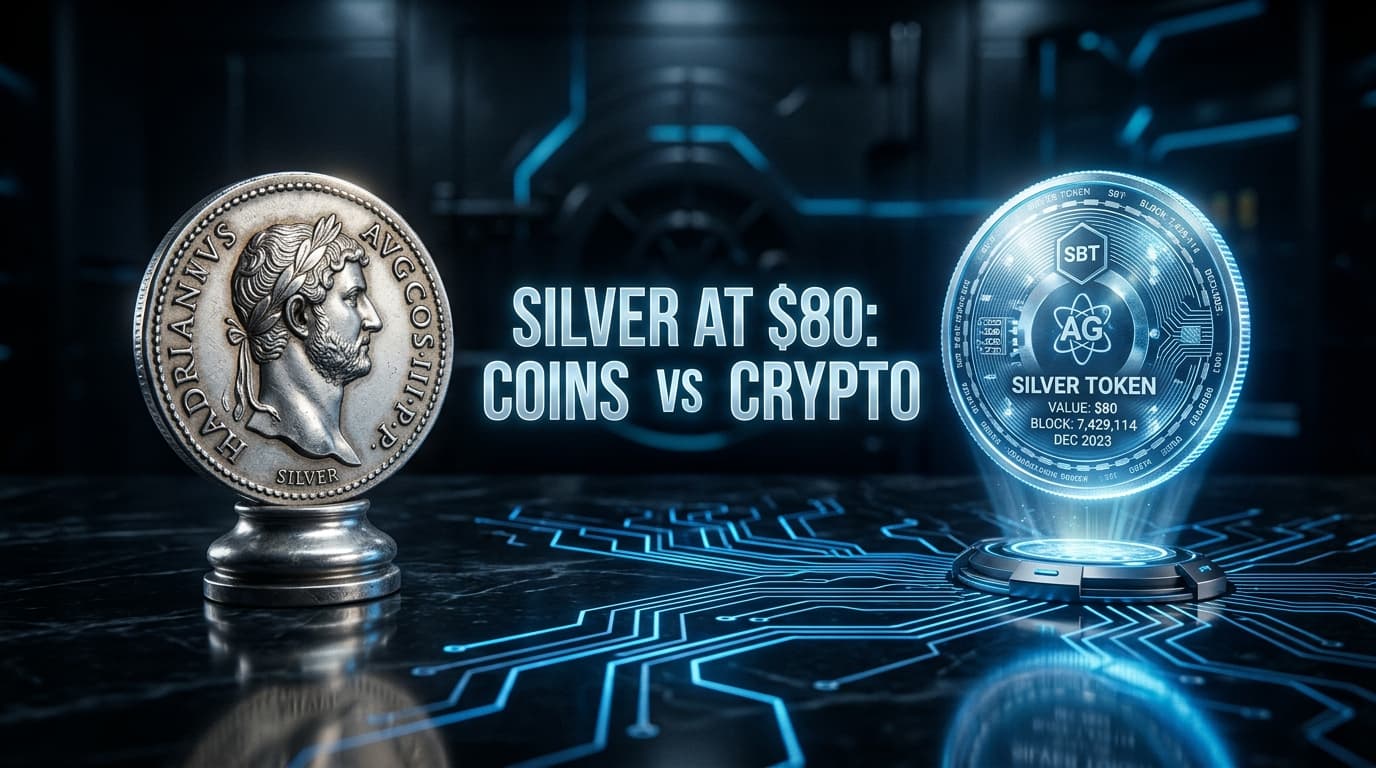
Spot silver climbed more than 140% in 2025, touching record levels above $80 per ounce and drawing in a new wave of investors who had never thought seriously about the metal before. That surge created an unexpected tension: traditional collectors and numismatists watching their rare coin portfolios outperform most asset classes, while a parallel market for blockchain-based tokenized bullion scaled to over $270 million in total market capitalization. Both paths are backed by the same underlying commodity, but they are fundamentally different bets. Understanding the distinction matters more than ever when volatility is the dominant market condition.
Rare Silver Coins: The Premium You Are Actually Paying For
Numismatic silver, meaning coins with historical significance, low mintage, or high-grade condition, does not simply track spot price. It layers a collector premium on top of the metal's intrinsic value. That premium is driven by scarcity, provenance, and demand from a collector base that spans both hobbyists and institutional buyers. The rare coin market grew approximately 20% in value over the past year, outpacing gold's 10% annual increase over the same period, according to market data from early 2025. The coin collection market overall is projected to grow from $9.8 billion in 2024 to $16.2 billion by 2030 at an 8.3% compound annual growth rate.
The tradeoff is liquidity. Selling a rare silver coin requires authenticating the piece, finding a willing buyer or consigning to an auction house, negotiating a price, and physically transferring the asset. Dealer buyback spreads typically run 2 to 5% below spot for bullion-grade coins and can be wider for numismatic pieces depending on market depth. In practice, liquidating a significant rare coin position can take days to weeks, and the realized price depends heavily on market timing and venue selection. These are not ETF-style exits.
Storage and insurance add another layer of cost. Professional vault storage for physical precious metals runs approximately 0.5 to 1% of asset value annually. A $50,000 collection costs $250 to $500 per year just to protect, on top of the initial 5% or higher dealer premium paid at acquisition. Over a five-year holding period, the all-in cost for physical silver, including premiums, storage, and insurance, ranges from roughly $6,875 to $9,375 on that same $50,000 investment.
Tokenized Bullion on BASE and Beyond: The On-Chain Alternative
The tokenized precious metals market has matured significantly. As of mid-2025, the tokenized gold market alone surpassed $2.57 billion in total market capitalization, led by Tether's XAUT at $1.3 billion and Paxos Gold (PAXG) at $983 million. On the silver side, projects like Aurus tSILVER back each token with one gram of 99.9% LBMA-accredited silver held in audited third-party vaults, with Chainlink's Proof of Reserve providing automated, on-chain verification that physical stocks match token supply.
The operational advantages are measurable. Tokenized bullion trades 24 hours a day, seven days a week, including during the periods when COMEX futures markets are closed, a feature that proved meaningful during sharp macro moves in 2025 when on-chain gold prices reflected real-time safe-haven demand before traditional markets reopened. Settlement is atomic rather than T+2: transactions clear simultaneously on-chain, eliminating the counterparty exposure that exists in conventional commodity trading. Fractionalization allows positions as small as 0.001 ounces, lowering the entry barrier for retail participants.
On BASE and other EVM-compatible chains, the fee structure is structurally different from traditional finance. On-chain transaction costs for stablecoin-settled trades are typically a fraction of a percent per swap, and silver ETF-equivalent expense ratios on traditional platforms run 0.25 to 0.50% annually. By comparison, tokenized platforms often charge custody fees in the same range but with the added benefit of DeFi composability: token holders can lend their holdings for yield or post them as collateral without liquidating the underlying position.
Liquidity Under Pressure: Where Each Model Breaks Down
The March 2020 episode in silver markets is instructive, even as a historical reference point. During that crisis period, physical silver premiums spiked 50 to 100% over spot as dealers pulled back and supply chains seized. Silver ETFs simultaneously faced potential trading halts and creation suspensions. Neither responded cleanly. Tokenized bullion platforms, which did not exist at scale in 2020, are designed to avoid ETF-style creation bottlenecks since minting is permissionless and backed by allocated metal, not paper derivatives.
That said, tokenized silver carries its own failure modes. Custodial risk is real: the value of any token depends entirely on the operator's vault integrity, audit quality, and legal jurisdiction. Smart contract vulnerabilities represent a second attack vector that physical silver is simply immune to. Regulatory treatment remains inconsistent globally, and some platforms require KYC compliance that adds friction to what is nominally a permissionless asset.
For collectors debating which format to hold, the liquidity picture breaks down roughly as follows. Tokenized bullion wins on exit speed and trading costs in normal conditions. Physical rare coins win on counterparty independence, zero smart-contract risk, and the ability to capture numismatic premiums that tokenized instruments cannot replicate. A rare 1921 Peace Dollar in MS-65 condition is not fungible with a gram of silver, and no blockchain token represents that premium.
Fees on BASE: What the Numbers Actually Look Like
Platforms built on BASE network benefit from Coinbase's layer-2 architecture, which substantially reduces gas fees compared to Ethereum mainnet. A typical token swap on BASE costs a few cents rather than the dollar-plus amounts associated with mainnet congestion. For peer-to-peer commerce involving physical collectibles, platforms like Fisheez operate on BASE with a buyer-paid service fee structure that scales from 8% on transactions under $50 down to 0.5% on transactions over $10 million, with funds held in USDC via smart contract escrow until delivery is confirmed. This structure makes on-chain settlement economically viable for lower-value coin transactions where traditional escrow services would be cost-prohibitive.
The comparison with traditional coin dealing is stark. A rare coin sold through a major auction house typically incurs a buyer's premium of 17 to 20% plus the seller's commission. Even accounting for on-chain fees, the cost structure of blockchain-native marketplaces is lower for both sides of a moderate-value transaction, assuming the buyer and seller are comfortable with wallet-to-wallet settlement.
What 2025 Volatility Reveals About Each Strategy
Silver's dramatic 2025 run exposed a key asymmetry. Tokenized bullion captured the spot price appreciation in real time, with 24/7 markets allowing holders to act on macro signals, rate announcements, or geopolitical events the moment they occurred. Rare coin collectors benefited from the same underlying price move, plus the additional numismatic premium that widened as collector demand accelerated. The coin collection market's 20% appreciation in that period is a composite of both effects.
The honest assessment is that the two formats are not in direct competition for the same investor. Tokenized bullion is the tool for investors who want liquid, low-cost, programmable exposure to silver's price. Rare physical coins are for collectors who want a tangible asset with historical value, counterparty independence, and the potential for premium appreciation that tracks neither the spot market nor any blockchain. Volatility, if anything, makes the case for holding both, keeping some liquid on-chain and some irreplaceable in a vault.
What This Tells Us About Where Commodity Markets Are Heading
The growth of on-chain precious metals, from a negligible niche to a multi-billion-dollar asset class in under five years, signals a structural change in how commodity exposure is accessed. BCG projects tokenized assets broadly reaching $16 trillion by 2030, with gold serving as the anchor. Silver, given its dual role as monetary metal and industrial input for AI data centers, solar panels, and electronics, is following a similar trajectory on-chain. The traditional rare coin market will not disappear, but the infrastructure being built around tokenized commodities is eroding the historical advantages of legacy distribution channels, including dealer premiums, geographic access barriers, and settlement delays. Collectors who understand both layers are better positioned than those who treat the choice as either/or.