
How One Tool Sale Turned a Block Into a Repair Collective
It started with a circular saw priced at $80.
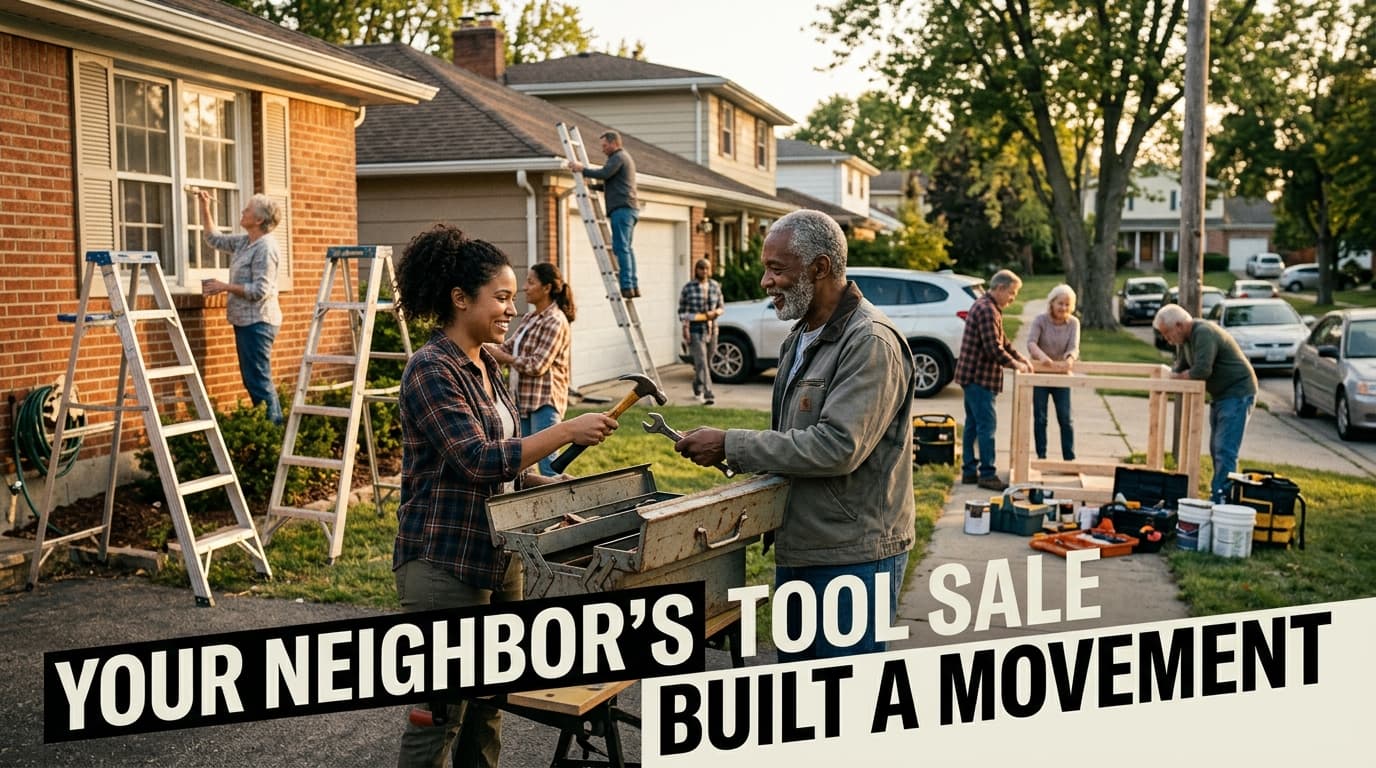
Your neighbor Marcus had upgraded to a cordless model and listed his old corded Skil on a peer-to-peer marketplace. Within two hours, three households on the same block had messaged him. Nobody wanted to outbid the others. Instead, someone typed a question that changed everything: "What if we just all pitch in and share it?" By the end of the week, eight families had pooled funds from four separate tool sales, created a shared inventory spreadsheet, and scheduled their first block-wide repair weekend. That circular saw fixed a rotting deck board, recut a stuck gate post, and trimmed the overgrown fascia on the corner house.
This kind of neighborhood tool sharing is not as rare as you might think. The Tool Library in Buffalo, New York, started with just 50 tools and 12 members in 2011 and now operates more than 5,000 tools serving over 1,900 active members. Nationally, over 60% of homeowners chose DIY solutions for home repair in 2024, and community repair groups are multiplying to support them. The movement catches on because the math is simple: when neighbors pool resources, everyone fixes more and spends less.
If you want to spark something similar on your street, this checklist is your starting point. Each tool below costs under $200, handles a broad range of common repairs, and becomes dramatically more valuable when shared.
1. Cordless Drill/Driver (Around $60-$120)
A cordless drill/driver is the single most-used tool in any community repair toolkit. You can hang shelves, tighten deck hardware, assemble furniture, and drive screws into fences with one. Models from Ryobi, Black+Decker, and Milwaukee all land well under $200 for a kit with two batteries and a charger. When shared across six households, a $100 drill effectively costs each family about $17, and none of you need to store it permanently. Buy one together on a peer-to-peer marketplace and rotate it by the week.
2. Orbital Sander ($40-$90)
Surface prep is the step most people skip, and it is also why most paint jobs fail within two years. An orbital sander strips old paint from window trim, smooths rough deck boards, and preps doors for refinishing. Neighborhood tool sharing works especially well for sanders because most households need one only two or three times a year. A 5-inch random orbit sander from Ridgid or Makita handles the same tasks whether it is smoothing a porch railing or refreshing a weathered fence.
3. Circular Saw ($70-$150)
This is the tool that started Marcus's collective, and for good reason. A circular saw makes straight cuts in lumber, plywood, and composite decking that a jigsaw or handsaw cannot replicate cleanly. It is essential for replacing rotted sill plates, cutting new deck boards to length, or trimming a door that drags on a new floor. For a repair collective doing community repair work across multiple houses, one reliable 7-1/4-inch corded model handles dozens of projects annually.
4. Stud Finder ($20-$60)
Stud finders prevent the costly mistake of anchoring heavy shelving, TV mounts, or handrails into drywall alone. A magnetic stud finder works fine for basic tasks, but a $40-$60 electronic model with AC wire detection adds a safety layer that matters when neighbors with varying skill levels are sharing the same tool. In a neighborhood tool sharing arrangement, one stud finder split across eight households costs virtually nothing per person.
5. Utility Knife Set with Extra Blades ($15-$40)
Do not underestimate the humble utility knife. Scoring drywall, trimming weatherstripping, cutting roof shingles, and slicing carpet padding all require a sharp utility blade. A set with extra blades and a belt clip runs under $40 and stays sharp longer when stored properly. For a repair collective, this is the tool that lives in a communal bag and gets replaced by whoever uses the last blade, keeping the cost essentially zero across the group.
6. Caulking Gun Kit ($20-$60)
Drafty windows and leaking gutters are among the most common neighborhood home improvement complaints, and a caulking gun addresses both. A ratchet-drive or drip-free model paired with exterior-grade silicone caulk handles window frames, door thresholds, siding gaps, and bathroom tile. When your collective sets aside a "weatherproofing weekend" in fall, one caulking gun rotates from house to house down the block, sealing gaps that cost every household money in heating and cooling. Community repair projects like this generate real, measurable savings.
7. Oscillating Multi-Tool ($60-$150)
The oscillating multi-tool is the most versatile item on this list. With interchangeable blades and pads, it sands, cuts, scrapes, and grinds in spaces where no other tool fits. Grout removal, trim cutting, plunge cuts around door casings, and scraping old adhesive from subfloors all become manageable tasks. Shared across a group tackling varied projects across multiple properties, its cost-per-use drops to almost nothing within the first season.
8. Laser Level ($30-$100)
Crooked shelves and misaligned fence posts are the hallmark of a rushed project. A laser level eliminates the guesswork. Entry-level self-leveling models from Dewalt and Bosch land well under $100 and project a horizontal line accurate enough for tile work, deck boards, and picture rail installation. For neighborhood tool sharing, a laser level is the kind of precision tool most people would never buy solo because they use it once every two years. Shared across a collective, it justifies its cost in the first month.
What Happens After the First Weekend
The eight tools above are a starting point, not a destination. What the research on community repair shows, again and again, is that the tools matter less than the habit they create. The Tool Library in Buffalo diverted 7,554 pounds from landfills and saved community members more than $40,000. The Station North Tool Library in Baltimore built a membership of 2,200 people around 3,000 shared tools. These are not fringe programs. They are evidence that neighborhood tool sharing scales naturally once the first shared purchase breaks the ice.
When Marcus's block finished their first repair weekend, two things happened. They fixed six separate problems that had been sitting undone for months. And they made plans for the next one. That is how repair collectives grow: not through formal committees or complicated bylaws, but through neighbors discovering that the work is easier and more enjoyable together. The tools are just the entry point. Repair Cafe research shows that community repair events consistently produce social bonds alongside fixed items, and those bonds keep people coming back.
The trickiest part of any shared-tool arrangement is the money. Who paid for what? Who owns the circular saw if the collective dissolves? How does the group handle someone who wants to exit and recoup their share? These questions are real, and they are why trusted transaction infrastructure matters as much as the tools themselves.
Keeping the Collective Fair
When your group sources tools through peer-to-peer marketplaces, using a platform built around transparent transactions protects everyone. Fisheez is a blockchain-based marketplace on the BASE network where buyers and sellers transact in USDC through SmartShell Escrow, a smart contract that holds funds until the deal is confirmed complete. For a neighborhood collective pooling money to purchase tools from individual sellers, this means no one's contribution disappears and no funds release until the tool arrives and the group is satisfied.
The fee structure on Fisheez keeps costs low for buyers making modest purchases: 8% on transactions under $50, scaling down as amounts grow, and sellers pay nothing. When three neighbors split a $120 oscillating multi-tool purchase, each contributing $40, the last thing anyone needs is a disputed transaction and a missing tool. SmartShell Escrow removes that risk entirely.
Fisheez is also a Public Benefit Corporation with a separate nonprofit, Fishlanthropy Foundation, which directs 5% of revenue to community causes. That structure is not incidental. It reflects the same values your repair collective runs on: fair systems, transparent rules, and community accountability produce better outcomes than individual guesswork. Your block's next repair weekend might start with one good tool sale. The collective it builds could last for years.