
How One Seller Turned $350 Garden Sets Into a Greener Block
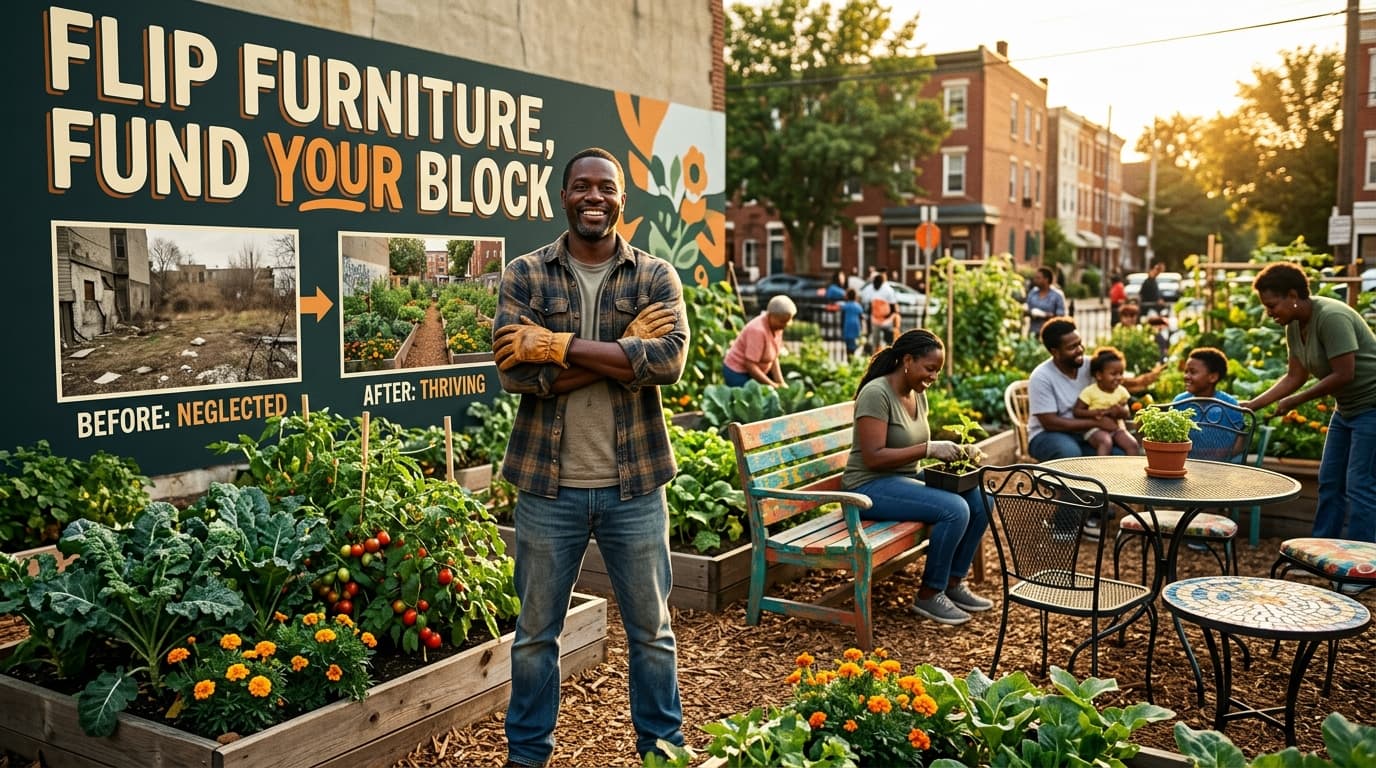
Marcus had been flipping patio furniture for two seasons when something shifted. He was deep into his third spring sell-off, watching his phone blow up with offers on a cast-aluminum dining set he had sourced in November for $80, cleaned up, and photographed against a freshly raked lawn. When it sold for $420, he did something different with the proceeds. Instead of pocketing all of it, he walked over to the corner lot where his neighbors had been talking for months about planting raised garden beds. He handed over $200 toward soil, lumber, and seeds. That block party the following summer, with tomatoes and zucchini growing in beds at the entrance, became something the whole street showed up for. Marcus will tell you the furniture flip was the business. The garden was the point.
That combination, outdoor furniture P2P sales funding tangible neighborhood transformation, is more achievable than most sellers realize. The secondhand furniture market in North America hit $13.81 billion in 2024 and is on track to reach $25.62 billion by 2033, growing at over 7% annually. Within that market, outdoor and garden furniture occupies one of the most underserved and seasonally volatile niches, which is exactly where experienced resellers find their edge.
The Seasonal Arbitrage That Makes This Work
The profit logic behind garden furniture flips is straightforward once you see it: the value of a patio dining set is not fixed. It swings by as much as 70% depending on the month you sell it. A six-piece aluminum dining set that sits on a listing for $150 in November becomes a $450 item in April, because every homeowner with a backyard suddenly needs outdoor seating two weeks before Memorial Day. That is not speculation. That is a repeatable pattern you can build a calendar around.
Advanced sellers exploit this window by buying aggressively between October and February. End-of-season desperation means homeowners will often accept 40 to 50% of their asking price just to clear the garage before the first freeze. Estate sales during winter months frequently have patio sets priced at 10 to 20% of retail. Retail clearance at major home improvement stores in January can drop a $600 dining set to $180. The spring resale of that same item at $400 to $500 represents a margin that is hard to find anywhere else in the resale economy.
Most patio furniture is heavy and bulky, which means national resellers cannot compete with you on local deals. Your market is the person three miles away who needs chairs for their deck by the weekend. That geography is a structural advantage, and the patio furniture market is projected to keep growing to $38.7 billion by 2035, so demand is not softening.
Advanced Pricing and Bundling Strategy
Pricing outdoor furniture for P2P sales is a skill, not a formula. The standard framework: like-new pieces with original cushions command 50 to 65% of retail; good condition sets hit 40 to 55%; sets with a solid frame but missing cushions land at 25 to 40%. The real leverage, though, is in bundling. A patio dining table listed solo might clear $150. List it alongside the six matching chairs plus a market umbrella and weighted base, and the same buyer will pay $380 to $420 because it solves their whole problem in one purchase.
Value-add restoration is the multiplier that most casual sellers skip. Power washing alone creates a visual transformation that photographs well and justifies a premium. Replacing worn cushions, at a cost of $120 to $160, can add $200 to $500 in perceived value. A $15 can of spray paint on faded aluminum, or a $20 bottle of teak oil on weather-beaten wood, can lift a sale price by $100 to $200. Document the before and after in your listing photos and buyers will pay for the effort. Detailed flipping guides show consistent 40 to 150% returns for sellers who invest in presentation.
Sourcing discipline matters as much as pricing. Estate sales, curb alerts, and off-season retail clearance are the primary channels. Premium brands including Brown Jordan, Gloster Teak, and Pottery Barn Outdoor command resale prices between $500 and $3,000 depending on condition. Even Polywood Adirondack chairs are reliable repeaters: buy for $50 to $80 off-season and sell for $150 to $200 in spring.
From Sales Revenue to Street-Level Change
Here is where garden furniture flips intersect with something larger. Research consistently shows that urban greening produces measurable community dividends. Neighborhoods with community gardens have seen residential property values increase by more than 9%. Green space reduces temperatures from the Urban Heat Island Effect by up to 10 degrees. In Toronto, neighborhoods with multiple community gardens recorded a 70% increase in butterfly species. These are not abstract benefits. They are things neighbors notice, which is why community garden projects tend to build momentum once they start.
These outcomes do not require a grant or a nonprofit infrastructure. They can start with a consistent resale strategy and a deliberate decision about where to direct the proceeds. If you are running six to ten garden furniture flips per season at an average margin of $200 to $300 per transaction, you are generating $1,200 to $3,000 in seasonal profit. Routing even a portion of that into community greening supplies, soil, raised bed lumber, native plant seedlings, or shared outdoor seating, produces visible change at the block level. That is the kind of investment that turns a summer cookout into a block party worth remembering.
Choosing the Right Platform for Community-Minded Sellers
If you are serious about maximizing returns from outdoor furniture P2P sales while keeping overhead low, platform choice matters. Fisheez is a blockchain-based peer-to-peer marketplace built on the BASE network that removes one of the biggest friction points in resale: seller fees. Sellers pay nothing. Buyers pay a tiered service fee starting at 8% on transactions under $50, dropping as low as 0.5% on larger sales. That structure means every dollar from a $350 garden set stays in your pocket, available to reinvest in the next sourcing run or direct into your neighborhood green fund.
Fisheez uses SmartShell Escrow to protect both parties. Buyer funds lock in a smart contract in USDC on the BASE network and release when the buyer confirms receipt, when a timer expires, or through dispute resolution handled by Peacemakers: trained community volunteers who arbitrate conflicts through a fair process, not a for-hire service. The result is a trust layer that mirrors the ethos of community-oriented selling. Through the Fishlanthropy Foundation, a legally separate 501(c)(3), 5% of Fisheez revenue flows into charitable causes, which means the platform itself is oriented toward the kind of impact that sellers like Marcus are already creating at the neighborhood level.
The Flip That Keeps Giving
The secondhand outdoor furniture market is seasonal, local, and deeply predictable for sellers who do the work. Buy in fall and winter. Sell in spring and early summer. Invest in presentation and bundling. Source premium brands when you can. These are the mechanics. But what the best sellers understand is that the real compounding effect comes from redirecting capital intentionally.
A $350 garden set flip is a business move. Channeling a share of that margin into raised beds, native plantings, or a community tool library turns it into a neighborhood strategy. Block parties get greener. Property values edge up. And the seller who made it happen gets to watch all of it unfold from a chair they sourced for $40 in January.