
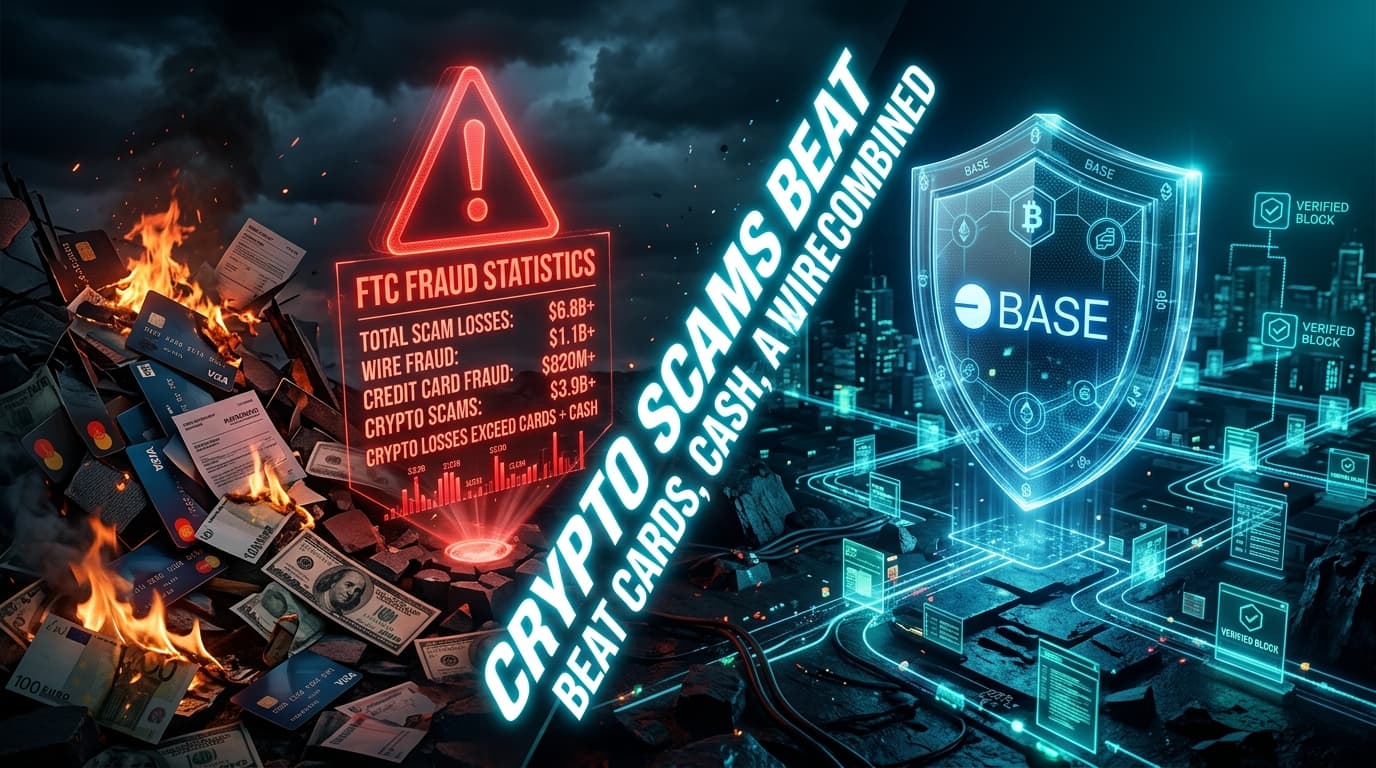

Crypto Lost More to Fraud Than Cards, Cash, and Wire Transfers Combined Last Year
In 2024, consumers reported losing $12.5 billion to fraud, a 25% jump over the prior year. Bank transfers and cryptocurrency accounted for more of those losses than every other payment method combined, including credit cards, wire transfers, and cash. If you are a DeFi investor thinking about hiring a financial coach, that number should stop you cold, because it is about to get more complicated. The argument here is that crypto is also the safest way to pay a coach, and the data supports it. The distinction is not the currency. It is whether funds are locked in code or sent on trust.
The scarier statistic is not the total loss figure. In 2023, 27% of people who reported a scam actually lost money to it. In 2024, that number jumped to 38%. Total fraud reports stayed nearly flat at 2.6 million, which means scammers are not casting wider nets. They are converting more victims per encounter. If you think you can spot a scam because you are crypto-native, the 2024 FTC fraud data suggests that confidence is exactly what they are counting on.
Step 1: Confirm the Market Rate Before You Talk to Anyone
The U.S. business coaching market is estimated at $20 billion in 2025. The life coaching segment alone is $1.6 billion. Average annual compensation for a U.S. business coach runs around $70,400. At $150 per hour for a qualified financial coach, you are in normal, competitive territory, not a red flag, not a bargain. Executive coaching ROI has been measured at 788% in American University research, which means the fee is genuinely trivial if the engagement delivers even a fraction of that return.
Knowing this before you speak to anyone protects you in both directions. A coach quoting $80 per hour in a market that prices at $150 is not a deal; it is a signal worth investigating. Someone quoting $400 is not automatically elite. Anchoring to market rate before any conversation strips the price framing out of the sales pitch before it starts.
Step 2: Vet Credentials On-Chain and Off
There are approximately 232,000 coaching businesses operating in the U.S. right now, and global practitioner counts reached roughly 123,000 in 2025, up 15% from 2023. A crowded market with low barriers to entry is exactly where fraud concentrates. The FTC treats coaching fraud as its own named enforcement category, covering online business coaching scams, real estate seminar schemes, and pyramid structures dressed as mentorship programs.
Seventy-three percent of coaches report that clients and organizations now expect certification or credentials, according to the International Coaching Federation. Verifying ICF status takes about two minutes on their public registry. On-chain reputation is a different kind of check: it is a verifiable transaction history that survives platform changes and cannot be edited after the fact. A testimonial on a website tells you what someone wants you to believe. An on-chain record tells you what actually happened.
Step 3: Choose BASE Network for the Transaction
BASE is not a random L2. As of 2025, it holds 46.58% of all L2 DeFi TVL, rising from $3.1 billion in January to a peak above $5.6 billion in October. Arbitrum holds another 30.86%. Together they represent over 75% of the category, meaning every other L2 combined accounts for less than a quarter of the market. For a financial coaching blockchain escrow transaction, liquidity concentration matters because it means more active users, more coach listings, and more on-chain reputation data to evaluate.
BASE also holds Stage 1 classification, meaning it has live, permissionless fraud proof systems in place, a status most L2 networks have not reached. Gabriel Saunders, an analyst at The Block, put it plainly in the 2026 L2 Outlook: "The standout winner has been Coinbase's Base, built on the OP Stack, having dominated across users, transactions, and overall activity throughout the year." Morpho's integration into the Coinbase app drove BASE deposits from $354 million to over $2 billion in under a year, which means the mainstream Coinbase user base is already flowing into BASE. Robinhood, Sony, Kraken, and Uniswap all deployed on OP Stack in 2025. The institutional credibility is not theoretical.
Step 4: Set Up a SmartShell Escrow Contract Before Any Session
Here is the core misunderstanding most DeFi users carry into service transactions: crypto is irreversible, so sending funds to a coach's wallet is a one-way door. That irreversibility is real, and it is dangerous in a raw transfer. But it is also what makes a locked escrow contract structurally unbreakable protection for both parties. The funds do not move until the contract conditions are met. Nobody can reverse the lock from outside, and nobody can access the funds without satisfying the terms.
Fisheez implements this through SmartShell Escrow, a smart contract on BASE that holds funds in USDC. The platform never touches the money; the contract does. As Tobi Opeyemi Amure noted in FinanceFeeds, this structure means "the platform never touches the money; the smart contract keeps it," which simplifies regulatory requirements and builds trust through code rather than reputation. Traditional escrow services charge up to 5% in fees, require human staff, and operate on business hours. A financial coaching blockchain escrow on BASE settles at internet speed, 24 hours a day, for a small network fee. The non-custodial model is also legally cleaner for both parties than routing funds through a payment processor.
Step 5: Structure Milestone Payments, Not Lump Sums
Job and employment scam losses grew from $90 million in 2020 to $501 million in 2024, a 457% increase over four years. Business opportunity scam losses totaled $750.6 million in 2024 alone. The common thread in nearly every case is a lump-sum payment made before value was delivered. The operational heart of escrow protection is not the lock mechanism in isolation; it is breaking an engagement into milestones so your exposure at any single point is bounded.
SmartShell supports nested contracts for milestone-based releases. Instead of locking $1,500 for a ten-session coaching package upfront, you structure it as five two-session milestones, each with its own release condition. If the engagement goes sideways after session two, your remaining funds are still locked. Each milestone is also a natural checkpoint to reassess whether the coach is delivering what was agreed. Paying in milestones is not a sign of distrust; it is what any rational buyer does when the product is delivered over time.
Step 6: Verify the Coach's On-Chain Reputation After Each Milestone
Pre-hire credential checks are table stakes. The more durable protection is treating reputation verification as a recurring step throughout the engagement, not a one-time filter. On-chain reputation compounds in a way that off-platform testimonials do not. A coach who has completed fifty milestone-based engagements with clean release records has a verifiable track record that no LinkedIn profile can replicate.
Fisheez's Pearl Rewards system is built around this principle, creating on-chain reputation signals for both buyers and sellers that persist across transactions. Fifty-nine percent of coaches expect revenue growth through more clients and more sessions rather than rate increases, which means the $150 per hour market is stable and competitive. For buyers, that stability is good news. For coaches, an on-chain reputation record is the most portable asset they can build, because it follows them regardless of which platform they are listed on next year.
The Difference Between Getting Scammed and Getting Results Is One Contract
The same irreversibility that makes a raw crypto transfer to a stranger's wallet one of the riskiest financial decisions you can make is what makes a locked escrow contract one of the safest. The $12.5 billion fraud environment is not an argument against using crypto to hire a coach. It is an argument against sending crypto without a contract. Those are not the same thing, and conflating them is what scammers are counting on.
At 788% ROI, a $150 per hour financial coach is not an expense. It is an investment with a measurable historical return, and the escrow fee is cheap insurance on that return. Fisheez charges sellers nothing and buyers a tiered fee starting at 8% under $50, scaling down to 0.5% above $10 million, compared to the 20% Fiverr and Upwork extract from the freelancer's side. The financial coaching blockchain escrow workflow described here executes entirely within the Fisheez marketplace on BASE. For a deeper look at how SmartShell protects both sides of a service transaction, the mechanics of escrow-based hiring are worth reviewing before your first session.
Christopher Mufarrige, Director of the FTC Bureau of Consumer Protection, said it directly: "Scammers' tactics are constantly evolving." The answer is not to avoid the market. It is to build the protection into the transaction structure before the first session starts. What the maturation of BASE and the smart contract escrow model actually signals for the industry is more significant than any single platform: the infrastructure for trustless professional services is finally cheap enough, fast enough, and decentralized enough to be practical. The question is no longer whether blockchain escrow works for hiring a coach. It is whether you will use it before or after you learn why you should have.