
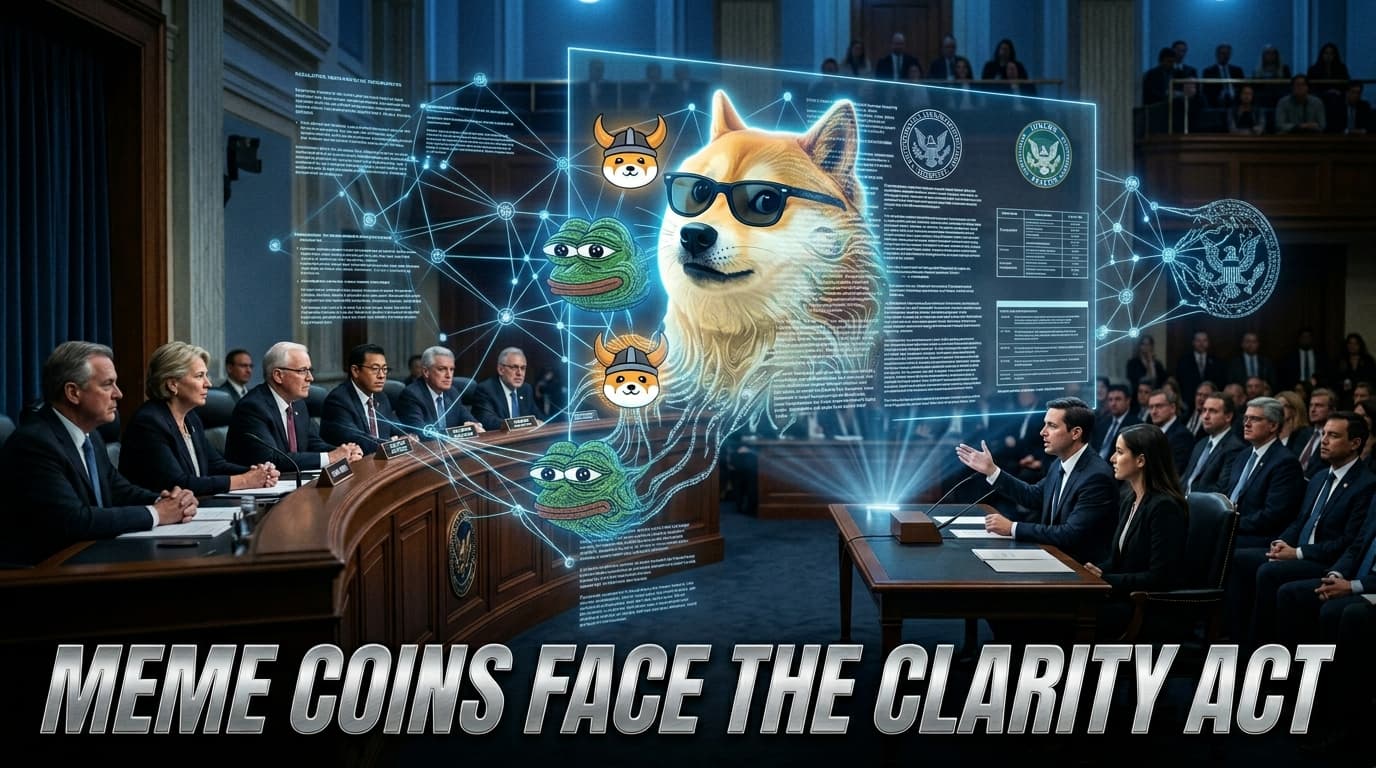

Meme Coins Face CLARITY Act: Will They Survive US Regulation?
You accepted payment in a meme coin last month because the buyer insisted—it was trending on Twitter, Elon Musk had tweeted about it, and for a brief moment it felt like riding the next big wave. Then you watched its value swing 40% in a week, wondering whether to cash out or hold, all while secretly worrying if accepting that payment put your business on the wrong side of regulators. That tension between opportunity and uncertainty defines the meme coin landscape right now.
Every time you see another viral token launch with a dog logo or cartoon frog, you're looking at an asset class in regulatory limbo—wildly popular but legally ambiguous. The hype makes them attractive for quick transactions, yet the lack of clear rules leaves sellers wondering whether they're building on quicksand. It's the digital equivalent of accepting payment in beanie babies during the 90s craze: exciting until you realize nobody knows what they're actually worth.
That ambiguity is about to change with the Digital Asset Market Clarity (CLARITY) Act moving through Congress, legislation that will finally establish which digital assets are securities, which are commodities, and which fall into new categories. The SEC has already signaled that most meme coins won't be treated as securities because profits derive from speculation rather than managerial efforts—but that doesn't mean they're home free. The real question isn't whether meme coins survive, but which ones thrive under new rules and which disappear when regulatory clarity exposes their weaknesses.
By the end of this, you'll understand exactly how the CLARITY Act reshapes the crypto landscape, which blockchain projects will face compliance issues versus those positioned to flourish, and what it means for online sellers who want to leverage digital assets without regulatory headaches.
What the CLARITY Act Means for Digital Assets and Meme Coins
The CLARITY Act creates the first comprehensive regulatory framework for digital assets by drawing a bright line between securities and commodities. According to analysis from Harvard Law School, assets that function like traditional investments—where profits come from managerial efforts of a centralized team—will fall under SEC oversight as securities. Meanwhile, decentralized digital commodities like most meme coins will be regulated by the CFTC as commodities, similar to how wheat or gold are treated.
This distinction matters because it determines everything from disclosure requirements to which platforms can list these assets. Securities must register with the SEC, provide prospectuses, and comply with investor protection rules that add significant compliance costs. Commodities face lighter regulation focused on market integrity and anti-fraud measures rather than intensive disclosure regimes. The SEC staff statement explicitly notes that typical meme coins aren't securities because price movements depend on speculative trading, not managerial efforts—a position that aligns them with commodities under the CLARITY framework.
Legislative tracking from Latham & Watkins shows the CLARITY Act passed the House in 2025 and is progressing through Senate committees, with January 2026 updates indicating bipartisan support for creating regulatory certainty. This momentum suggests the framework could become law within the next 12-18 months, transforming how digital assets are treated across all fifty states.
For meme coins, this regulatory split means survival depends on staying firmly in the commodity category. Projects that maintain decentralization and avoid profit-sharing mechanisms will likely thrive under CFTC oversight, while those that introduce staking rewards, revenue sharing, or centralized development roadmaps risk crossing into securities territory with all the compliance burdens that entails.
Blockchain Projects That Pass: Pure Meme Coins vs. Problematic Utility Tokens
The dividing line between compliant and problematic blockchain projects comes down to one question: do investors expect profits primarily from the efforts of others? That's the core of the SEC's Howey test, and it's why pure meme coins like Dogecoin or Shiba Inu likely pass while many utility tokens face registration issues. According to the SEC staff statement, typical meme coins aren't securities because price appreciation depends on collective speculation and social media trends, not a development team's roadmap or business decisions.
Contrast that with a blockchain project promising token holders profit-sharing from platform fees, staking rewards tied to project growth, or exclusive access to features managed by a centralized team. These utility tokens trigger securities classification because they create reasonable expectation of profits from managerial efforts—exactly what the CLARITY Act subjects to SEC registration. A project that markets its token as "digital equity" or promises "revenue distributions" is essentially advertising itself as a security whether it intends to or not.
This creates a paradoxical situation where the simplest, most decentralized meme coins might have cleaner regulatory paths than sophisticated blockchain platforms with complex tokenomics. The Harvard Law analysis notes that projects adding utility features to attract investors often inadvertently cross into securities territory, while those remaining purely speculative commodities avoid the heaviest compliance burdens. For online sellers, this means accepting payment in established meme coins could be less legally risky than newer utility tokens with ambitious roadmaps.
The key distinction lies in decentralization versus centralization. A token with no controlling entity, no development roadmap, and no promises beyond speculative trading fits the commodity definition. A token governed by a foundation, funded through token sales for development, and marketed with growth projections starts looking like a security. Under the CLARITY framework, that difference determines whether you're dealing with something like digital wheat or digital stock—and that affects everything from tax treatment to which platforms can legally facilitate transactions.
Safe Plays for Online Sellers: USDC Escrow Over Meme Coin Volatility
While regulatory clarity will eventually separate surviving meme coins from problematic projects, you shouldn't gamble your business revenue on which category a particular token falls into during the transition. The smarter play is to use dollar-pegged stablecoins like USDC through platforms that lock payments in escrow, ensuring your earnings hold their value regardless of market swings or regulatory uncertainty. This approach gives you the benefits of crypto transactions—borderless, fast, programmable—without the volatility risk that makes meme coins challenging for serious business operations.
Platforms like Fisheez solve this by enabling P2P transactions where buyers can pay with any currency through Stripe's conversion, but the seller receives funds in USDC locked in SmartShell Escrow on the BASE network. That means if you sell a $500 item, you're guaranteed $500 in stablecoin value at settlement, not $500 worth of a meme coin that could be worth $450 by the time the escrow releases. The buyer gets convenience, you get certainty, and neither of you needs to worry about whether today's trending token will still be legally viable tomorrow.
This matters because even compliant meme coins will face wild price swings during the CLARITY Act implementation period as markets adjust to new classifications. A token might be perfectly legal as a commodity but still lose 30% of its value in a week due to exchange delistings or liquidity shifts. Stablecoin escrow removes that timing risk, turning crypto from a speculative asset into a reliable payment rail for your business. You're not betting on token appreciation—you're using blockchain for what it does best: secure, transparent, programmable transactions.
For online sellers navigating this regulatory transition, the safest strategy is to embrace stablecoins as your primary crypto payment method while letting meme coins remain speculative investments separate from business operations. This approach keeps your revenue predictable, your accounting clean, and your business insulated from the regulatory turbulence that will reshape the crypto landscape over the next year.