

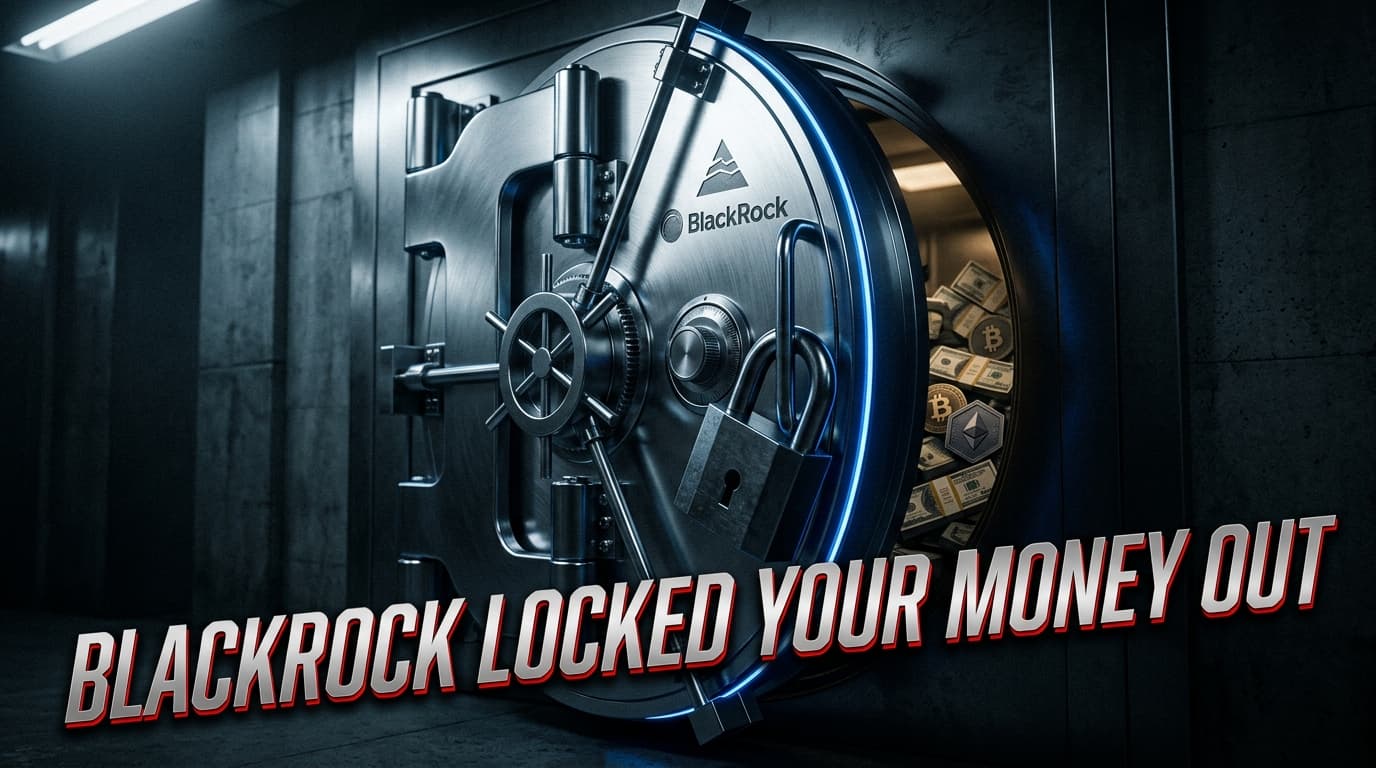

BlackRock Just Locked the Door. Are You Paying Attention?
On March 6, 2026, BlackRock told investors in its $26 billion HPS Corporate Lending Fund that they couldn't have their money back. Not all of it, anyway. Shareholders had requested redemptions on about 9.3% of the fund — roughly $1.2 billion. BlackRock capped repurchases at 5%. That means investors who wanted out got back about $620 million and were told the rest would have to wait. The fund's stock dropped 7.2% the next day, hitting its lowest point since May.
Let that sink in. You put your money into a fund managed by the largest asset manager on the planet — $10 trillion in assets under management — and when you decide you want it back, they say no. Not because you did anything wrong. Because they used your money to make illiquid loans to mid-sized companies that can't be sold quickly, and now there's a line at the door and not enough cash to cover it.
This isn't a glitch. This is the model.
The Structure Was Always the Problem
BlackRock's HLEND fund is what's called a non-traded business development company. It's sold to retail and institutional investors as a way to access private credit returns — the kind of yields you can't get in public markets. Sounds great. The catch is that the underlying assets are long-term, illiquid loans. You can't sell them on a Tuesday because investors got nervous on a Monday. So the fund has quarterly redemption limits built in — 5% per quarter — and this is the first time in the fund's history that investor requests have blown past that cap.
Blackstone is dealing with the same thing right now. Their $82 billion private credit fund just saw record withdrawal requests. They temporarily raised their redemption limit to meet demand rather than cap it, but that's a band-aid on a structural wound. When enough people head for the exit at the same time, the math stops working.
This is the same dynamic that collapsed real estate funds in 2022 and 2023. Blackstone's BREIT fund — a non-traded REIT — was gating redemptions for over a year. BlackRock watched that happen and still built HLEND on the same structural foundation. They're not making a mistake. They're making a choice. The model generates enormous fee revenue when assets are locked up and investors are patient. The problem is that patience runs out.
And here's the part that should make you uncomfortable: while BlackRock is limiting what investors can take out, they're simultaneously building out tokenization infrastructure across their entire operation. They're moving their own assets onto blockchain. They understand exactly where this is going. They're just making sure they get there first, and that your capital funds the journey.
The Banks Are Doing the Same Thing
This isn't just a BlackRock story. Every major bank in the country is running a version of this playbook. You deposit money. They lend it out at multiples. They invest it in instruments that can't be liquidated overnight. The Federal Reserve prints more dollars to paper over the gaps, which inflates away the purchasing power of whatever you do manage to hold onto. The whole system is built on the assumption that not everyone will ask for their money at the same time. When they do — when confidence breaks — the system breaks with it.
We've seen this movie. 2008 was a version of it. The regional bank failures in 2023 were a version of it. What's coming is a bigger version of it, and the warning signs are everywhere. Geopolitical instability. Slowing growth. Loan default risk climbing in the private credit market. Investors rushing for the exits at BlackRock and Blackstone simultaneously. This isn't paranoia. This is pattern recognition.
The Federal Reserve has one real tool: print money and lower rates, or raise rates and watch debt loads become unpayable. There's no clean exit from a decade of near-zero interest rates and balance sheet expansion. Something is going to break. The question is whether you're holding assets that depend on someone else's liquidity when it does.
Why Stablecoins Are a Different Animal
I'm not here to tell you to put everything in crypto. I'm a builder, not a hype man. But I do want to be clear about what a properly structured stablecoin actually is, because the misinformation around this is constant.
A USDC or a USDT backed one-to-one by U.S. Treasury securities is not a speculative asset. It's a dollar. A real dollar, held in reserve, not lent out ten times over, not locked in an illiquid loan to a mid-sized company in Ohio. When you hold USDC, there's a corresponding Treasury bill sitting in a custodial account. You're not trusting a fund manager's liquidity model. You're not trusting a bank's reserve ratio. The backing is there, dollar for dollar.
That's a fundamentally different risk profile than what BlackRock just demonstrated. When you want your money, you can move it. No quarterly caps. No gating mechanisms. No fund manager deciding that your redemption request is inconvenient this quarter.
This is why Fisheez holds transaction funds in USDC on the BASE network through SmartShell Escrow. When a buyer locks funds into a smart contract on our platform, those funds are in USDC — not in a bank's reserve pool, not in a fund with a 5% quarterly redemption cap. The smart contract holds it. The buyer controls the release conditions. There's no Fisheez executive who can decide to gate your funds because we made bad bets with them. We can't. The architecture doesn't allow it.
That's not a feature I built because it sounded good in a pitch deck. I built it because I've watched what happens when you hand your money to an intermediary and trust them to give it back when you need it. Sometimes they do. Sometimes they cap you at 5%.
Pay Attention. The Clock Is Running.
I'm not calling a specific crash date. Anyone who tells you they know exactly when this breaks is selling something. What I am telling you is that the conditions for a serious liquidity crisis are stacking up in plain sight, and the institutions that are supposed to protect your wealth are quietly building their own escape routes while limiting yours.
BlackRock limiting withdrawals while simultaneously tokenizing their own corporate infrastructure is not a coincidence. They know what's coming. They're positioning for a world where blockchain-based assets are the standard — they just want to own that infrastructure, not have you use it independently.
Pay attention to what the banks are doing with your deposits. Pay attention to what the Fed is doing with the money supply. Pay attention to which assets you hold can be accessed when you need them, and which ones have a fund manager standing between you and your cash.
The answer isn't to panic. The answer is to understand the structure of what you're holding — and to stop assuming that the largest institutions in the world have your interests aligned with theirs. BlackRock just proved they don't. The door is open to a different way of holding and moving value. The question is whether you'll walk through it before the next gate comes down.