


The banks told you crypto was dangerous. They said it was for criminals, speculators, and libertarian fantasists who wanted to blow up the global economy. They said the blockchain was a solution looking for a problem. They said trust the institutions.
While they were saying that, they were building the backend to use it against you.
That's not a conspiracy theory. That's what's actually happening, and the people doing it aren't even hiding it anymore. A recent breakdown of public statements from WEF insiders, BlackRock executives, and international banking institutions lays it out plainly: the global financial system is being rebuilt from scratch, on blockchain rails, and ordinary people aren't being invited to the design meeting.
What They're Actually Building
Here's the part that should make your stomach drop. BlackRock, the largest asset manager on earth controlling roughly $10 trillion in assets, has been quietly leading the charge on asset tokenization. That means converting real-world assets (real estate, stocks, bonds, private equity) into digital tokens on a blockchain. That sounds fine in theory. More liquidity, lower friction, faster settlement. Sure.
But pair that with a 'global asset registry', a system to track all individual wealth and assets worldwide, and the picture changes entirely. What you have is not a more efficient market. What you have is a surveillance grid for money. Every asset you own, logged and indexed, visible to whoever controls the registry. The WEF has been talking openly about frameworks that look exactly like this, dressed in the language of 'financial inclusion' and 'systemic transparency.'
Then add CBDCs: Central Bank Digital Currencies, which over 130 countries are now developing or piloting. And not just domestic CBDCs: cross-border settlement systems like Project mBridge are designed to let central banks transact directly with each other, bypassing the current correspondent banking network. The infrastructure for a programmable, trackable, globally coordinated financial system is being assembled in real time. The pieces are almost all in place.
And layer on top of that: digital ID rollouts in country after country, increasingly tethered to financial access. No verified digital ID, no account. No account, no participation in the economy.
If you think those pieces are unconnected, you're not paying attention.
I've Seen What Happens When Platforms Have All the Power
I built a business on Amazon. Eight years. I was the number one brand in my category, ahead of Nike and Under Armour. And Amazon was taking 45 cents out of every dollar I made: FBA fees, advertising, the 15% category cut. In 2020, they changed one thing in their app, and I lost 40% of my revenue overnight. No warning. No recourse. No appeal that mattered. They changed the rules because they could, and I had nowhere to go.
I also spent the better part of a decade in a patent battle against two of the largest internet companies in the world over technology that generated over a billion dollars for someone else. The courts didn't rule in our favor. The system worked exactly the way it was designed to work, for the people with the leverage.
So when someone tells me that centralized institutions are building a new financial architecture and it's definitely for your benefit, I've heard that pitch before. I know how it ends.
The same dynamic that let Amazon take 45% of every seller's revenue, the same dynamic that let big tech swallow a patent and face no real consequence: that's the dynamic being built into the global financial system right now, but with state power behind it and no exits available. A programmable CBDC can have spending rules encoded directly into the currency. An unrealized capital gains tax, something now seriously discussed in multiple countries, can be triggered algorithmically the moment your tokenized assets appreciate. A digital ID tied to your financial account can be suspended. And if everything you own is on a global registry, they always know exactly what you have.
The goal isn't efficiency. The goal is control.
The Response That Actually Makes Sense
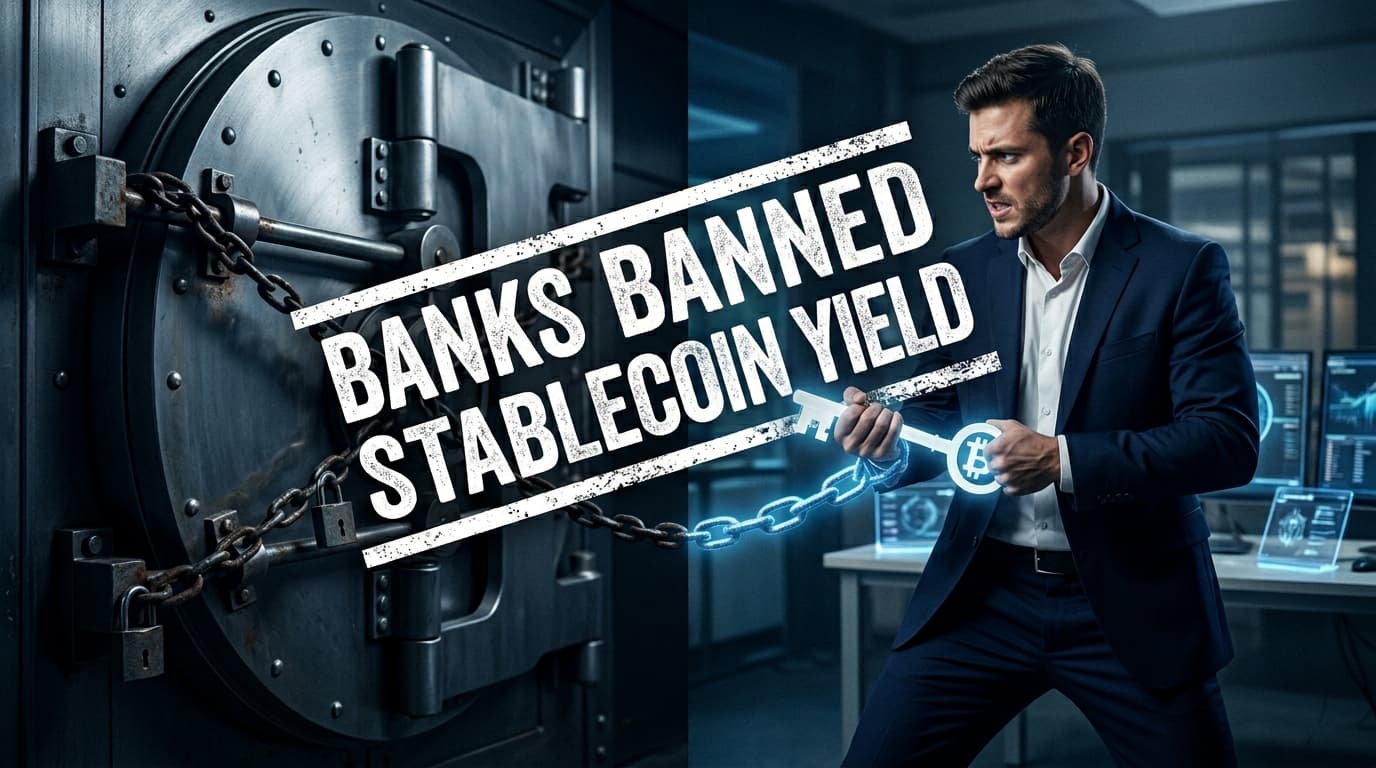
Bitcoin is the only asset in this picture that doesn't have a CEO, a board, or a government that can change its rules overnight. I'm not a Bitcoin maximalist. I use stablecoins on BASE to run Fisheez because they solve a real problem for buyers and sellers right now. But Bitcoin as a store of value outside the system? That argument has never been stronger. The legislative battles currently happening around stablecoins are happening precisely because the banks want to control the on-ramps and off-ramps. They want programmable money; they just want to be the ones who program it.
Self-custody matters. If your Bitcoin is on an exchange, it's not your Bitcoin. It's an IOU from a company operating under a license that can be revoked. Hardware wallets exist. Use them. The point of decentralization is that there's no single throat to choke, but that only protects you if you actually hold your own keys.
Physical gold and silver are not a meme. They're the oldest hedge against exactly this kind of state overreach. They can't be tokenized without your consent. They can't be programmed. They don't require a digital ID to hold.
And for commerce, for buying and selling between people, the answer is platforms that don't sit between you and your money. Fisheez runs on smart contracts. When a buyer pays, the funds lock in a USDC escrow on the BASE network. No bank holds it. No platform can freeze it mid-transaction. The smart contract executes based on conditions both parties agreed to. That's not a pitch; that's just what the technology actually does when you build it right instead of building another rent-extraction machine. The way Fisheez escrow works is the opposite of what the global asset registry crowd is building: transparency for the people in the transaction, not for the people watching from above.
The Window Is Closing
I don't know exactly when this flips from 'being built' to 'fully operational.' Neither does anyone else. The timeline speculation in these conversations is always the weakest part. But the infrastructure is not speculation. Project mBridge is real. BlackRock's tokenization funds are real. The CBDC pilots are real. The digital ID legislation is real. These aren't fringe predictions; they're documented initiatives from the most powerful financial institutions on earth.
The version of crypto the banks wanted you to be afraid of was decentralized, ungovernable, and accountable to no one above you. That was the threat. Now they've built their own version: centralized, programmable, surveilled, and they're calling it innovation.
You were warned off the tools that could protect you right up until the moment the people warning you finished building their own version of those same tools. That's not a coincidence.
Get your assets into things you control. Learn how self-custody works. Pay attention to what's happening with stablecoin legislation and CBDC development, because the rules of money are being rewritten right now, and the comment period is closing fast. The people building this system are counting on you staying confused, staying skeptical of the alternatives, and staying inside their perimeter.
Don't.