

The $503 Billion Remodeling Market Has a Payment Problem That Blockchain Is About to Fix
The U.S. home remodeling market hit $503 billion in 2024, and analysts at the National Association of Home Builders project another 3% inflation-adjusted expansion in 2026 with an additional 2% the year after. Basement conversions, whole-house remodels, and major system replacements are driving much of that volume. The homeowners commissioning this work are spending real money, often $15,000 to $50,000 on a single project, and they are doing it through a payment system that has not changed meaningfully in decades: wire the deposit, hope the contractor shows up, argue about change orders, and pray the final check lands in the right hands.
That system is cracking. And on-chain contractor payments are positioned to replace it faster than most homeowners realize.
Why Basement Remodels Are the Perfect Test Case
Basement renovations check every box that makes a construction project structurally difficult to pay for. They tend to run long, often eight to fourteen weeks. They split easily into discrete phases: framing, electrical rough-in, insulation, drywall, finish work. They involve multiple subcontractors who each expect payment on different schedules. And they regularly land in the $10,000 to $20,000 range per phase, which is exactly the deal size where traditional escrow from a title company is too expensive to bother with but the exposure is still large enough to sting badly if something goes wrong.
The contractor fraud picture makes this worse. Industry estimates suggest approximately 10% of contractors engage in unethical billing practices, and the pattern is consistent: a large upfront deposit, a slowdown after the first milestone, a dispute over materials costs, and a homeowner holding an unfinished basement and a drained checking account. Post-disaster fraud alone accounts for $9.2 to $9.3 billion in annual losses in the U.S., and standard home improvement projects produce their own quiet toll that never makes headlines but shows up constantly in FTC complaints and state licensing board filings.
This is the problem that blockchain-based payment rails are built to solve.
Smart Contracts and the Milestone Model
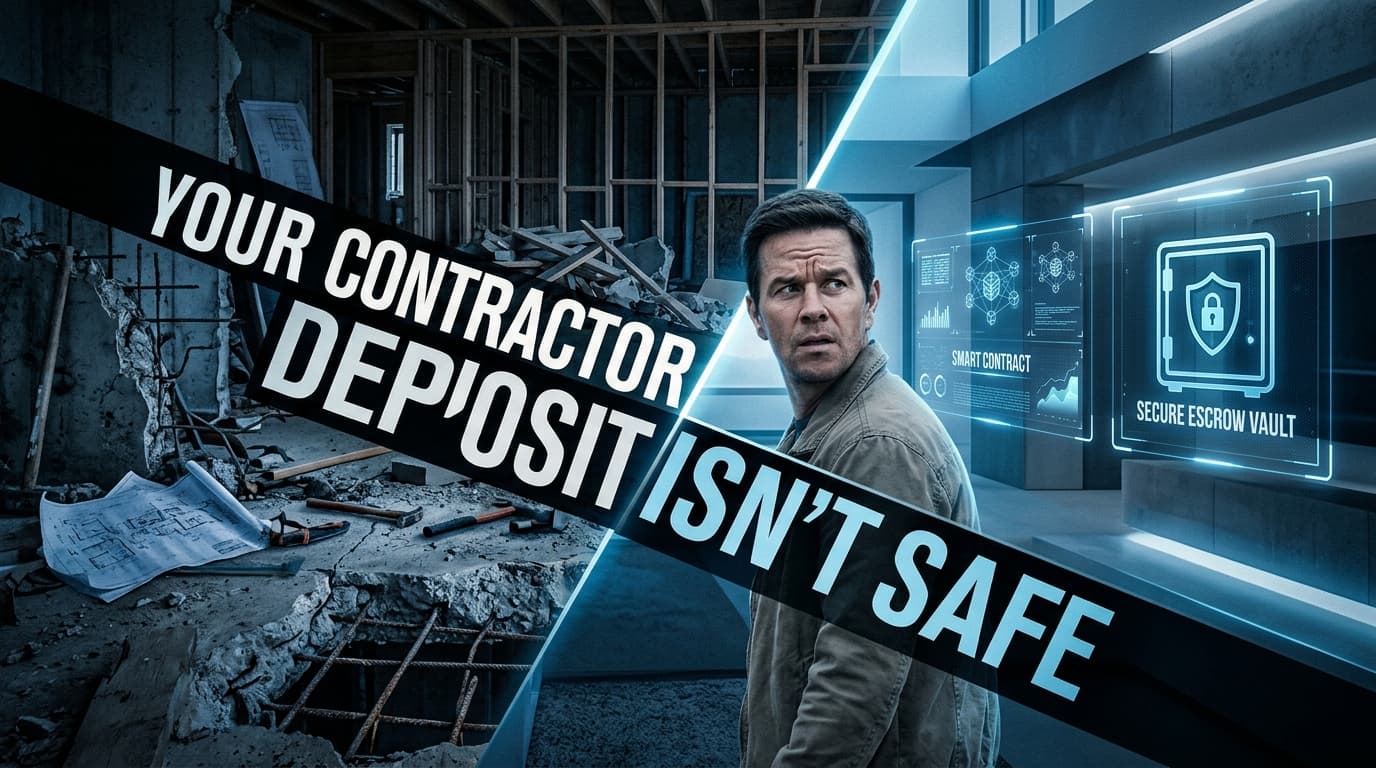
Smart contract escrow works like this: a buyer deposits funds into a blockchain-based contract before work begins. The contract holds those funds in a stablecoin, typically USDC, and releases them only when predefined conditions are satisfied. For a basement remodel, those conditions map cleanly to project milestones. Frame inspection passes, first tranche releases. Electrical rough-in signs off, second tranche releases. No milestone, no money.
The smart contract market is growing from $2.14 billion in 2024 to a projected $12.07 billion by 2032. The construction sector is contributing to that growth because the problem fit is so direct. Research presented at the Construction Blockchain Consortium in late 2025 noted that payment automation through smart contracts addresses one of the industry's most entrenched problems: late and disputed payments between general contractors and subcontractors. When the release logic lives in code rather than in a payment schedule someone typed into a Word document, the ambiguity that generates most disputes disappears.
Milestone-based smart escrow also eliminates entire categories of fraud. The deposit-and-disappear scheme that accounts for a large share of contractor complaints cannot work when funds are locked in a contract that will not release them until an agreed condition is verified. This is not a marginal improvement. It is a structural change to who controls the money during a project.
BASE Network Growth and the Infrastructure Behind It
On-chain contractor payments at the scale the remodeling market requires need a network that can handle volume without punishing users on gas fees. Ethereum's base layer cannot do that. Layer-2 networks can, and BASE is emerging as the infrastructure most likely to host real-economy transactions at homeowner scale.
BASE surpassed Arbitrum One in DeFi TVL in January 2025 and currently holds 46% of the entire L2 market. USDC, the stablecoin of choice for real-money transactions, averaged 83,400 daily active users on BASE in November 2025, a 233% increase from the same period the year before. Transaction costs on BASE are measured in cents. Coinbase, which incubated BASE and has committed to making stablecoins and the network a central part of its 2026 strategy, has the distribution and the regulatory standing to bring this infrastructure to mainstream users who have never opened a crypto wallet in their lives.
The practical result is that a $15,000 basement remodel can now be structured as a series of on-chain contractor payments with milestone-triggered releases, settled in USDC, at a fraction of the cost of traditional escrow. A conventional escrow service for a $250,000 home purchase runs $2,500 to $5,000. Smart contract settlement for the same transaction runs a few dollars. For a $15,000 project, that difference is the entire margin.
Platforms Moving Into the Space
The real-economy application of smart escrow for services is moving from concept to live infrastructure. Platforms operating on BASE are already enabling peer-to-peer transactions for goods and services where funds lock at payment, release on completion, and dispute outcomes are enforced by the contract logic rather than by whoever has a better lawyer. Fisheez, a peer-to-peer marketplace built on BASE, uses milestone-capable smart contracts that hold USDC until both parties confirm the deal is complete, an architecture directly applicable to phased construction payments.
Beyond individual platforms, the broader B2B and marketplace sector is moving toward smart escrow as standard infrastructure. The B2B marketplace sector is growing at a 19.2% CAGR through 2033, and early adopters who wire smart escrow into their payment rails are gaining durable advantages over competitors still pushing ACH.
What Homeowners Should Do Right Now
The shift toward on-chain contractor payments in home improvement is not yet universal. Most general contractors still operate on handshake deposits and paper draw schedules. But the window to get ahead of this curve is open, and the preparation is practical rather than technical.
Start by vetting contractors on their willingness to work within structured payment terms. Any legitimate contractor should be comfortable with milestone-based payment releases because their incentives align with it: they get paid faster when milestones are verified, and disputes over scope are reduced because the release conditions were agreed in writing before work started. A contractor who pushes back hard on milestone payments is, statistically, more likely to be one of the 10% whose practices create problems.
Second, understand the stablecoin layer. Payments in this model settle in USDC. That means you need to know how to convert dollars to USDC and back again before your project starts, not in the middle of a dispute over whether the framing passed inspection. The conversions are straightforward and Coinbase provides direct fiat on-ramps, but the learning curve is real and it should not happen under pressure.
Third, look at the network. BASE's 2026 growth trajectory, combined with Coinbase's institutional push toward stablecoin infrastructure, means the tooling available in twelve months will be materially better than what exists today. Projects starting in late 2026 will have access to more mature contract templates, greater contractor familiarity with the process, and lower friction at every step.
The Industry Shift That Matters
Home remodeling has historically been one of the sectors most resistant to financial innovation. Payments are informal, trust is personal, and the industry's fragmentation makes it hard to push change from the top down. Blockchain changes that calculus because it does not require industry-wide coordination. It requires two parties, a willing contractor and a homeowner who understands the tools, and a shared willingness to move the money on-chain.
The $503 billion remodeling market will not tokenize overnight. But basement remodels, with their natural milestone structure and their $10,000 to $20,000 phase deals, are precisely the contracts where the economics of on-chain contractor payments tip decisively in favor of the new model. The homeowners who vet contractors now, learn the stablecoin rails, and structure their next major project around milestone-triggered escrow will not just protect themselves from fraud. They will be participating in the earliest stage of a structural shift in how construction work gets paid for in the United States.