

Base Ditches Optimism: The 2026 Layer 2 Shakeup Explained
You've probably felt that nagging uncertainty when you bridge assets to a Layer 2 network. Maybe it was waiting minutes—or hours—for your funds to show up, watching transaction fees spike unexpectedly, or wondering if the chain you chose today will still be the right one tomorrow. For the last few years, Base running on Optimism's OP Stack has been the go-to for many, but that fragmented tech stack meant every transaction carried that subtle background anxiety about reliability.
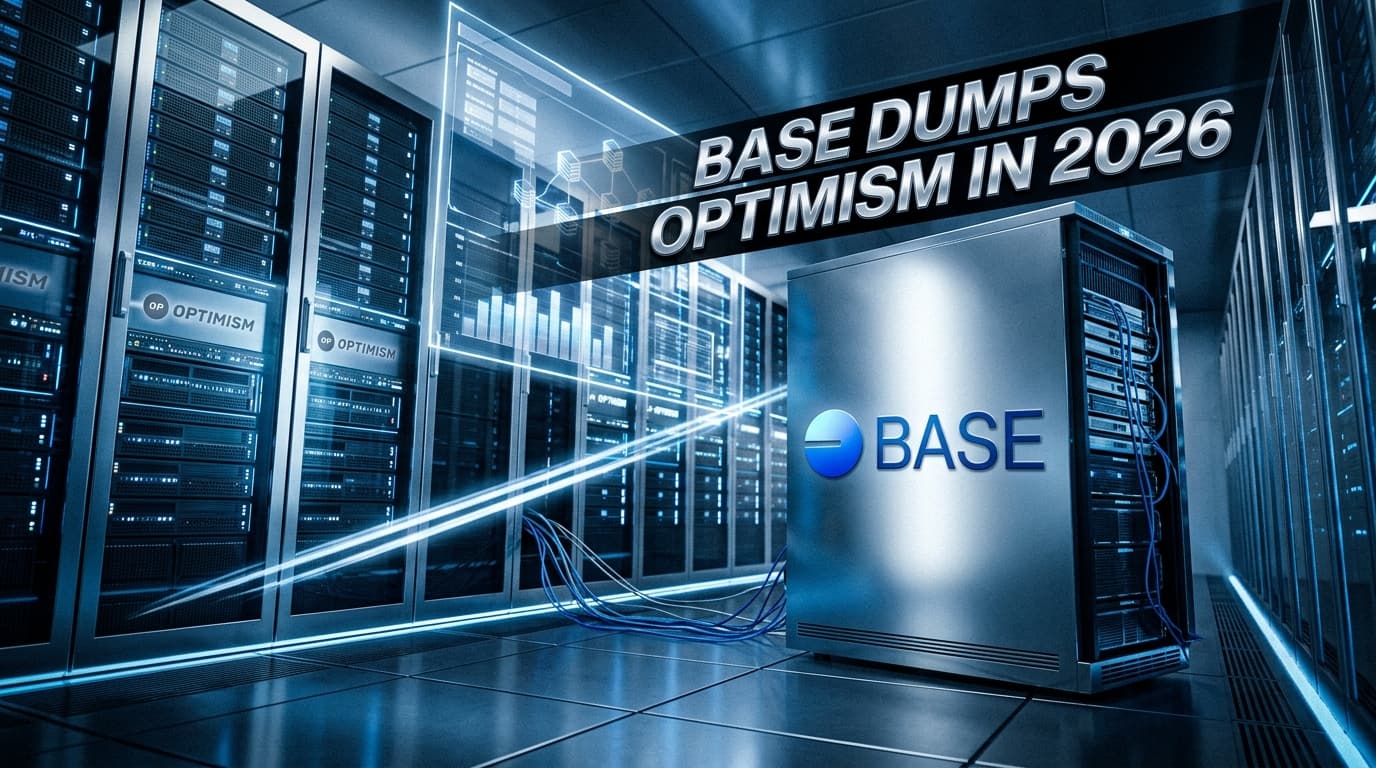
Then in early 2026, Base made the announcement that changed everything: they're ditching Optimism's OP Stack entirely for their own unified, Base-operated solution. This isn't just another protocol upgrade—it's a fundamental rethinking of how Ethereum scaling should work when real people's money and transactions are on the line. The fragmented approach where Layer 2s borrowed tech from different sources is giving way to a cohesive, purpose-built architecture designed from the ground up for stability and speed.
By the end of this article, you'll understand exactly why Base made this pivotal move, what the unified stack means for your transactions and assets, and how this positions Base to dominate the Layer 2 landscape for years to come. We'll break down the technical implications in plain English, explore what this means for developers building on Base, and show you why this change matters whether you're a casual user or a serious builder.
The Announcement: Base's Shift to a Unified Stack
The official Base blog post dropped in February 2026 with a straightforward title that belied its seismic impact: "Consolidating Our Tech Stack." Inside, Base's engineering team detailed their plan to migrate away from the patchwork of dependencies that had powered the network since its inception. Instead of pulling code from Optimism's OP Stack, Flashbots' MEV solutions, and Paradigm's client implementations, everything would be consolidated into a single, cohesive repository called base/base. This wasn't just a rebranding exercise—it was a declaration of technological independence designed to streamline every aspect of the network's operation.
Think about what that consolidation actually means for developers and users. When Base relied on Optimism's OP Stack, every bug fix, every performance tweak, every security patch had to be coordinated across separate teams with potentially different priorities. Now, with the unified stack, Base controls the entire pipeline from sequencer to prover to bridge. According to The Block's coverage, this move is expected to reduce latency, improve finality times, and give Base's team full autonomy to implement optimizations without waiting for external code merges.
What's particularly interesting is how Base has approached compatibility. They're not building a closed garden—the unified stack remains open-source and maintains interoperability with Ethereum's broader ecosystem. But by consolidating their dependencies, they're eliminating the friction points that could slow down innovation. CoinDesk reported that this shift was driven by Base's explosive growth in 2025, which revealed scaling bottlenecks that couldn't be addressed quickly enough through the old fragmented model. When you're handling billions in transaction volume, every second of latency costs real user experience.
Why Base is Breaking Away from OP Stack
The move away from OP Stack isn't just about technological preference—it's about survival in the rapidly evolving Layer 2 space. Base's engineering team realized that relying on external dependencies was creating bottlenecks that threatened their competitive edge. When Optimism pushed an update that worked for their use cases but created issues for Base's specific transaction patterns, Base developers had to either wait for fixes or build complex workarounds. That lag meant slower innovation and compromised user experience at a time when every other L2 was racing to reduce fees and improve speed.
Maintenance complexity was another critical factor. Managing dependencies across Optimism's OP Stack, Flashbots' MEV solutions, and Paradigm's client implementations meant that security audits had to cover multiple codebases, each with its own update schedule. Every time one component needed a patch, it had to be tested against all the others, creating a combinatorial explosion of potential failure points. Base's unified stack simplifies this dramatically—one codebase means one set of security tests, one deployment pipeline, and one team responsible for the entire stack's stability.
The new architecture also enables a much faster innovation cycle. Base's engineers can now push upgrades tailored specifically to their network's needs—they're talking about up to six protocol upgrades per year, compared to the two or three they could manage under the old system. This agility matters because it lets them respond to emerging threats like new MEV attack vectors within weeks rather than months. According to Coinbase's 2026 crypto market outlook, scalability and security improvements are the key differentiators that will separate the L2 winners from the also-rans in the coming years. Base's unified stack positions them perfectly for that competition.
Base's 2026 Dominance: Leading L2 in TVL and Users
The numbers don't lie—Base isn't just making moves technically, they're dominating the Layer 2 ecosystem where it matters most: real user adoption and locked value. By early 2026, Base had surged past $5.6 billion in total value locked (TVL), capturing a staggering 46% of all DeFi assets across Layer 2 networks. That's not just growth—that's market leadership on a scale that makes other L2s look like niche experiments. When you see that kind of concentration, it tells you that developers and users are voting with their funds, choosing the network they believe offers the best combination of security, speed, and reliability.
What's driving this dominance? It's not just speculation. Base has become the go-to network for real-world applications that need both scale and Ethereum's security guarantees. Daily active users consistently top 900,000—people aren't just bridging in to check gas prices, they're actively using decentralized exchanges, NFT platforms, and increasingly, peer-to-peer marketplaces that require predictable transaction outcomes. According to The Block's 2026 Layer 2 outlook, Base now processes more than 40% of all L2 DEX volume, surpassing even Optimism and Arbitrum in key metrics that measure actual economic activity rather than just token transfers.
This growth creates a powerful network effect that feeds on itself. More TVL attracts better developers building more sophisticated applications, which in turn attracts more users who bring more value. Base's unified stack gives them the technical foundation to scale this ecosystem sustainably—they can optimize their architecture specifically for the transaction patterns emerging from their actual user base rather than trying to fit into someone else's framework. That's why you're seeing everything from high-frequency trading protocols to escrow-protected marketplaces choosing Base as their home: they trust the infrastructure won't buckle under pressure.
What Changes for Developers and Users on Base
If you're building or using applications on Base right now, here's what the unified stack means for you in practical terms. First, compatibility remains paramount—existing smart contracts will continue working without modification, and user wallets won't need any updates to interact with the network. The upgrade to the new stack happens at the infrastructure layer, not the application layer, so from your perspective as a user, transactions should feel faster and more predictable without requiring you to change anything about how you use Base today.
For developers, the biggest immediate change is documentation and tooling consolidation. Instead of navigating separate docs for Optimism's OP Stack, Flashbots' MEV-Boost, and Paradigm's Reth client, everything will be consolidated into Base's own developer portal with unified APIs and a single SDK. Node operators will need to migrate to the new client software, but Base has promised a smooth transition path with backward compatibility for several months. The real advantage comes from being able to file bugs and request features directly to the team that controls the entire stack, rather than hoping your issue gets prioritized by an external dependency.
Looking ahead, Base has outlined an aggressive roadmap with planned hardforks labeled V1 through V3. The first major upgrade, codenamed "Fusaka," focuses on MEV protection improvements and sequencer optimization. Future forks will introduce more sophisticated ZK/TEE proof systems that could dramatically reduce withdrawal times while maintaining security. These upgrades are now possible because Base controls its entire stack—they're not waiting for other projects to implement features they need. For applications that depend on predictable transaction outcomes, like escrow-protected marketplaces or DeFi protocols, this control over the roadmap means they can build with confidence that Base will evolve to meet their needs.
Why Base's Evolution Powers Safer P2P Trades in 2026
This technical evolution isn't just academic—it directly translates to better, safer peer-to-peer transactions for everything from used cars to freelance services. When you're trading high-value goods or hiring someone for a complex project, you need predictable transaction costs and guaranteed execution. Base's unified stack delivers exactly that by eliminating the fragmentation that could cause unexpected fees or delayed settlements at critical moments. The MEV protection improvements in the upcoming "Fusaka" hardfork, for instance, mean your escrow transaction for a $15,000 car won't be front-run by sophisticated bots trying to extract value from the timing.
Consider how this works practically: you set up a smart contract escrow on Base using USDC, with money locked until delivery or an agreed timer expires. With the unified stack's optimizations, that transaction settles in seconds with fees measured in pennies rather than dollars, and there's no risk of it getting stuck because of congestion from other Layer 2s sharing the same infrastructure. Faster finality times mean both buyers and sellers see confirmation immediately, reducing anxiety during high-stakes trades.
This reliability matters most for applications that have to work every time, like the SmartShell Escrow systems that protect both goods and services transactions. When the underlying network can upgrade rapidly to address emerging threats, the applications built on top can offer better guarantees. Base's control over its entire stack means they prioritize improvements that matter most for real-world commerce—transaction speed, cost predictability, and security against manipulation. That's why platforms designed for peer-to-peer trading bet on Base: they know the infrastructure will evolve to support users rather than leaving them vulnerable to someone else's roadmap.