
$150, a Stranger, and a Smart Contract: Your First BASE Escrow Buy
You found a listing for a premium oil filter kit at $150. The seller is someone you have never met, the platform is blockchain-based, and you are about to send real money. If that scenario sounds like a recipe for getting burned, it used to be. Today, the math is different.
The stablecoin market crossed $246 billion in 2025, and a growing slice of those dollars is moving through peer-to-peer transactions on layer-2 networks like BASE, Coinbase's Ethereum-compatible chain. Gas fees on BASE run $0.05 to $0.15 per transaction compared to $5 to $50 on Ethereum mainnet, which makes small-ticket purchases like auto parts and accessories genuinely viable for the first time. But raw speed and low fees only solve part of the problem. The other part is trust, and that is exactly what BASE escrow is built to address.
What BASE Actually Is
BASE is a layer-2 blockchain built by Coinbase on top of Ethereum. It inherits Ethereum's security while offloading computation to a faster, cheaper layer. The network launched in August 2023 and had accumulated over $2.8 billion in total value locked by early 2026. It runs standard Ethereum-compatible smart contracts, which means developers can deploy escrow logic that executes automatically without relying on a centralized server or a company's promise to play fair.
For a DIY mechanic buying auto parts from a peer, that technical infrastructure translates into one practical outcome: the money you send is locked by code, not held by a business that could disappear tomorrow.
Getting USDC Into Your Wallet
Most peer-to-peer marketplaces using smart contract escrow on BASE settle in USDC, a dollar-pegged stablecoin with a market cap north of $40 billion. The 1:1 peg means your $150 filter kit costs exactly 150 USDC, with no exchange-rate math required.
Here is the fastest path for a first-time buyer:
Step 1: Create a Coinbase account. Coinbase is the most straightforward onramp because it natively bridges USDC to BASE. Verify your identity and connect a bank account or debit card.
Step 2: Buy USDC. In the Coinbase interface, select USDC and enter your purchase amount. Coinbase tracks all USDC versions internally and routes funds to whichever chain you specify.
Step 3: Select BASE as your network. When withdrawing or sending USDC, choose BASE as the destination network. Sending USDC to the wrong chain can result in permanent loss, so double-check the network selection before confirming.
Step 4: Connect a self-custody wallet (optional but recommended). MetaMask and Coinbase Wallet both support BASE. A self-custody wallet puts you in direct control of your funds rather than relying on an exchange's custodial account. For peer-to-peer purchases, many platforms require a connected wallet address.
Security fundamentals apply here: write your seed phrase on paper and store it offline. Anyone with your seed phrase controls your funds permanently.
How BASE Escrow Actually Works
Traditional escrow relies on a third party, usually an attorney or an escrow company, to hold funds. That process takes three to seven days and typically costs one to three percent of the transaction value. Smart contract escrow on BASE compresses that to seconds and a fraction of a cent in gas.
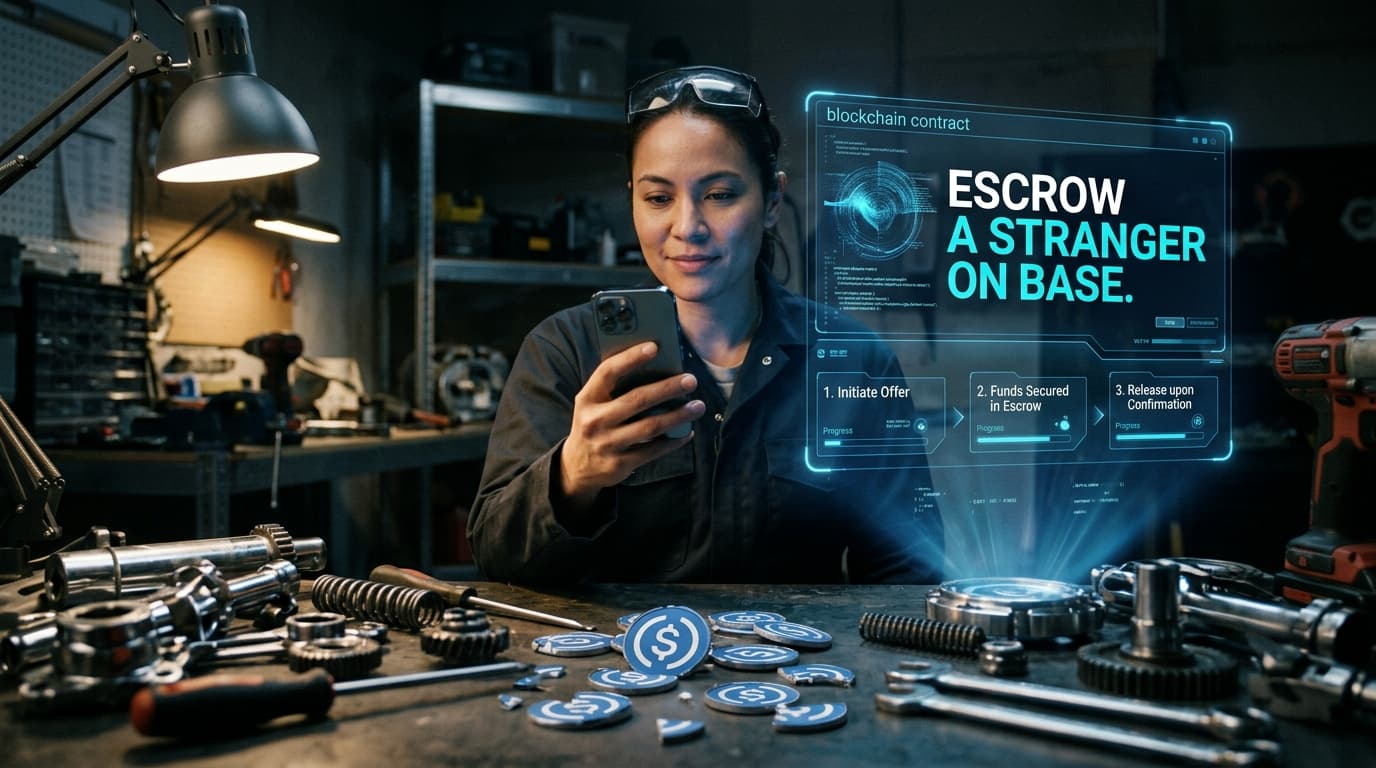
The mechanics follow a four-step pattern that is consistent across most platforms:
- Contract creation. The buyer and seller agree to terms. A smart contract is deployed (or an existing one is invoked) encoding the release conditions.
- Fund locking. The buyer deposits USDC into the contract address. The funds are now held by code on-chain, visible to both parties and verifiable by anyone.
- Condition verification. The seller ships the filter kit and provides delivery confirmation. Depending on the platform, this can be a timer, a buyer confirmation click, or an outcome from a dispute process.
- Automated release. Once conditions are met, the contract releases USDC to the seller instantly. No manual approval, no waiting for a bank to process a wire.
The on-chain record is permanent. Every condition, confirmation, and fund movement is logged to the blockchain, creating an auditable trail neither party can alter retroactively.
Walking Through a $150 Auto Parts Purchase
Say you are buying a performance air filter kit from a private seller. The listed price is $150 USDC. Here is how the transaction flows in practice:
You browse the listing and initiate the purchase. The platform creates or invokes a BASE escrow contract and prompts you to send 150 USDC plus any applicable buyer fee. On platforms like Fisheez, which operates on BASE, the buyer pays a tiered service fee while sellers pay nothing, and funds lock in a smart contract the moment your payment confirms.
Your USDC sits in the contract, visible on-chain, while the seller ships the filter. Once the delivery window closes or you confirm receipt, the contract releases funds to the seller automatically. If something goes wrong, the dispute process uses the on-chain record as evidence rather than relying on screenshots or email chains.
The total gas cost for this interaction on BASE is measured in cents, not dollars. For a $150 transaction, that is materially different from legacy payment processors that charge two to three percent plus a flat fee.
Why Stablecoin P2P Commerce Is Growing
The automotive blockchain market stood at $842 million in 2024 and is projected to grow at a 29.2% compound annual rate through 2034, reaching $10.9 billion. A significant driver is exactly this use case: parts sourcing and accessories changing hands between individuals who have no prior relationship and no institutional intermediary they both trust.
The GENIUS Act, passed in July 2025, provided federal regulatory clarity for US stablecoins for the first time, which reduced legal ambiguity for buyers and sellers transacting in USDC. That regulatory tailwind, combined with BASE's low transaction costs, is drawing peer-to-peer commerce on-chain in categories where it previously made no economic sense.
For the DIY mechanic who knows exactly which filter fits a 2019 F-150 but cannot find it on a mainstream retailer at a fair price, blockchain-native marketplaces now offer a credible alternative: deal with a peer, let the smart contract carry the trust, and pay cents in gas rather than percentage-point fees to a payment processor.
What to Do Before Your First Transaction
A few practical steps before you commit $150 to your first on-chain escrow purchase: verify the platform's smart contract has been audited by a recognized security firm; check on-chain activity to confirm the contract address has a track record of successful releases; start with a smaller test transaction if the platform allows it; and confirm the dispute resolution process before funding the escrow.
Smart contract escrow eliminates the need to trust a stranger. It does not eliminate the need to trust the platform deploying the contract. That distinction matters, and spending ten minutes on due diligence before your first purchase is the only variable you control entirely.
The technology is ready. BASE escrow is handling billions in transaction volume across DeFi and commerce applications. The $150 auto parts buy is no longer a leap of faith, it is a contract.