
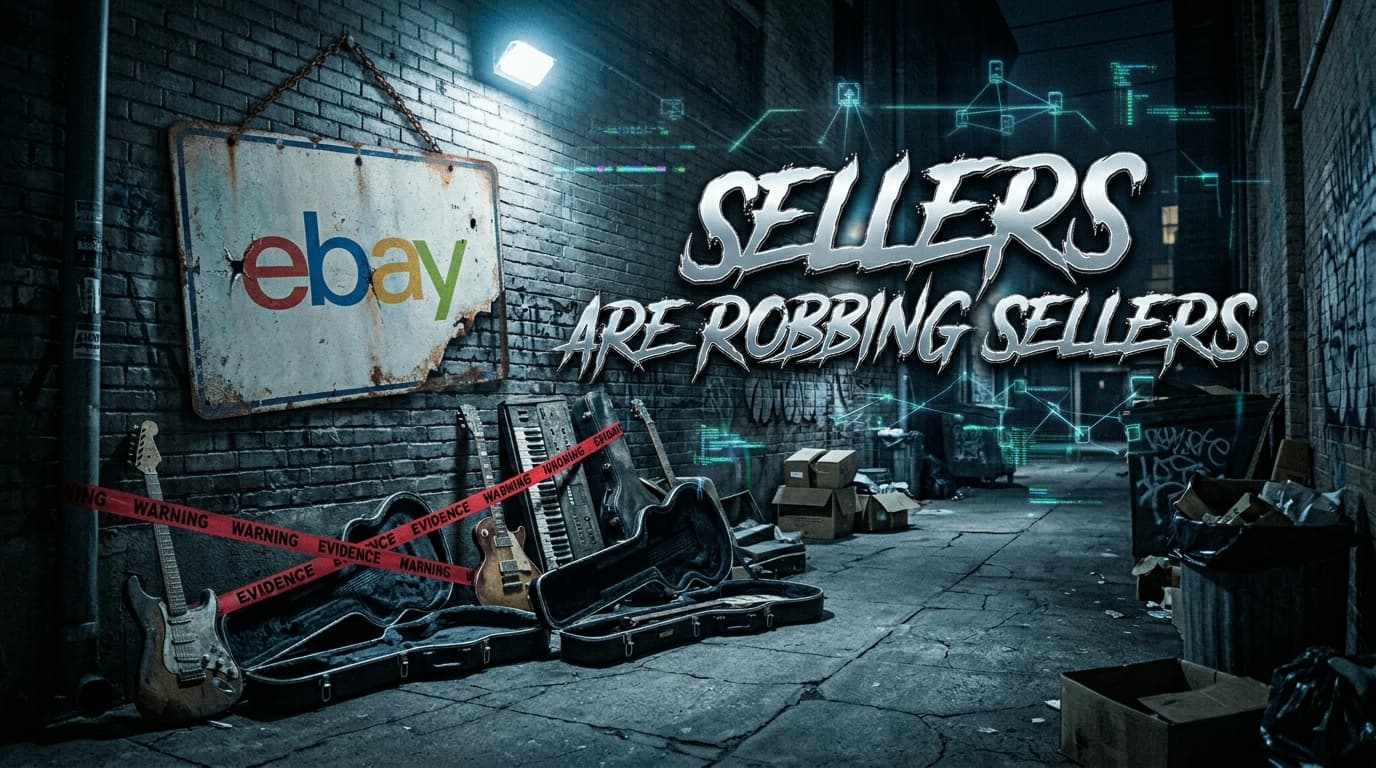

$42 Billion in Fraud Says the Auction Model Is Broken
Payment fraud reached $42 billion globally in 2025. That number is not abstract. For musicians, it lands every time a $3,000 keyboard walks out the door after a wire transfer that reverses three days later, or when a buyer "never receives" an instrument that tracking shows was delivered. The auction model, built for fast throughput and thin margins, was never designed to carry the weight of high-value peer-to-peer instrument sales. Smart contract escrow was.
The smart contracts market was valued at $2.02 billion in 2024 and is projected to hit $3.69 billion in 2025, a CAGR that outpaces virtually every traditional fintech segment. Buried inside that growth is a very specific use case: locking buyer funds on-chain until a transaction is actually complete. For anyone who has sold a synth on eBay or chased a buyer through Reverb's dispute process, the appeal is immediate.
What You Are Actually Paying on Reverb and eBay
Before you can argue for a better system, you need to know what the current one costs. On Reverb, sellers pay a 3.5% selling fee plus a payment processing charge of roughly 2.7%, landing total seller costs at around 7.7% of the sale price. On eBay, outside of the guitars-and-basses carve-out at 3.5%, the standard final value fee runs 10%, plus PayPal or managed payments processing at 2.9% plus $0.30. Combined fees of 12 to 13% are common.
On a $3,000 keyboard, that is $360 to $390 leaving your pocket before you account for shipping, packaging, or the time you spend on dispute correspondence. That fee does not buy you protection. It buys you listing visibility and a dispute process that, by multiple seller accounts, tends to favor buyers regardless of documentation. One seller on a gear forum described a buyer falsely claiming defects, forcing a return within 24 hours with, in their words, "no recourse," despite having video proof of the instrument's condition at the time of shipment.
The auction format compounds this. When you sell on a time-limited bid, you lose pricing power. You also lose the ability to vet who is actually buying. And because the platform owns the transaction rails, a dispute resolution outcome is entirely at the platform's discretion.
How Smart Contract Escrow Changes the Equation
Smart contract escrow works by locking buyer funds in a blockchain-based contract at the moment of purchase. The funds do not move until specific conditions are met: the buyer confirms receipt, a timer expires, or a dispute is resolved. No platform can redirect those funds. No wire can reverse. The contract logic is public and auditable.
Research on smart contract-based marketplace systems has shown up to a 70% reduction in fraud cases compared to traditional marketplace infrastructure. Settlement time collapses from three to five business days to near-instant. And critically for sellers, the buyer's funds are confirmed to exist before any instrument ships. You are not racing against a chargeback window.
Platforms using smart escrow infrastructure processed $5.7 billion in 2025, with transaction costs on-chain running under 0.1% compared to the 1 to 3% traditional escrow services charge. For a $3,000 keyboard, that difference in infrastructure cost alone is material, and it flows through to fee structures that actually favor the seller.
The BASE Network's Role in Making This Practical
Theoretical blockchain advantages have existed for years. What changed is that low-cost, high-throughput Layer-2 networks made them economically viable for everyday transactions. BASE, Coinbase's Ethereum Layer-2, generated $75.4 million in revenue in 2025, representing 62% of total L2 revenue and surpassing Arbitrum One in transaction volume. Its DeFi TVL sits at $4.63 billion, accounting for 46% of the entire L2 market.
Those are infrastructure numbers that matter for musicians. A network with that level of economic activity has the liquidity, developer tooling, and institutional backing to support commerce applications at scale. Stablecoins, particularly USDC, settle instantly on BASE without the volatility risk that made earlier crypto payments impractical for instrument sales. Coinbase has explicitly positioned BASE and stablecoins as the core of its 2026 strategy, targeting consumer applications that go well beyond DeFi speculation.
Fisheez, a peer-to-peer marketplace built on BASE, has implemented this model for goods and services transactions. Its SmartShell Escrow holds buyer funds in USDC until the deal closes, with disputes handled by trained community Peacemakers rather than a platform algorithm. Sellers pay no listing or transaction fees. The buyer-side fee structure is tiered, dropping to fractions of a percent on higher-value sales.
Why Auction Platforms Cannot Catch Up Structurally
The deeper issue with auction platforms is not fees or fraud in isolation. It is architecture. eBay and Reverb are custodial systems. They hold the transaction relationship and the dispute authority. Every seller protection they offer is a policy, not a protocol. Policies change, usually in response to buyer pressure or regulatory scrutiny, and sellers have no leverage when they do.
After Etsy acquired Reverb, users began reporting increased platform surveillance of messages to detect off-platform sales, with account penalties following. Musicians selling on Reverb now operate under terms that can shift without meaningful notice. This is the inherent vulnerability of centralized marketplace models: the rules are owned by the platform.
Smart contract escrow inverts this. The rules are in the contract. A seller listing a $3,000 stage piano on a blockchain-native marketplace knows, at the protocol level, that buyer funds are locked, that the release condition is transparent, and that no platform policy update can retroactively change the terms of a specific deal. That is not a marketing claim. It is a property of how the code executes.
What This Means for the Instrument Market
The growth of on-chain commerce infrastructure is not a niche development. The smart contracts market is projected to reach $815 billion by 2034, driven by adoption across insurance, trade finance, and peer-to-peer commerce. For musicians, the practical question is not whether blockchain-based sales will become mainstream. It is whether you want to be selling on platforms built for the old model when the new one is already operational.
A $42 billion fraud problem does not get solved by better dispute forms. It gets solved by removing the conditions that make fraud structurally possible: unconfirmed funds, reversible payments, and opaque platform authority over outcomes. Smart contract escrow addresses all three at the protocol level. For high-value instrument transactions, that is not a feature. It is the prerequisite for a market that works.