
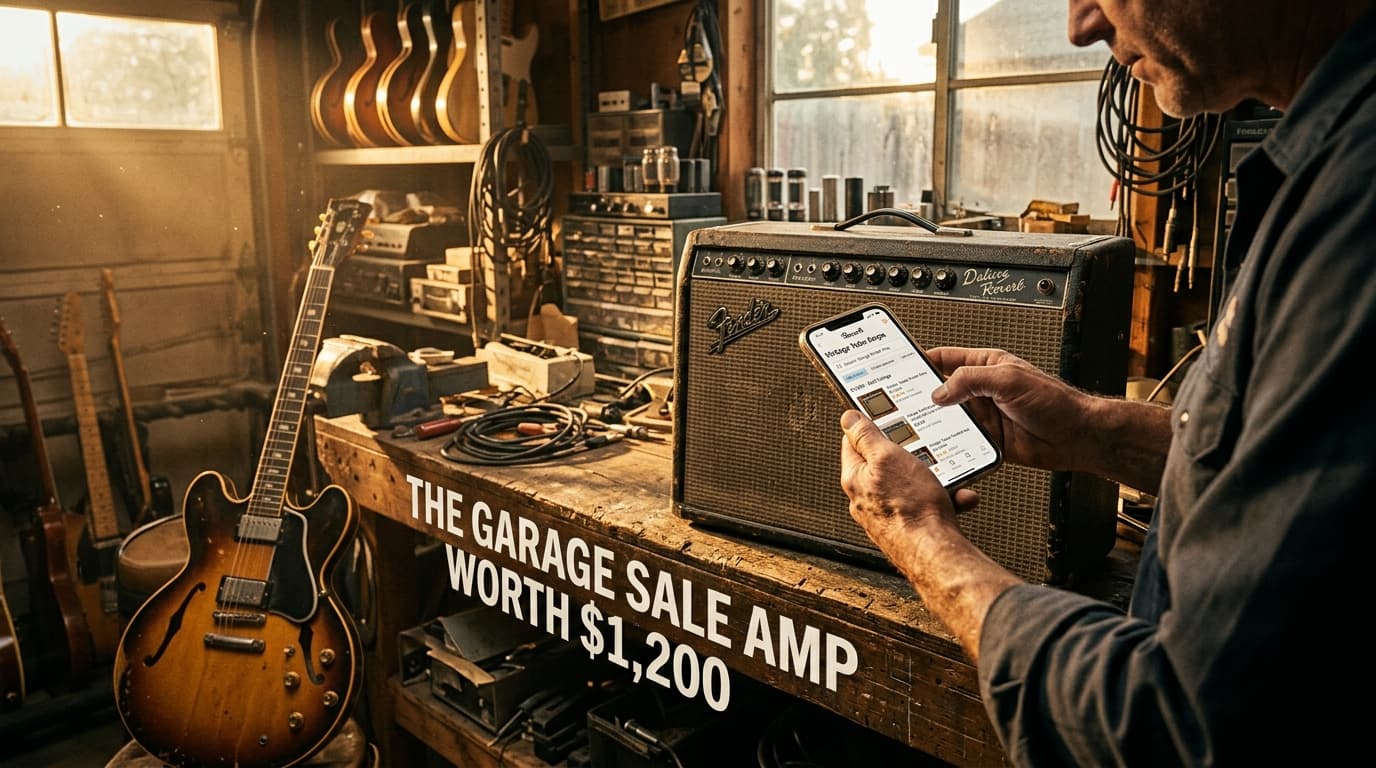

The Amp in the Driveway
The price tag says $450. The amp is a late-'60s Ampeg combo, sitting in someone's garage between a broken lawnmower and a box of Reader's Digest. The seller has no idea what they have. You might.
That split-second calculation running in your head right now is exactly what separates a TideTurner NFT guitars amps strategy from a casual weekend browse. The vintage instrument market hit $1.67 billion in 2024 and is on pace to reach $2.5 billion by 2032. Instruments from 1958 to 1964 are appreciating at roughly 26% compared to more recent vintage models. This isn't a hobby with occasional upside. It's a market, and you're standing in front of an opportunity.
Tim Schroeder, who builds amplifiers for Jeff Tweedy and Nels Cline, has a name for amps like this one. He calls them sleepers. Vintage '60s Ampeg combos that deliver Fender-like tones at a fraction of the price. The internet has started pushing sleeper prices up as information spreads, but the garage sales haven't caught up yet. That gap is where the money lives.
How to Know If It's Actually Worth $1,200
Before you hand over $450, you need five minutes and a working guitar. Plug in and listen. Schroeder's red-flag list is specific: crackling or popping with nothing plugged in, excessive hum, scratchiness when you turn the knobs, power tube plates glowing bright red, voice-coil rub when you play a note, cabinet rattles that don't belong. Any one of those symptoms can add $200 to $400 in repair costs before you can list it.
Originality matters more than most buyers realize. According to Tone Fest Guitar Gallery's vintage price guide, a refinished cabinet loses 40 to 60% of its resale value, and replaced pickups knock off another 15 to 30%. On a vintage amp, non-original speakers, replaced transformers, or a modified circuit tell the same story. You want the amp that looks like it sat in that garage untouched, not the one someone "fixed up."
Schroeder's practical advice is to budget below your actual cash reserves. If you have $600 available, buy at $450 and keep $150 to $200 for a tube check, a bias adjustment, and a capacitor inspection. A $500 amp that works properly is worth more than an $800 amp that pops and buzzes and creates a fire hazard. Go in with that math already done.
The Research Move That Separates Flippers from Collectors
Here is the move that Daniella and Alexandra, two IT professionals who run ILikeToDabble.com, figured out without any music industry background. Before buying anything, go to eBay and filter by "completed" and "sold" listings. Not asking prices. Actual transactions. Then cross-reference what you find on Reverb and Sweetwater to build a realistic range for what buyers are actually paying.
They target items listed at 3 to 5 times below comparable sold prices. Alexandra bought an Ibanez AF 155 for just under $300 and sold it for $800 including shipping. That is a 167% return on a guitar she found through patient, systematic research, not expertise or luck. The couple cleared just under $10,000 in a single year doing this a couple of hours per week. Their best month was $3,000. Their slowest was $750. The holiday season through New Year was consistently their strongest window.
The $450 Ampeg you are looking at needs the same treatment before you commit. If completed sales on eBay show comparable units moving at $1,100 to $1,300, you have your number. If the sold comps top out at $600, you have a different decision to make. The research takes twenty minutes and it is the entire foundation of the strategy.
The Fee Math Nobody Does Until It's Too Late
Here is where most flippers leave money on the table, and it is not because they bought wrong. It is because they sold on the wrong platform.
You buy the amp for $450. You do $150 in rehabilitation. Your cost basis is $600. You list it for $1,200 and it sells. On eBay, the platform takes 10 to 15% of that sale. That is $120 to $180 gone before you see a dollar. Your $600 profit just became $420 to $480. That fee was not visible when you were standing in the driveway running the math.
On Fisheez, sellers pay zero. Not a promotional rate. Not a limited-time offer. Zero, built into the platform's structure. Vinted, a European resale platform running the same seller-pays-nothing model, reached a $5 billion valuation and grew revenue 61% year over year in 2023. The model is financially real. And when eBay eliminated seller fees for private sellers in Germany, those new sellers ended up buying twice as much as buyers who never sold. Lower fees on one side of the transaction move volume on both sides.
A TideTurner NFT guitars amps holder gets the benefit on the buy side too. TideTurner NFT holders receive a discount on Fisheez's buyer-side service fee, with the best available discount applying to each transaction. You are saving on the way in and paying nothing on the way out.
Poshmark tried to restructure fees in October 2024 and reversed the change in under three weeks after power sellers reported double-digit revenue drops. Mercari ran a 0% seller fee experiment starting in March 2024 and reversed it by December. Sky Canaves, principal retail analyst at eMarketer, put it plainly: sellers have bargaining power, they have their own communities, and they can go somewhere else. The TideTurner holder already knows where somewhere else is.
Why the Platform You Sell On Is Part of the Strategy
Schroeder's warning about eBay and Craigslist sellers is worth taking seriously from both directions. He says sellers on those platforms may not know the state of what they are selling, or may misrepresent it out of ignorance or greed. That cuts both ways. When you are the seller, your buyer has the same concern about you.
Fisheez's SmartShell Escrow solves this structurally. Buyer funds lock in a smart contract in USDC on the BASE blockchain at the moment of payment. They release when the transaction completes, when the buyer approves early release, or when a dispute is resolved by Peacemakers, trained community volunteers who arbitrate fairly and are eligible for prize pools through participation rather than paid per dispute. There is no bank in the middle, no platform holding your money, and no buyer who can claim a chargeback three weeks after the amp shipped. For a $1,200 vintage gear transaction, that protection matters.
Timing matters too. Daniella and Alexandra's data points directly at the holiday season through New Year as the strongest selling window. A TideTurner NFT guitars amps holder who buys in September and lists in November is playing the calendar correctly. The buyers who are investment-motivated, and 65% of high-value vintage instrument buyers are, tend to move before year end.
The TideTurner Math, Totaled Up
Let's put the full transaction on paper. You buy the $450 Ampeg with a discounted buyer-side fee as a TideTurner NFT holder. You spend $150 on rehabilitation. Your cost basis is $600. You sell it for $1,200 on Fisheez and pay zero in seller fees. Net profit: $600.
Run the same flip on eBay. Same buy, same rehab, same sale price. eBay takes up to $180 in seller fees. Net profit: $420. The TideTurner NFT guitars amps advantage on just this one transaction is up to $180, plus whatever you saved on the buyer-side fee going in. Across a year of flipping, with some months at $3,000 and slower months at $750, that delta compounds into a number worth caring about.
The TideTurner NFT is not a badge or a membership card. It is a profit multiplier that is active on every transaction you run through the platform. It is also resellable, so if your flipping activity slows down, the NFT holds value you can recover. As an NFT holder, you also get a vote on how Fisheez allocates 5% of its revenue through the Fishlanthropy Foundation, which means the platform's charitable giving reflects the priorities of the people actually using it.
If you are already hunting vintage gear on weekends and running the fee math in your head at garage sales, the TideTurner NFT is the structural upgrade that makes the math work harder for you. The amp in the driveway is waiting.