
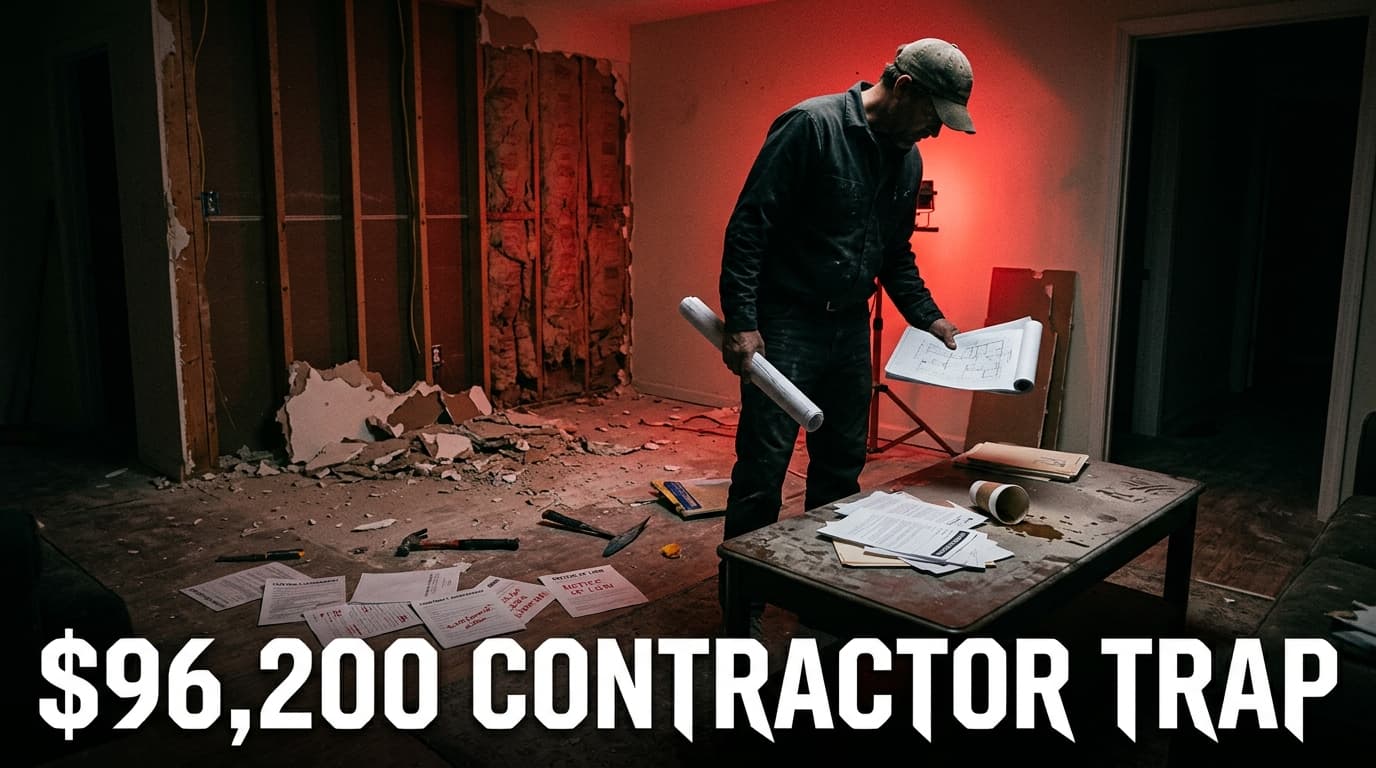

The $96,200 Lesson Nobody Wants to Learn
The Salientino family of Shoreham, Long Island hired a contractor in 2025 to remodel their home. The contractor gutted the place down to the studs, collected $96,200 for flooring, appliances, and materials, and disappeared. A family of five spent months living in a camper parked next to a house with exposed wires running through every room. That is not a horror story. That is a predictable outcome of a predictable mistake.
The FTC logged 81,925 reports of home improvement fraud in 2024 alone. A Pennsylvania contractor took $12,000 to gut a woman's basement and vanished. A West Virginia contractor collected $48,200 from seven different homeowners for work that was never finished. These aren't isolated cases from unlucky people. They are a documented pattern, repeating across every state, every year, because the conditions that enable fraud never change: money paid upfront, no accountability structure, and a homeowner who assumed goodwill was enough.
Why Smart People Still Hire the Wrong Painter
Here is the contradiction that should bother you. A Clever Real Estate survey of 1,000 homeowners found that reputation ranked first among what people say they want in a contractor, at 25 percent. Experience came second at 23 percent. Cost ranked third at 19 percent. People say they know what matters. Then the same survey found that 33 percent of those same homeowners admitted they'd hire someone with a questionable reputation to save money.
That's not a knowledge problem. It's a behavior problem. People understand the risk and take it anyway because the savings feel concrete right now and the downside feels abstract until it isn't. Jamie Dunaway-Seale, who authored the Clever Real Estate report, put it plainly: a questionable contractor is someone who may be dishonest about price, overestimates their skills, does poor work, or simply doesn't show up. Hiring one, she noted, often ends up being more expensive in the long run. Angie Hicks, co-founder of Angi, was blunter: if a deal seems too good to be true, it probably is. When you're hiring interior painters, the $300 quote isn't a deal. It's a warning.
The Real Price Tag on a $300 Paint Job
A professional-quality paint job should last seven to ten years. When a painter cuts corners, that window collapses to one to three years. You're not saving money by going cheap; you're moving your repaint date up by a decade and paying full price again when it fails.
The math gets worse when you understand what actually drives paint durability. It isn't the brand on the can. Surface preparation is the primary factor in how long any paint job lasts. Premium paint like Sherwin-Williams Duration or Benjamin Moore Aura covers 250 to 400 square feet per gallon and holds for eight to twelve years. Cheap or thinned paint covers 150 to 250 square feet per gallon and fails in two to four years. What most people miss is this: a $90 gallon of premium paint applied over dirty, chalky, unprimed siding won't outlast a $25 gallon applied correctly. A painter who skips prep ruins even the best materials. When you're hiring interior painters and the quote seems remarkably low, the margin they're cutting isn't coming out of their profit. It's coming out of the prep work you'll never see until the paint starts peeling.
The Red Flag That Could Cost You $50,000
The quality problem is expensive. The liability problem is catastrophic. Roll City Painting documented a real case in the Dallas-Fort Worth area where an uninsured painter fell from scaffolding on a second-story exterior job. The homeowner was held legally responsible for the contractor's medical bills because the contractor carried no workers' compensation coverage. A $5,000 project became a $50,000 nightmare, not because the paint was bad, but because the homeowner never asked to see proof of insurance.
There's a second variant of contractor fraud that most people have never heard of. A contractor arranges financing through a lender they claim to know personally, gets you to sign paperwork quickly, and by the time you read the fine print you've taken out a high-interest home equity loan. The contractor has already been paid by the lender. Your calls go unanswered. You're now servicing debt on work that was never completed. The FTC explicitly warns against this and advises never paying the full project amount upfront. Some states legally cap how much a contractor can collect as a down payment before work begins. Angie Hicks puts the upfront maximum at 10 to 20 percent for larger projects. If someone is asking for more than that before a single brush touches a wall, that is your signal to walk.
How Milestone Payments Change the Entire Dynamic
The structural problem with hiring interior painters, or any contractor, is that traditional payment models hand over money and then hope. You pay a deposit, work begins, quality may or may not meet expectations, and your only leverage disappears the moment funds leave your account. Milestone-based escrow reverses that entirely.
When payment is tied to verified stages, surface prep complete, priming done, final coat approved, the contractor's incentive to cut corners or disappear evaporates. There's no point in vanishing when the money they're after is still locked. The part that surprises most people: legitimate contractors often prefer this structure. Funds held in escrow give them confidence they'll be paid once work is verified complete, which removes the payment uncertainty that plagues every small contractor business. It isn't adversarial. It's a shared accountability system that protects both sides. That's exactly what SmartShell Escrow on Fisheez delivers. Funds lock in a smart contract in USDC on the BASE blockchain, and releases happen in stages tied to verified milestones. No bank, no middleman, no "pay and pray."
Vet Before You Write the Check
Before any conversation about price, verify the license and insurance. Not after the quote. Not once you've decided you like them. Before. Ask for the certificate of insurance directly from the insurer, not a document the contractor hands you. If they can't produce it, the conversation is over.
Cap your upfront payment at 10 to 20 percent, regardless of what they tell you about material costs. Require a written contract that specifies payment milestones tied to completion stages, not to calendar dates. If a contractor resists a written contract, that resistance is your answer.
For any job over a few hundred dollars, use escrow. When you're hiring interior painters to prep a space before listing it for sale, that paint job isn't a home improvement. It's a business asset. It affects your listing photos, your buyer's first impression, and your final sale price. Protecting it with milestone-based payments is a business decision, not an abundance of caution. Fisheez charges sellers zero percent in platform fees, which means the protection is cost-neutral on your side. The SmartShell Escrow structure ties every payment release to verified work, enforced automatically by smart contract, with no third-party escrow service to set up and no manual inspection coordination required. The FTC's guidance is simple: never make the final payment until the work is done and you're satisfied. SmartShell Escrow makes that the default, not a negotiation.
The Salientinos didn't make an unusual mistake. They made the most common one: they paid before the work was protected. You don't have to.