

The 35% Headline Is Hiding Something
The stamp market posted a 35% gain that made headlines, and experienced collectors read those numbers with a familiar mix of recognition and skepticism. The gain is real. The problem is who it belongs to.
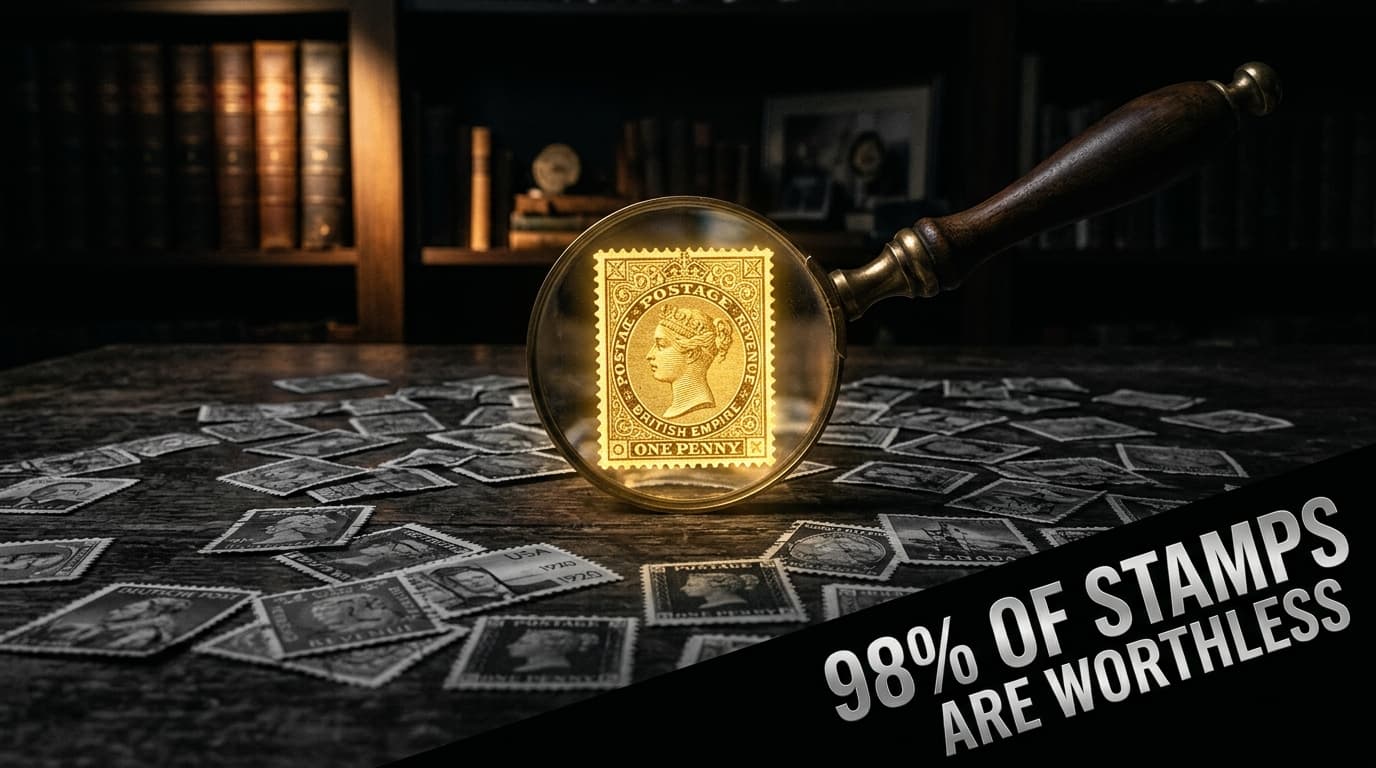
Richard Lehmann, who spent 25 years surveying over 11,000 stamp items for his MoneyStamps research, put the number plainly: fewer than 2% of stamps qualify as investable. The other 98% are largely depreciating, many worth a fraction of their listed catalog price. That 35% headline belongs almost entirely to a tiny tier of genuine rarities, while the broader market tells a much quieter story of declining values and shrinking demand.
The structural reason for this split is worth understanding. When eBay scaled into philately and captured roughly 20% of all online stamp transactions, it didn't just create a new sales channel. It destroyed the information asymmetry that had propped up common stamp prices for decades. Collectors discovered that stamps they believed were scarce were actually abundant, and prices adjusted accordingly. The American Philatelic Society peaked at 56,000 members in 1988; by 2023, that number had fallen to 25,546. The overall stamp market grows at a 2.5% CAGR. Those two facts belong in the same sentence.
What this means practically is that you are not investing in stamps. You are investing in the 2%, and the selection criteria are not forgiving.
What the 2% Actually Returns
The performance data for the investable tier is specific enough to be worth sitting with. Lehmann's 25-year survey identified 4,164 recommended items out of 11,552 total. Those recommended items returned 255.5% over the period, compounding at 10.2% per year, with a total portfolio value of $13,807,210. The non-recommended items returned 8.8% per year. That 1.4-point gap sounds almost trivial until you let it compound for two and a half decades.
The auction trails for individual pieces tell the same story in starker terms. The 15c Brown and Blue Center Inverted (Scott 119b) sold for $1,200 in 1904, $35,000 in 1967, $180,000 in 1982, and $800,000 in 2013, a 66,567% total gain over 109 years. The 5c Blue Perf 12x10 (Scott 423C) moved from $5,250 in 1999 to $67,500 in 2008, a 1,186% gain in nine years. In 1954, Life magazine assembled a collection of 53 world rarities estimated at $1 million; that same collection would be worth in excess of $250 million today.
The Stanley Gibbons GB250 Stamp Index, which tracks rare stamps as an asset class, benchmarks average returns at 5 to 7% annually over the last decade. Lehmann's recommended tier clears that benchmark by a meaningful margin. The pattern is consistent: genuine rarity, properly selected, compounds. Everything else does not.
Why Timing and Cost Basis Are Everything in This Tier
Even inside the 2%, the picture is not uniformly rosy, and that nuance is where the real investment discipline lives. The 1856 British Guiana One-Cent Magenta, arguably the most famous stamp in existence, sold for $9.8 million in 2014 and then resold at Sotheby's in 2021 for $8.3 million, a decline of roughly 15% over seven years. The 5c Deep Blue (Scott 204) sold for $350,000 in both 2009 and 2012, posting no gain over three years. Even trophy stamps have flat periods and down cycles.
Lehmann himself noted that for U.S. collectors, current conditions represent a genuine buying window: "Stamp buying has rarely been a timing play as investments go, but this is one of those times." The 35% of stamps now purchased above $10,000 as investments rather than collectibles is intensifying competition for the best pieces, which means the window for disciplined acquisition at reasonable prices is not permanent.
This is where cost basis becomes the variable that actually separates good outcomes from great ones. In a market where the investable tier compounds at 10.2% per year, the price you pay on entry is not just a number. It is the foundation every subsequent year of appreciation is built on. A stamp bought at a 2% discount to its fair market value does not save you 2%. Over a ten-year hold at 10% annual appreciation, that lower entry point compounds into a meaningfully larger absolute return. The math is not complicated, but it requires taking acquisition cost seriously as a precision variable rather than an afterthought.
Where Blockchain Fits: Authentication as a Value Driver
The market has already started pricing in the value of verified provenance. In October 2023, Stanley Gibbons launched a blockchain authentication service for stamps valued above $5,000, creating tamper-proof digital provenance records verifiable through a standard web interface. The estimated impact: a 10 to 15% increase in values for authenticated pieces. That is not a speculative projection. It reflects what institutional buyers are already willing to pay for certainty in a market where counterfeit stamps cost buyers an estimated $120 to $150 million annually.
The logic is straightforward. When the item you are buying is worth $25,000 and the difference between a genuine example and a sophisticated forgery is invisible to most eyes, on-chain transaction records become a material part of the asset's value, not a technological novelty. This is why the philatelic market's move toward blockchain provenance is structural rather than fashionable.
Fisheez operates on the BASE network with SmartShell Escrow, which locks buyer funds in USDC within a smart contract until deal completion. Funds release on timer expiry, early buyer release, or Peacemaker dispute resolution, with no manual intervention by Fisheez. Peacemakers are trained community volunteers who earn eligibility for prize pools through their participation, not fees paid per dispute. For high-value stamp transactions where authentication disputes and fraud risk are documented and quantified, that escrow architecture is a genuine protection layer, not a feature added for marketing purposes. Robert A. Siegel, one of the leading philatelic auction houses, reports over $35 million in annual sales; the institutional market has long understood that trust infrastructure is worth paying for. Fisheez builds it into the transaction by default.
The TideTurner Math: Quantifying the Acquisition Edge
This is where the numbers get specific, and where TideTurner NFT stamps postal history collectors have a structural advantage worth calculating directly.
Start with the sell side. eBay charges sellers 10 to 15% per transaction. On a $10,000 stamp, that is $1,000 to $1,500 leaving the table before you have done anything else. Fisheez charges sellers nothing. Traditional auction houses add buyer's premiums of 15 to 25% on top of hammer price, which compresses what sellers net and what buyers pay relative to actual market value. The Fisheez fee structure charges buyers a tiered service fee, from 8% on transactions under $50 down to 0.5% on transactions above $10 million, with sellers paying zero in every case.
Now add the TideTurner NFT. There are five levels: Whale, Octopus, Dolphin, Starfish, and Seahorse. The Seahorse provides a 20% fee discount. The Whale TideTurner provides a 100% fee discount, eliminating the buyer fee entirely. On a $10,000 purchase that would otherwise carry a meaningful buyer fee, a Whale TideTurner brings your acquisition cost down to the listing price, full stop. The best available discount applies; discounts do not stack.
The detail that makes TideTurner NFT stamps postal history collectors' math work differently from a standard loyalty program is resellability. The NFT itself can be resold after use. That means the cost of obtaining the discount is not a sunk cost. You use the fee reduction on a high-value acquisition, then resell the NFT, and the net cost of having had that advantage approaches zero.
Return to Lehmann's baseline: the investable tier compounds at 10.2% per year. A 1 to 2% reduction in acquisition cost at entry, compounded over a five to ten year hold at that rate, is not a rounding error. It is a calculable, repeatable edge on the only tier of the stamp market where disciplined selection pays. TideTurner NFT stamps postal history investors are not buying a perk or a membership badge. They are buying a precision instrument for the one game in philately that is actually worth playing.