
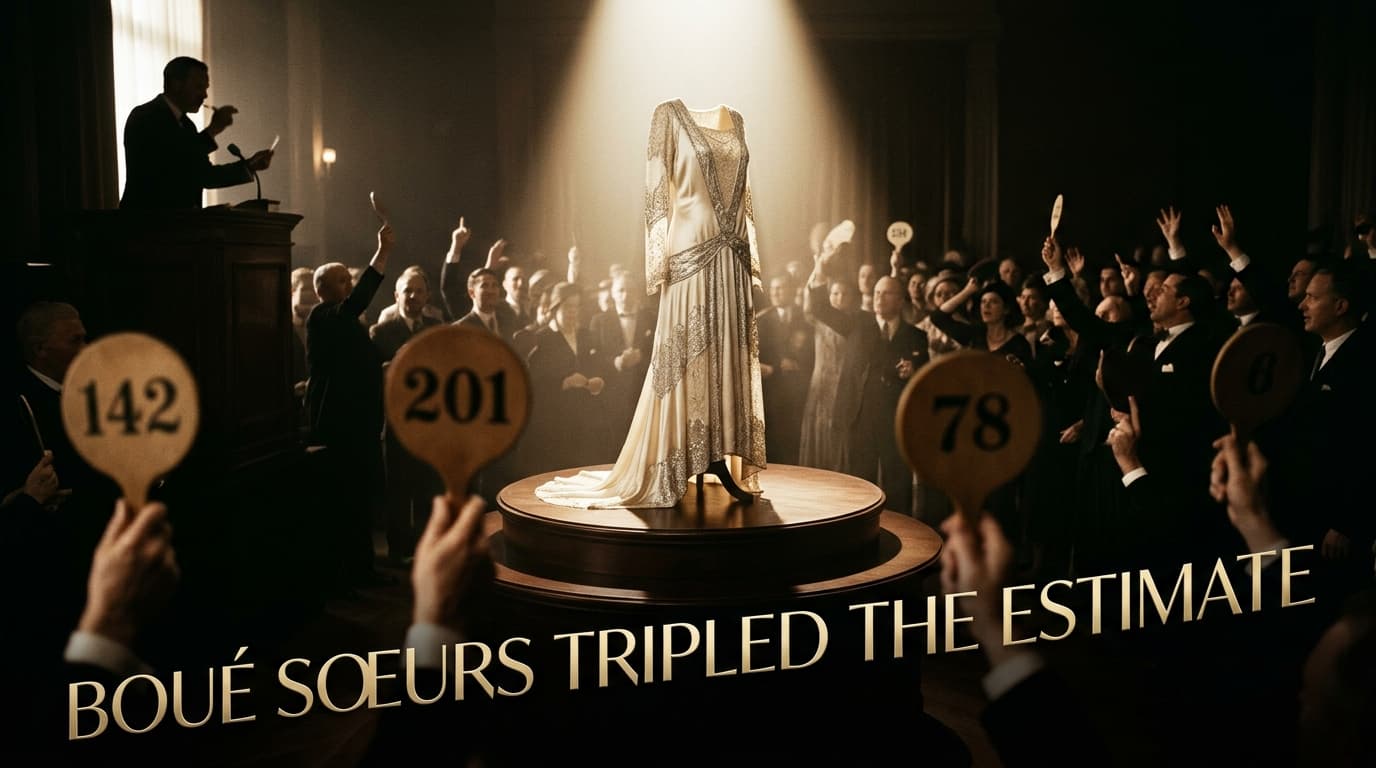

The $16,875 Moment Nobody Expected
The gavel came down at $16,875. The estimate had been $6,000 to $12,000. A circa-1928 Boué Soeurs evening gown, pulled from Augusta Auctions' Annual Autumnal Elegance sale in September 2025, had just beaten its high estimate by more than 40% and its low estimate by 181%. Three bidders, one room, and the kind of competitive spiral that turns a generous estimate into a rounding error.
Two lots later, a stylistically similar cream silk gown with no attribution sold for $1,000. Same auction. Same room. Same format. The gap between those two results, $15,875, is the entire argument of this article.
That sale finished at $115,438 across all lots with a 90% sell-through rate, which is a genuinely strong result. But the headline is not the total. It is what separated the gown that tripled its low estimate from the one that barely cleared four figures. Understanding that gap is the difference between a disappointing wardrobe flip and a result that makes you rethink your entire selling strategy.
Why the Format Did the Heavy Lifting
The Boué Soeurs premium was not purely about the label. Labels matter, but the label alone does not explain why rational buyers paid nearly three times the floor estimate. What explains it is what live competitive bidding does to the human brain before the gavel falls.
Behavioral economists call it the endowment effect. Once a bidder places a bid, they begin to feel psychological ownership of the item before they have won it. At that point, losing the auction does not feel like simply deciding not to buy something. It feels like losing something that was already theirs. Loss aversion kicks in, and the original price limit starts to feel negotiable. The competitive desire to win against other bidders compounds this, often becoming more important to the buyer than the item's actual value.
This is why live auction format is not a passive listing mechanism. It is an active price-escalation engine. Fixed-price listings let buyers decide in isolation, with no stakes and no clock. Live selling vintage designer clothing removes that isolation entirely. eBay's own data shows auction-style listings for unique and collectible items achieve 20 to 30% higher final prices than fixed-price listings, and that is before you layer in the specialist audience dynamics of a dedicated fashion auction.
Designer Gowns: Where Provenance Becomes a Bidding Weapon
Named couture performs disproportionately in specialist live auctions for a specific reason: brand narrative triggers emotional attachment earlier in the bidding sequence. The moment a bidder reads "Boué Soeurs, Paris, circa 1928," they are not evaluating fabric. They are placing themselves in a story. Kerry Taylor Auctions in the UK has built an entire strategy around this, using historical context and storytelling about each piece to deepen the emotional connection before a single bid is placed. That connection is what the endowment effect then weaponizes.
The luxury pre-loved market has grown from $24 billion in 2018 to a projected $81 billion, and the collectors driving that growth are not shopping by fabric weight. They are buying identity, history, and scarcity. Your job as a seller is to hand them the narrative before the bidding opens, not during it.
Here is the counterintuitive part: setting your starting bid too low for a designer piece actually suppresses the final price. Anchoring research shows that a low opening bid signals low value, especially for luxury items where price is itself a quality cue. For a Balenciaga jacket or a documented Chanel suit, a starting bid that reflects the item's status sets the psychological floor that competitive bidding then builds on. A desperate-looking low anchor can permanently cap what bidders believe the piece is worth.
Vintage Jackets: Different Category, Different Playbook
Branded vintage outside couture plays by different rules, but it still dramatically overperforms in live formats when you understand the trigger. In the same September 2025 Augusta sale, a collection of 1950s and 1960s men's hats by Stetson, Dobbs, Churchill, and Borsalino sold for $1,313 against a $300 to $500 estimate, beating the high estimate by 163%. A group of 1940s and 1950s California rockabilly and Western shirts closed at $1,125 in the same room.
These were not couture pieces with documented provenance narratives. What drove the bids was something different: collector community identity and brand scarcity. Rockabilly collectors, Western Americana enthusiasts, and vintage menswear obsessives are not bidding against their price limits because they feel ownership of a historical artifact. They are bidding because the specific combination of brands and era is genuinely rare, and because other people in the room want the same thing.
The pacing implication is practical. For live selling vintage designer clothing in this category, strategic lot grouping matters more than individual item storytelling. Grouping a Stetson with a Borsalino creates a collection that no single item achieves alone. It triggers scarcity and social validation simultaneously, which is a different psychological lever than provenance narrative but an equally powerful one.
The Format Decision: Specialist Live Auction vs. General Marketplace
The practical choice facing any wardrobe flipper is not live versus fixed-price in the abstract. It is which live format matches which category of inventory. Augusta's September 2025 sale achieved 90% sell-through despite an acknowledged decrease in international bidders due to U.S. trade policy at the time. That result tells you something important: for specialist fashion auctions, domestic collector depth and category focus can compensate for a smaller global audience. The room does not need to be large. It needs to be right.
The strategic framework that falls out of the data is fairly clean. Designer couture with documented provenance belongs in a specialist live auction where the audience arrived specifically to bid on fashion history. Branded vintage with strong community identity, your Western shirts, your mid-century menswear, performs best in timed live auctions with strategic lot grouping that creates collector FOMO. Generic vintage, unlabeled pieces with no clear community hook, is better served by fixed-price or timed online listings where low overhead matters more than price escalation. Forcing generic vintage through a live format adds friction without adding the psychological triggers that justify the format in the first place.
Three Levers That Pull Bids Past Estimate
The first lever is anchoring correctly. For designer pieces, your starting bid is a quality signal, not just a floor. Set it where it communicates that you know what you have. A Boué Soeurs gown opened at $500 tells bidders something very different than one opened at $4,000, and that first impression shapes every bid that follows.
The second lever is building the narrative before the gavel. Kerry Taylor's approach of sharing historical context, condition notes, and provenance details before bidding opens is not just good marketing. It is priming the endowment effect earlier in the sequence, so that by the time competitive bidding starts, multiple bidders already feel partial ownership. The emotional work happens in the pre-bid window, not during the live session itself.
The third lever is timing the lot to the right sale calendar. Specialist auction houses like Augusta run on seasonal cadences, with the September Autumnal Elegance sale and a December winter follow-up forming a predictable rhythm. Entering the right sale at the right moment in that calendar matters as much as the item itself. A summer consignment sitting in storage until the December sale is not wasted time; it is strategic timing.
Where to Run Your Next Live Sale
Specialist auction houses are the gold standard for high-value couture. Augusta and Kerry Taylor have the audiences, the credibility, and the competitive bidding depth that push results like the Boué Soeurs hammer price. They also have submission requirements, consignment timelines, and seller commissions that make them the wrong fit for mid-tier inventory or sellers who want direct control over their own live selling vintage designer clothing events.
For collectors who want live auction dynamics without the gatekeeping, Fisheez is worth watching. The platform is built on the BASE network with SmartShell Escrow, which locks buyer funds in USDC at the moment of payment and releases them on deal completion, with no bank or middleman involved. For high-value pieces where payment security is a real concern, that structure addresses the trust problem that keeps many sellers away from peer-to-peer live sales.
The fee structure is also structurally different from anything else in the market. Sellers pay 0%. Buyers pay a tiered service fee that starts at 8% for transactions under $50 and scales down to 0.5% above $10 million. Compare that to eBay's 10 to 15% seller commission, Etsy's 6.5% plus, or Amazon's 15 to 45%, and the math on a $1,313 hat lot or a $16,875 gown changes considerably in the seller's favor.
The Live Selling feature is listed as coming soon, with smart contract protection built into the live sale format itself. That is the piece that matters for this audience: live auction competitive bidding dynamics, the endowment effect, the scarcity triggers, the psychological escalation that turned a $6,000 estimate into a $16,875 hammer, with escrow protection baked in rather than bolted on afterward. The secondhand market is heading toward $367 billion by 2029. The sellers who figure out format strategy now, before the crowd catches up, are the ones who will own the best results when that wave arrives.