

She Had $8,000 Reasons to Get This Right
Maria had already lost $5,200. She'd hired a freelance web designer through a referral, paid half upfront like she was told to, and then watched the project slow to a crawl over three months before the designer stopped answering emails entirely. No files delivered. No refund. Just a half-built site and a Venmo transaction she couldn't reverse.
She wasn't alone in this. Jennifer Bourn, a brand strategist who has worked with clients worldwide since 1998, has documented what she calls "horror story after horror story" from business owners who signed contracts without understanding the terms, never received their files, and walked away with nothing to show for thousands of dollars spent. This isn't bad luck. It's a pattern, and it has a predictable shape: informal payment, no milestone structure, and a designer who knew the hiring process had no teeth.
Maria knew she needed a better method before she spent another dollar. What she came up with was something most business owners have never considered.
Why Freelance Design Hires Go Wrong So Predictably
The problem isn't that there are too many bad designers. The problem is that the standard hiring process makes it almost impossible to tell the good ones from the bad ones before money changes hands.
Most SMB design hires follow the same sequence: browse a portfolio, hop on a single video call, like the vibe, pay a deposit. There's no live pressure test, no milestone structure, and no payment protection. Over 60% of businesses reported being targeted by scammers in a recent BBB poll of more than 500 accredited businesses, and vendor fraud is one of the most consistently documented categories in that data. The BBB has received over 300 reports of vendor impersonation alone.
Consider what happened to Jaclyn in Seattle. A scammer impersonated one of her company's regular subcontractors with a spoofed email and professional invoice, right down to the ACH routing details. She described it as "a very elaborate scam with little to no spelling or grammar errors." A polished presentation is no longer a reliable trust signal, and a single Zoom call with a designer you found through a referral is roughly the same level of vetting.
Milestone escrow is standard practice in construction, software development, and real estate for six-figure contracts. Yet most small business owners hiring a designer for $3,000 to $10,000 still pay via Venmo or PayPal with zero recourse. The proportional risk is identical. The protection is not.
The Live Auction Idea Nobody Told Her About
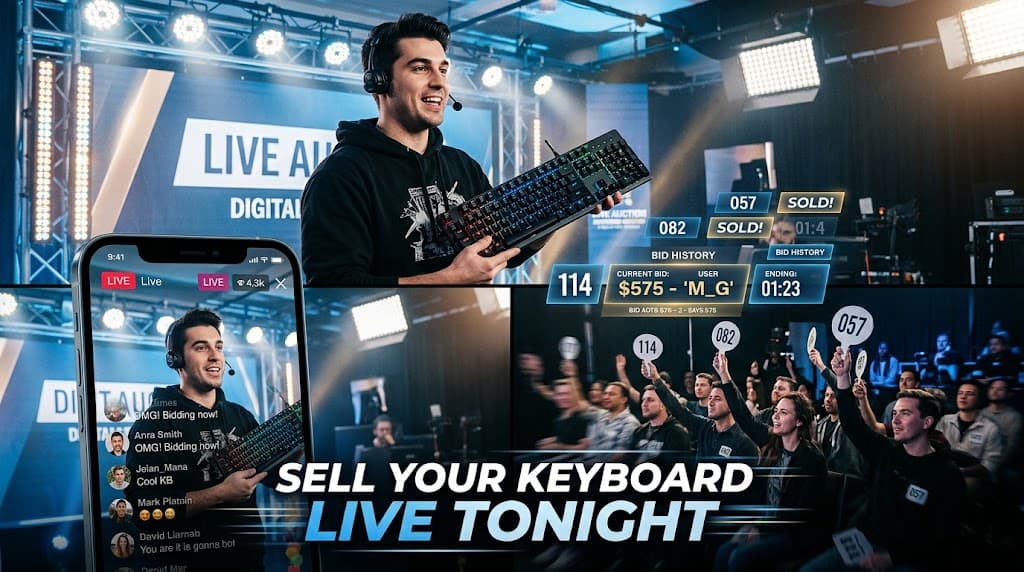
Maria's solution was unconventional. Instead of scheduling one call per candidate and hoping for the best, she ran a live auction for website design services where multiple designers competed in real time, on camera, answering her questions in public with no script and no prep time.
She ran it on Fisheez, a peer-to-peer marketplace built around live selling and smart contract escrow. The live format mattered for a specific reason: when you're watching someone answer a question in real time, under mild pressure, in front of other candidates, you see things that a polished portfolio and a rehearsed sales call will never show you. Hesitation. Vagueness. The pivot away from a question they don't want to answer.
Live selling builds trust quickly, and the same dynamic that makes it effective for products makes it unusually powerful for vetting service providers. A designer who can't explain their revision process on camera, in plain language, without fumbling, probably doesn't have a revision process. That distinction, between a designer who leads with business objectives and one who leads with color palettes and personal preferences, surfaces immediately under live questioning in a way it almost never does on a standard discovery call.
Eight Questions That Separated the Real Designers from the Rest
Maria used a checklist drawn from Jennifer Bourn's practitioner framework, and she asked every question live, to every candidate, in the same session.
The first question was about design process: not what tools they use, but how they move from kickoff to final delivery, and what happens at each stage. A strong answer names specific phases. A weak answer describes the finished product instead of the path to it.
The second question covered revisions: how many rounds are included, what counts as a revision versus a new request, and what happens when the client and designer disagree about scope. The third asked directly about missed deadlines: has it happened, what caused it, and how was it handled. Any designer worth hiring has a real answer to this. Evasion is the answer.
The fourth question addressed scope changes, specifically what the process is when a client asks for something outside the original agreement. The fifth asked about file delivery: who gets what files at the end, in what formats, and what happens if the relationship ends mid-project. The sixth was about intellectual property: who owns the work, and at what point does ownership transfer.
The seventh question asked whether any part of the project would be outsourced, and if so, to whom and how quality is managed. The eighth was about cost estimation: given the scope on the table right now, what's your number and how did you arrive at it. Bourn's point is direct on this one. Any designer who understands the scope should be able to give an accurate estimate. If they can't, they either don't understand what you're asking for, or they plan to outsource it and haven't figured out to whom yet. Both are red flags.
Drastically low bids deserve scrutiny too. A designer who comes in far below every other quote may be using your project to learn skills they don't yet have. A drastically high bid may simply be price inflation based on a guess about what you can afford.
Why Passing the Live Test Wasn't Enough, and What She Did Next
Maria's top candidate answered every question clearly, on camera, without hesitation. She still didn't pay him a single dollar until the escrow was set up.
This is the second layer, and it's the one that actually ghost-proofs the project. Even a designer who performs brilliantly in a live auction for website design services can run into cash flow problems, take on too many clients, or simply disappear once they have your deposit. The live format filters for competence and transparency. It doesn't eliminate human nature.
SmartShell Escrow, built into Fisheez, handles the second problem. When Maria paid, her funds locked in a smart contract on the BASE network in USDC. The designer couldn't touch them. Release was tied to milestone approval, not to trust, not to goodwill, and not to a payment platform's dispute resolution process that may or may not rule in her favor.
The mechanics work like this: funds are deposited, milestones are defined in the contract, each milestone is verified before the corresponding payment releases, and the project settles in stages rather than in one lump sum at the end. As Castler's framework for milestone escrow puts it, the structure "reduces risks related to non-payment or non-performance by ensuring obligations are met before funds are released." SmartShell applies that same logic at the smart contract level, with nested contracts enabling stage-by-stage releases for each phase of the project.
If a dispute arises over whether a milestone was actually completed, Fisheez Peacemakers step in. These are community-trained volunteer arbitrators, not a corporate support ticket queue. They're trained specifically for this kind of structured disagreement, and rather than being paid per dispute, they earn eligibility for community prize pools through their participation. They're accountable to the community rather than to platform revenue.
What the $8,000 Number Actually Represents
Maria completed her redesign on time, on scope, and without a single payment dispute. The $8,000 figure isn't what she spent on the project. It's the combined total she calculated she would have lost if she'd repeated her previous hire twice more at the same rate, which, statistically, was exactly where she was headed.
The buyer fee on a $5,000 project through Fisheez lands well below the 8% floor tier, likely in the 2 to 3% range given the tiered structure. Compare that to Fiverr or Upwork, where freelancers pay 20% and quote higher to compensate, or to Facebook Marketplace and Craigslist, which cost nothing and protect nothing. The math is straightforward.
Running a live auction for website design services is replicable. You don't need to be a tech buyer or a procurement professional. You need a platform that supports live selling with escrow built in, a list of eight questions you're willing to ask on camera, and the willingness to treat the hiring process as seriously as the project itself. Set up a live session on Fisheez, invite your shortlisted candidates, run the questions, watch who answers and who deflects, and lock the winning bid into milestone-based SmartShell Escrow before the first deliverable is due.
The ghost problem and the underdeliverer problem are both, at their core, hiring process problems. The live format solves the first. The escrow solves the second. Maria used both, and she got her site built.