
The Gap Nobody Talks About
Fifty-five percent of US consumers say they want to shop via livestream. Only 12% ever have. That gap is not a demand problem. It is a supply problem, and the sellers who figure that out first are going to own the next decade of commerce.
The numbers back this up hard. The US livestream shopping market sits at roughly $50 billion and is growing 36% in 2026, already surpassing 5% of total digital commerce. TikTok Shop alone pulled $100 million on Black Friday 2024, triple the year before, with over 30,000 shopping livestreams running in a single day. Look at China if you want to see where this ends up: $682.5 billion in live commerce in 2023, projected to hit $1.1 trillion by 2026.
These are not niche numbers. Live selling is a channel shift, the same way mobile was a channel shift. The sellers who treat it seriously now, while the audience is still underserved, are the ones who will be uncatchable in three years.
Your First 90 Seconds Make or Break the Session
Nobody eases into a live session. Viewers drop off in the first two minutes if you don't hook them, and they are never coming back. You have ninety seconds to prove this is worth watching.
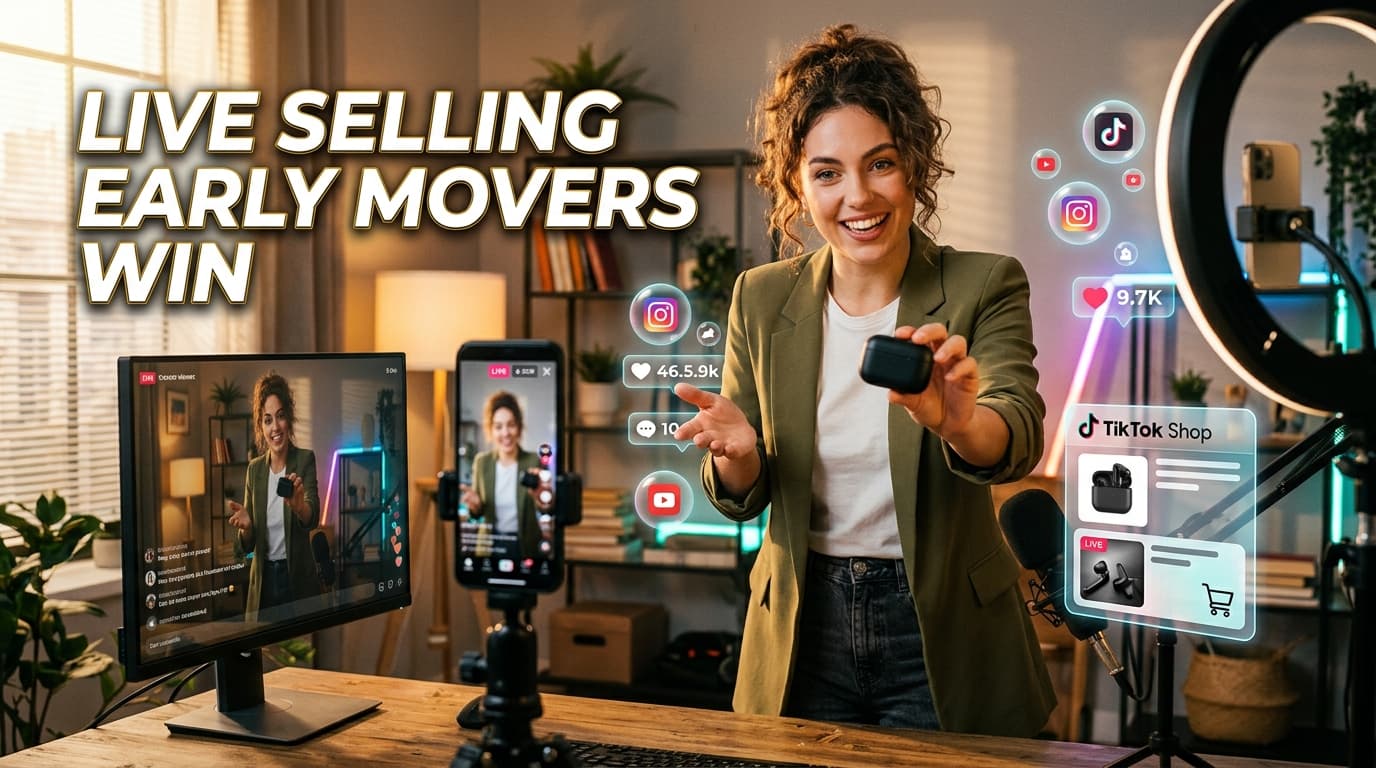
Start with the product in your hand and a problem on your lips. Not "hi everyone, welcome to my live." That burns your opening seconds on pleasantries nobody needed. Lead with the problem your product solves, say it out loud, and show the product immediately. Sarah Moret, founder of Curie, puts it plainly: focus on how the product makes your customer's life better, not just what the product is or what it does. That framing shift changes everything about how a live session opens.
Energy is not optional. Viewers are comparing you to every other tab they have open. A flat delivery is a dead session. You do not have to be manic, but you have to be present, moving, and genuinely interested in what you are about to show. Match the pace of the medium. Live selling moves fast. So should you.
Build a Following, Not Just a Viewer Count
A single session does not build a business. A consistent schedule does. The sellers who turn live commerce into a real revenue channel treat it like a show with a loyal audience, not a one-off event they hope goes viral.
Sam Mendelsohn, CMO of Sozy, learned this the hard way and now teaches it first: build your email and SMS program before you go live, not after. Your existing customers are your warmest audience. Notify them before every session. Give them a reason to show up, whether that is an exclusive live price, a first look at new inventory, or a drop they cannot get anywhere else. Pre-show promotion converts silent followers into live viewers, and live viewers into buyers.
Made by Mitchell is the proof. A Barbie-themed makeup tutorial live series on TikTok built $2 million in sales and 500,000 followers. That did not happen in one session. It happened because the format was repeatable, the audience knew when to show up, and each session rewarded the people who came back.
One more thing the data will surprise you with: the live-stream purchaser most likely to buy is a millennial, average age 33 to 36, earning over $100,000 a year. You are not selling to teenagers. You are selling to people with purchasing power and a preference for convenience. That audience rewards consistency over flash.
The Engagement Plays That Actually Convert
Live selling tips from people who have actually moved product tend to cluster around the same mechanics. Flash deals with visible countdowns. Pinned comments that surface the deal before new viewers even scroll. Q&A windows that let buyers get their objection answered in real time. Exclusive live pricing that cannot be found anywhere else on your site. These are not gimmicks. They are the structural reason live conversion rates run between 9% and 30% while standard ecommerce sits at 2% to 3%.
Three Ships Beauty ran a 60-minute session and closed $25,000 from 1,200 viewers, 356 orders, and a 26% conversion rate. That is not luck. That is tight execution on a format that was already proven to work. Eidon Swim hit a 318% sales spike compared to the prior day off a single influencer Instagram live that reached roughly 19,000 people. The ceiling on a well-run live session is genuinely high.
The psychological engine underneath all of this is scarcity and real-time social proof. When viewers see other people buying, asking questions, and commenting, they feel the pull of the crowd. You are creating a buying event, not a product listing. The tactics above are how you keep that energy alive for the full session without it feeling manufactured.
Why Social Platforms Leave You Exposed
Here is the part of live selling tips nobody puts in the headline. When you sell on Facebook Live, TikTok Shop, or Instagram Live, you are operating without a payment protection net. A buyer says they will pay and then ghosts. A sale goes through and a chargeback shows up 30 days later with no recourse. Disputes that should take days stretch to 14 to 21 business days and often resolve in the platform's favor, not yours.
This is not a hypothetical risk. It is the structural reality of building your revenue on platforms designed for engagement first and commerce second. Thirty-eight percent of consumers are not even sure whether the brands they follow offer livestream shopping. That is how early we are. Platforms are still figuring out the commerce layer, and sellers are absorbing the risk in the meantime.
The buyer experience matters too. When a viewer does not trust that their payment is protected if something goes wrong, they hesitate. That hesitation kills conversion. The social platforms have made enormous strides in discovery and reach. They have not solved the trust layer for high-consideration purchases, and that ceiling shows up when you try to scale past impulse buys.
The Payment Layer Is About to Change Everything
The financial infrastructure underneath live commerce is getting rebuilt right now, and most sellers have not noticed yet. Stablecoin payments are moving from crypto curiosity to practical commerce layer faster than anyone predicted.
Here is what that means in concrete terms. Stablecoin settlement clears in under 60 seconds. Traditional marketplace payouts take 7 to 14 days. For a live seller who just moved $10,000 in an hour, those are not abstract timelines. Cross-border transactions via stablecoin cost between 0.1% and 0.5%. The traditional alternative runs 6.35%. USDC monthly transaction volume now exceeds $1 trillion, up 78% year over year. Citi projects the stablecoin market hits $1.9 trillion by 2030. Shopify, Coinbase, and Stripe are already accepting USDC on Base. This is not frontier technology anymore. It is infrastructure arriving in real time.
Marketplaces that have made the shift are already seeing the downstream effects: 45% reduction in seller churn, 23% increase in international sales. Joe Lau, co-founder of Alchemy, described the moment clearly: stablecoins and deposit tokens are rapidly becoming the consumer and enterprise layers of the internet-native financial system. Platforms built on this layer from the start are positioning to capture the full value of that shift.
Live Selling With Protection Built In
The direction of live commerce is obvious if you squint at the data. China went from $682.5 billion to a $1.1 trillion trajectory. US live commerce is at $50 billion and accelerating. The channel works. The conversion rates prove it. What is still missing for most sellers is the infrastructure that makes it sustainable at scale, not just successful in the best-case session.
That infrastructure is showing up now. Fisheez is building live selling through Hubs, and the protection layer is not optional. SmartShell Escrow locks buyer funds in a smart contract the moment payment is made. Funds are held in USDC on the Base network and release when the deal is confirmed, not when someone at a platform decides to process your payout. Sellers pay 0% in fees. Buyers pay a tiered service fee that starts at 8% for transactions under $50 and drops to 0.5% above $10 million. The cost structure is designed to protect the seller's margin, not extract it.
This is the difference between platforms designed around discovery first and a marketplace designed around protection first. Disputes on Fisheez go to Peacemakers, trained community members who resolve conflicts fairly rather than defaulting to whichever party files the complaint louder. Settlement windows run 3 to 5 days instead of 14 to 21. The entire system assumes that a live sale is a real commercial transaction deserving real commercial protection.
The best live selling tips tend to focus on the performance: the hook, the energy, the countdown, the Q&A. All of that matters. But the most important tip may be structural: build on infrastructure where the default is protection, not exposure. Sellers who make the early move to platforms where escrow is built in, settlement is fast, and fees do not eat the margin they worked the session to generate are the ones who will be competing at a different level in two years. The supply gap is real. The tools to close it are arriving. Get in before the window narrows.