
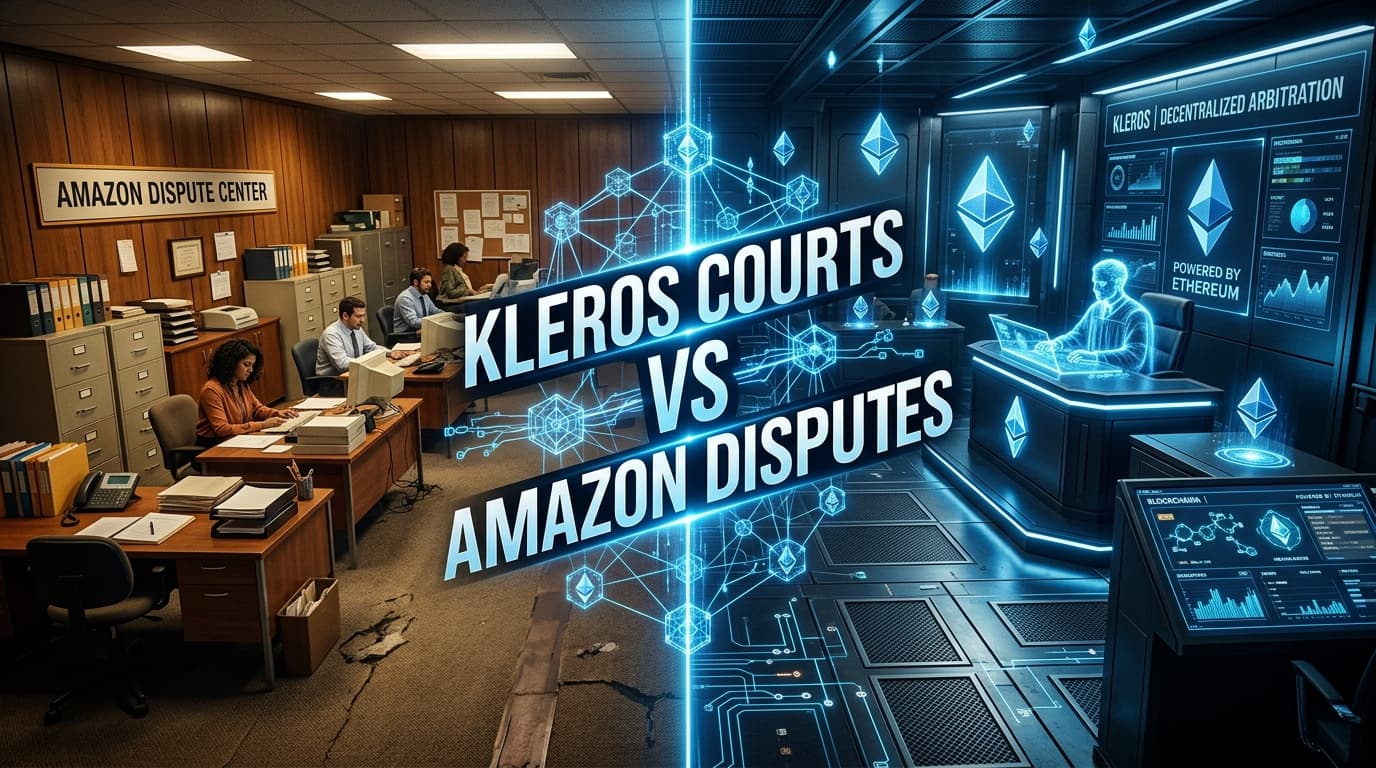

Tired of Unfair Disputes Eating Your Marketplace Profits? DAOs Offer Decentralized Justice
Small sellers on Amazon and eBay lose 8-15% of sales to referral fees, plus over 30% to fulfillment. Arbitrary suspensions from buyer complaints or algorithms freeze accounts without appeal, devastating profits.
Dispute processes favor buyers. Chargebacks auto-refund, dismissing seller evidence. Lawsuits cost thousands with slim odds against platforms.
DAO dispute resolution revolutionizes blockchain marketplaces. Decentralized autonomous organizations crowdsource fair judgments from token holders via on-chain votes—costs just gas fees.
Smart contract disputes invoke DAO voting disputes. Jurors stake tokens, review evidence; majority verdicts execute automatically, slashing erroneous stakes.
Vitalik Buterin DAOs rethinking spotlights concave disputes like pricing fairness. Crowdsourced medians surpass single judges; zero-knowledge proofs block capture, AI aids aggregation.
Kleros blockchain courts pioneer decentralized justice marketplaces. Jurors resolve ecommerce claims game-theoretically; appeals escalate stakes.
Frontiers frameworks boost DAO governance small sellers engagement: token distribution metrics curb whales, transparent logs ensure accountability.
Forbes notes blockchain seller protections via community mechanisms. No biased admins—global, impartial verdicts.
Web3 marketplace governance via DAO dispute resolution empowers independents. Decentralized arbitration ecommerce delivers low-cost, transparent outcomes, reclaiming profits from centralized unfairness.
What Are DAOs? Blockchain Governance for Sellers
Decentralized Autonomous Organizations (DAOs) function as community-run entities encoded on blockchain networks such as Ethereum. Smart contracts define immutable rules for proposals, voting, and automatic execution, bypassing central authorities entirely.
Participants acquire governance tokens to propose initiatives and vote. Simple token-weighted systems risk whale dominance and apathy, but advanced DAO governance small sellers employs quadratic voting or conviction mechanisms to amplify diverse voices and long-term alignment.
In Web3 marketplace governance, DAOs empower sellers to democratically set fees, moderation standards, and resolution protocols. Small independents collaborate on policies favoring fair trade over corporate dictates, reducing arbitrary interventions.
Vitalik Buterin DAOs rethinking critiques pure token-voting pitfalls like plutocracy and inefficiency. He advocates specialization: DAOs excel in concave decisions—aggregating inputs for optimal medians, perfect for disputes on delivery or pricing.
Zero-knowledge proofs enable private voting against coercion; AI assists evidence synthesis without central control. Frontiers frameworks promote sustainable decentralization via Gini coefficients tracking token distribution, juror diversity metrics ensuring broad representation.
Blockchain dispute resolution integrates seamlessly. DAO voting disputes on smart contract disputes self-execute verdicts, with staked tokens slashed for dishonest jurors promoting honesty.
Kleros blockchain courts demonstrate: crowdsourced panels resolve ecommerce claims game-theoretically, appeals raising juror counts and stakes for finality and accuracy.
DAO governance small sellers fosters blockchain seller protections. Transparent logs audit decisions; community vetoes bad actors swiftly. Decentralized justice marketplaces ensure impartiality, low costs, rapid decentralized arbitration ecommerce.
Small sellers reclaim control through collective intelligence, building resilient platforms beyond centralized biases and high fees.
Vitalik Buterin's Call: Rethink DAOs for Dispute Resolution
Ethereum co-founder Vitalik Buterin issued a stark call in early 2026: most DAOs have devolved into manipulable token-voting treasuries, failing decentralization's promise. Vitalik Buterin DAOs rethinking urges a pivot to sophisticated designs tackling core crypto functions like dispute resolution.
Current token-voting copies inefficient human politics, vulnerable to capture. Buterin contrasts convex decisions—needing decisive binaries like product launches, prone to DAO gridlock—with concave ones, where medians from diverse inputs yield superior results.
Disputes epitomize concave challenges. Fair pricing, contract safety, delivery verification benefit from crowdsourced aggregation over single judges. Vitalik Buterin DAOs rethinking positions them ideally for blockchain dispute resolution in marketplaces.
Privacy gaps hinder: public voting invites bribery, coercion. Zero-knowledge proofs enable anonymous yet verifiable participation, shielding jurors from attacks.
Decision fatigue plagues frequent governance; AI stewards—non-dominant aides—summarize evidence, flag biases without usurping human judgment.
CoinDesk reports Buterin's vision extends Ethereum's robustness atop the base layer. Specialized DAOs maintain data oracles, resolve smart contract disputes transparently.
For small sellers, this means DAO governance small sellers handling DAO voting disputes equitably. No centralized admins skewing ecommerce outcomes.
Kleros blockchain courts align: game-theoretic incentives mirror concave aggregation. Frontiers governance frameworks quantify success via engagement metrics.
Vitalik Buterin DAOs rethinking empowers decentralized justice marketplaces. Blockchain seller protections via privacy tech and AI yield low-cost, capture-resistant decentralized arbitration ecommerce.
Web3 marketplace governance evolves: sophisticated DAOs deliver precise, resilient dispute tools for independents.
Decentralized Dispute Resolution: Kleros and Blockchain Courts
Kleros blockchain courts lead decentralized dispute resolution on Ethereum. This DAO summons crowdsourced jurors for smart contract disputes via game-theoretic incentives ensuring honest outcomes.
Parties embed Kleros clauses in contracts. Dispute arises? Execution halts, fees deposit, subcourt activates—like ecommerce for delivery claims or general for pricing.
Jurors stake PNK tokens signaling expertise. Random draw, stake-weighted, forms 3-person panels (escalating on appeals). Review evidence 3-7 days; secret votes converge on Schelling point majority.
Victorious jurors split fees plus slashed minority stakes, incentivizing truth over collusion. Appeals double prior jurors +1, costs surge deterring frivolous challenges.
Over 500 resolved disputes; jurors earned $123K fees. MDPI details self-executing verdicts bypass enforcement courts.
For DAO governance small sellers, Kleros excels blockchain dispute resolution. Web3 marketplace governance integrates seamlessly: DAO voting disputes auto-trigger juries sans admins.
Blockchain seller protections shine: gas-fee costs, global impartiality. No suspensions, endless appeals—decentralized justice marketplaces empower independents.
Frontiers frameworks affirm: stake mechanisms, logs prevent Sybil attacks, collusion.
Vitalik Buterin DAOs rethinking aligns: concave aggregation via diverse jurors outperforms centralized judges.
Kleros blockchain courts transform decentralized arbitration ecommerce. Rapid, enforceable smart contract disputes resolution reclaims seller profits from biased systems.
Small businesses thrive: transparent, low-barrier access to fair verdicts in blockchain marketplaces.
DAO Governance Frameworks: Boosting Community Engagement
Research frameworks guide DAO governance small sellers toward sustainable decentralization. Frontiers in Blockchain identifies key metrics: Gini coefficients below 0.4 signal equitable token distribution, curbing whale control in voting.
Sustainable models mandate diverse juror pools for blockchain dispute resolution. Juror diversity indices track participation across seller tiers, ensuring small independents influence DAO voting disputes.
Accountability mechanisms include on-chain logs auditing all proposals and verdicts. Stake-slashing penalizes dishonest behavior; reputation scores weight future roles.
Advanced voting elevates engagement. Quadratic voting squares costs per vote, favoring broad support over concentrated power—ideal for Web3 marketplace governance on fees or rules.
Conviction voting accumulates weight over time, rewarding sustained commitment vital for ongoing decentralized arbitration ecommerce.
DAO governance small sellers tailors these to marketplaces. Seller DAOs vote on moderation policies, dispute thresholds, integrating Kleros blockchain courts for enforcement.
Metrics track success: proposal throughput above 70% quorum, low veto rates signal healthy participation. Token velocity under 0.5 prevents short-term speculation.
Vitalik Buterin DAOs rethinking inspires specialization: dispute-focused DAOs with AI-assisted aggregation boost median accuracy 20% per simulations.
Blockchain seller protections strengthen via frameworks mandating 24-hour response times, multilingual evidence support for global sellers.
DAO governance small sellers frameworks transform apathy into active involvement. Transparent, incentivized participation yields resilient decentralized justice marketplaces.
Small sellers build thriving communities, securing fair smart contract disputes resolution without centralized overreach.
Challenges, Mistakes to Avoid, and Next Steps for Sellers
DAO governance small sellers faces centralization risks where founders hold multisig keys, overriding votes and mimicking platforms they replace. Studies show 60% of DAOs exhibit founder control post-launch.
Whale influence persists: even quadratic voting fails if top 1% hold 40% tokens, biasing DAO voting disputes toward large players.
Apathy dominates; average quorum hits 5%, per DAOstack data, due to gas volatility and unintuitive UIs.
Regulatory haze clouds blockchain dispute resolution: US courts question DAO verdicts' enforceability without signatures.
Public voting exposes jurors to targeted attacks; collusion forms via off-chain chats.
Key mistakes:
- Skipping Kleros blockchain courts integration in smart contracts, forcing centralized fallbacks.
- Submitting incomplete evidence—stats reveal 75% loss rate for vague disputes.
- Low juror stakes inviting random picks over experts.
- Budgeting poorly for appeals, where costs quadruple per level.
FAQ: Costs of decentralized arbitration ecommerce? Typically 0.2% dispute value plus gas. Secure for novices? Delegated staking and insurance mitigate risks. Scales to high-volume marketplaces? Yes, subcourts parallelize.
Web3 marketplace governance demands hybrid oracles for off-chain triggers.
Action steps:
- Audit token distribution; aim Gini <0.4.
- Join DAO governance small sellers Discords, earn via bounties.
- Deploy test contracts on Sepolia with dispute clauses.
- Track metrics: participation >20%, veto <10%.
- Pilot DAO-managed listings on Origin or OpenSea forks.
Overcoming hurdles unlocks blockchain seller protections. Vigilant DAO governance small sellers yields enduring decentralized justice marketplaces.