
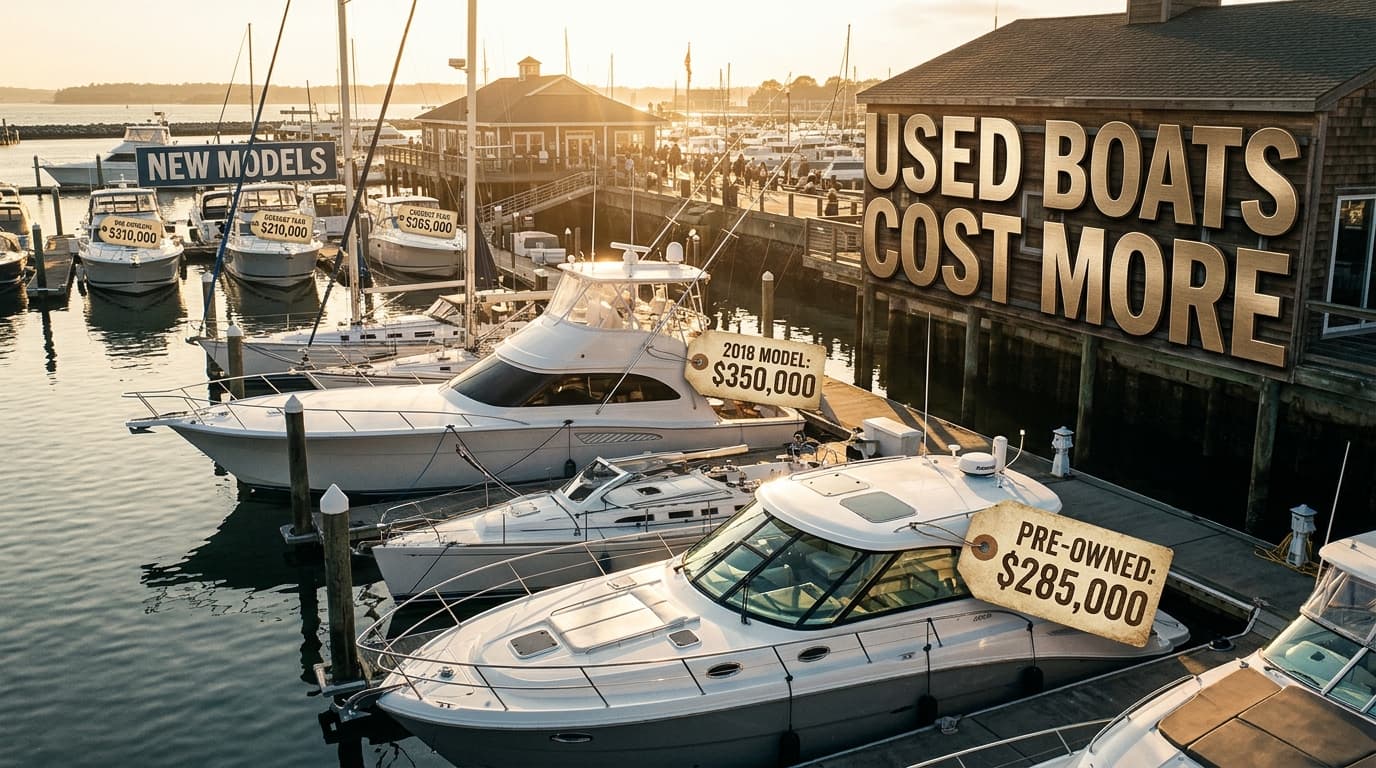

Used Boats Now Cost More Than New Ones — Let That Sink In
In the first half of 2024, the average used boat sold for $211,500. The average new boat sold for $174,000. If you assumed the secondary market was the discount bin, the data just called you wrong.
This is not a rounding error or a niche anomaly. It is the defining data point in boats powersports selling trends right now, and it reframes everything. Volume in the used segment dropped 12.4% over the same period, yet prices still climbed 4.2%. Fewer boats changing hands, at higher prices. That is not what a saturated market looks like. That is what scarcity-driven demand looks like, and it is exactly the dynamic that rewards flippers who read the room correctly.
The 'Oversupply' Myth Has a Math Problem
The oversupply narrative has been circulating since pandemic demand normalized, and it sounds reasonable until you check the actual numbers. NPA CEO Jim Woodruff has been direct about this: powersports is currently running 14.6% above its 2019 pre-COVID baseline. The market did not snap back to where it was before the boom. It settled higher.
Then there is the transaction ratio that most casual observers miss entirely. On a transactional basis, roughly three pre-owned vehicles sell for every one new unit. Pre-owned is not a secondary market in any meaningful sense; it is the primary market. April 2025 made the divergence impossible to ignore: new-unit powersports retail fell nearly 8% in a single month while used powersports sales rose 2.04% year-over-year in the same period. Demand is not disappearing. It is migrating, and it is migrating toward pre-owned.
Where the Volume Actually Lives
The scale of this market deserves a moment of attention. Pre-owned boat sales in 2024 totaled 858,798 units and $10.2 billion in value, accounting for more than three-quarters of all boat transactions. Pre-owned outboards led every category with 562,000 units sold. This is not a corner of the market; it is the market.
One counterintuitive detail in the current boats powersports selling trends data should sharpen your sourcing strategy. Boats that are just one year old are taking 75 extra days to sell compared to the same period in 2023. Nearly-new inventory is the hardest to move, not vintage. If you are sourcing older, well-maintained hulls, you are competing in a less crowded lane than the sellers sitting on last year's models. Meanwhile, the 36 to 45-foot segment saw volume drop 12.3% in H1 2024 while average sale prices rose 18% to $327,000. Volume down, prices up. The pattern holds across segments.
Margins Are the Real Story, and They Favor Pre-Owned
The financial case for pre-owned over new is not subtle. According to NPA data, profit margins on used powersports units can run two to three times higher than on new models, particularly when reconditioning and accessories are factored in. A dealer at the Atlanta NPA auction in June 2025 put it plainly: "I'm getting cleaner used inventory through NPA than I can trade for locally, and the margins are holding up even after transport." That is a real-world confirmation of what the wholesale data already shows.
NPA's average wholesale prices across marine units have been rising through their March and April 2025 reporting cycles, which matters because NPA serves over 95% of franchised powersports dealers in the U.S. Their pricing data is the closest thing the industry has to a real-time market signal. Ryan Keefe, NPA's VP of Marketing, has noted that clean, low-mileage units are performing near book value while higher-mileage inventory softens. The quality premium is real and measurable. NPA is also putting capital behind its own confidence: a new Kansas City auction site announced in March 2025, and a Denton, Texas facility breaking ground in February 2026. Infrastructure expansion is the most credible form of market optimism.
The Eco-Conversion Premium Is Coming, and Early Movers Win
Over 100 manufacturers are now actively developing electric boat solutions. Europe already holds more than 40% of the global electric boat market share. Yamaha's acquisition of Torqeedo in early 2024 signals that the largest OEMs are not watching this from the sidelines; they are buying into it. Arc Boats' Arc Sport packs a 226-kWh battery and 500-horsepower equivalent into a 23-foot hull, which is exactly the size class where vintage powersports boats live.
The early-mover window exists because of a gap that Dean Burnett at Yamaha acknowledged openly: electric sales have "slowed down a bit over the last 12 to 18 months" even as consumer interest grows. Tyler Temple, CEO of electric boat manufacturer Pollentia, frames it as a maturation story: battery systems are more efficient and affordable, motors are more powerful, and consumers are more open than ever. Dr. John Warner of American Battery Solutions describes leisure watercraft as a "very viable solution" as battery costs continue declining. The retail market has not fully priced in the eco-conversion premium yet, which means flippers who position vintage hulls for electric upgrades now are ahead of where the pricing will land. That gap closes eventually. The question is whether you are on the right side of it when it does.
Timing the Market: When to Buy, When to Sell
The tactical calendar for boats powersports selling trends is not complicated, but it rewards discipline. NPA data shows that pre-owned powersports values historically dip 5% to 7% in late summer. That is your acquisition window. Ryan Keefe has framed September and October as likely bottom territory, with spring performance serving as the true indicator of total market supply and demand. Buy when the seasonal softness creates motivated sellers. Sell into spring demand when buyers are primed and inventory feels tight. The spread between a late-summer acquisition price and a spring sale price is not guaranteed, but the seasonal pattern is consistent enough to build a sourcing calendar around it.
The Platform You Use Determines How Much of That Margin You Keep
The data makes a compelling case. Pre-owned boats are appreciating, margins structurally favor used over new, volume leaders are clear, and the seasonal timing is knowable. The question that remains is execution, and specifically, how much of the margin you actually keep after the transaction.
This is where boats powersports selling trends intersect with platform economics in a way most flippers underestimate. eBay takes 10 to 15% from sellers. Amazon takes 15 to 45%. On a $10,000 vintage outboard, that is $1,000 to $1,500 walking out the door before you have paid for transport, reconditioning, or your time. The market is moving toward infrastructure that does not penalize the seller for doing the work.
Fisheez charges sellers zero percent in platform fees. The buyer pays a tiered fee that scales down with transaction size; at the $5,000 to $10,000 range common in vintage powersports boats, that buyer fee sits at 3%. For high-value deals, SmartShell Escrow locks buyer funds in a smart contract on the BASE blockchain in USDC, releasing only on confirmed deal completion or dispute resolution. Facebook Marketplace and Craigslist offer no protection at that price point. A $20,000 vintage hull is not a transaction you want to run on a handshake and a hope.
For flippers moving volume, the Promoter Program lets you open listings to third-party promoters who earn automatic commission via SmartShell only when the deal closes. No upfront ad spend, no pay-per-click, just performance-aligned distribution. For repeat sellers, the Whale TideTurner NFT triggers a 100% buyer fee discount on transactions, eliminating the buyer fee entirely and making the total cost of the transaction lower than any traditional marketplace can match.
The margin is in the market. Whether you capture it depends on where you choose to transact.