
Resale Is No Longer a Trend. It's the Default.
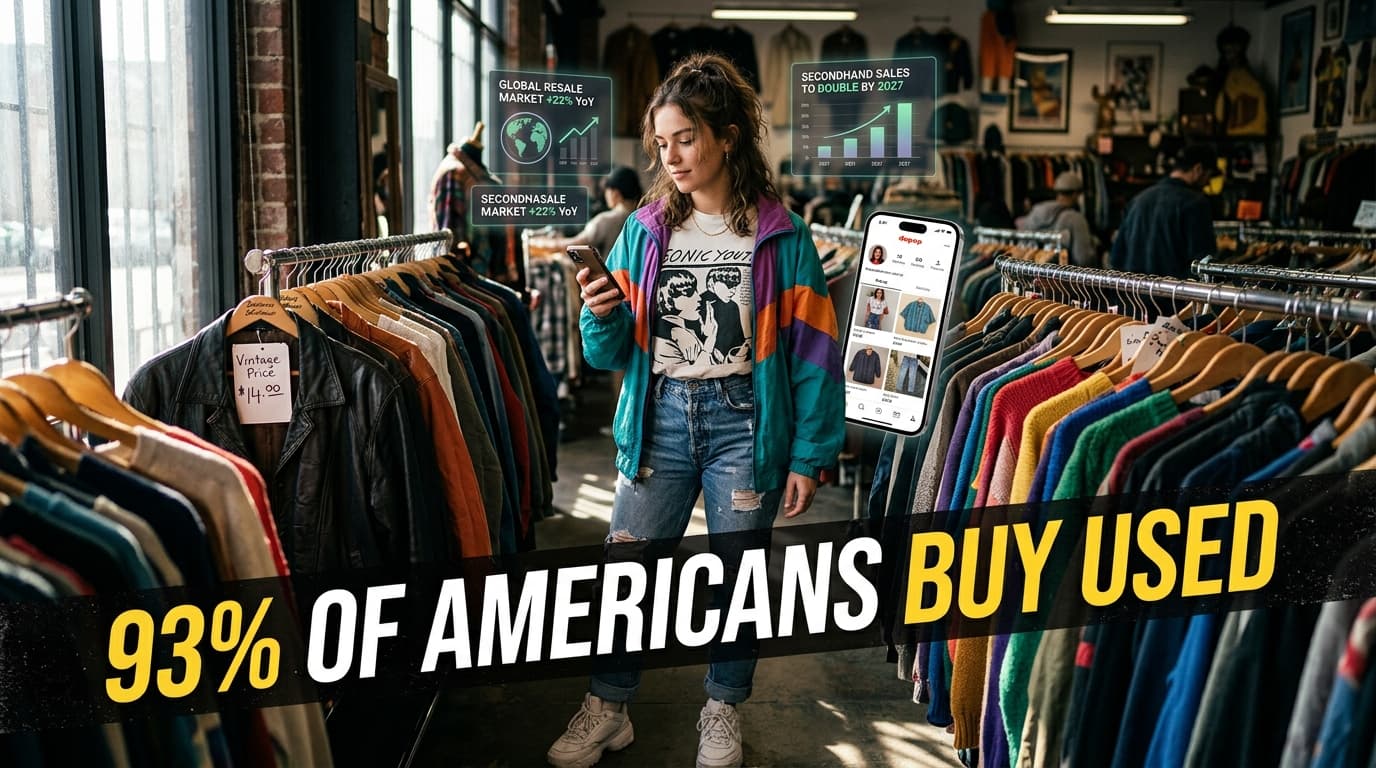
Ninety-three percent of Americans bought at least one secondhand item in the past year. Not a niche demographic. Not a specific income bracket. Virtually everyone. When a behavior reaches that kind of saturation, it stops being a trend and starts being the baseline, and the retailers and sellers who are still treating resale like a side channel are reading the map upside down.
The U.S. recommerce market is projected to hit $306.5 billion by 2030, representing nearly 8% of total retail spending. But here is the part that most coverage gets wrong: this is not a fashion story. Apparel accounts for only about 25% of resale activity. The other 75% is electronics, furniture, tools, sporting goods, and children's items. The resale economy is not a closet cleanout. It is how Americans buy appliances, power tools, baby gear, and laptops. Even at 93% participation, 19% of all U.S. consumers made their first-ever secondhand purchase in the past year. The ceiling keeps rising.
Tariffs, Inflation, and the Fear Economy Are Pouring Fuel on the Fire
Economic anxiety and resale behavior move together in a direct, measurable relationship. Sixty-nine percent of shoppers say they are more likely to buy or sell pre-owned items when financial news turns negative, and in 2025 and 2026, the financial news has been relentlessly negative. Tariffs have become a specific accelerant: 62% of consumers say rising trade costs will push them toward secondhand, and among younger generations that number climbs to 66%.
The behavior is not just about buying cheaper. It is also about generating income to stay afloat. Fifty-seven percent of resale sellers use what they earn to pay bills and cover everyday expenses. This is not hobby money or discretionary spending. For a meaningful slice of American households, resale income is a financial buffer against a volatile economy. Todd Dunlap, CEO of OfferUp, put it plainly: "In a world of economic uncertainty and rising prices, resale offers real value." The 79% of secondhand buyers who cite saving money as their primary motivation are not bargain hunters in the casual sense. They are making rational, necessary decisions.
Gen Z Didn't Just Adopt Resale. They Rewired It.
Gen Z did not inherit resale culture from their parents and adapt it. They rebuilt it from scratch with different priorities and different expectations. Fifty-four percent of Gen Z consumers prefer secondhand when it is available, compared to 44% of Millennials. Nearly half of Gen Z, 49%, sold a pre-owned item for the first time in the past year alone, and roughly a third of those sellers earned between $301 and $500 annually from those transactions.
Here is the counterintuitive part. Despite being the most digitally native generation in history, 75% of Gen Z resellers say they enjoy meeting in person to finalize purchases, a higher share than any other generation. The explanation is not nostalgia. It is community. One OfferUp user described a book-selling relationship that evolved over repeated meetups into a genuine friendship, with 45-minute conversations that eventually led to lunch. That is not an anomaly. For Gen Z, resale is a social infrastructure as much as an economic one, and the platforms that treat it as purely transactional are missing what actually keeps this generation engaged.
Resale Is Now Changing How People Buy New
The most structurally significant shift in the data is not about secondhand purchases at all. It is about first-purchase decisions. Forty-seven percent of consumers now factor resale value into their buying decisions when purchasing new items. They are not just thinking about what something costs today. They are underwriting the purchase against what they can recover later.
This logic is already reshaping purchasing behavior in visible ways. Twenty-six percent of consumers have cut back on cheap, low-quality apparel specifically because they cannot resell it. Forty percent say they prefer to try a brand secondhand before committing to buying new, a figure that jumped 17 percentage points in a single year. ThredUp CEO James Reinhart described this as consumers "increasingly thinking secondhand first," and 94% of retail executives now acknowledge their customers are already participating in resale. Resale is not running parallel to retail anymore. It has become part of how retail works.
The Platform Problem: Where the Money Goes and Where the Risk Lives
The resale boom has a structural problem that the headline numbers tend to obscure. The platforms most people use to participate offer either protection or low cost, but not both. eBay takes 10 to 15% from sellers. Amazon takes 15 to 45%. Etsy charges 6.5% and up. Facebook Marketplace and Craigslist are free, but they offer zero buyer or seller protection of any kind.
That trust gap has a measurable behavioral consequence. Sixty-three percent of resale shoppers say they meet in person specifically to reduce the risk of scams or unreliable counterparties. That is the number one stated reason for preferring face-to-face transactions over completing deals online. People are not choosing in-person meetups because they enjoy the inconvenience. They are doing it because the platforms they are using gave them no better option. Meanwhile, the average consumer uses four different marketplaces in a three-month period, and 47% start their shopping journeys on marketplaces rather than search engines or brand sites. The volume is enormous. The infrastructure protecting participants in that volume is thin.
What the Next Phase of Resale Actually Needs
The resale economy is not slowing down. Online resale is expected to nearly double by 2029, reaching $40 billion, and that projection was made before the current tariff environment fully materialized. The demand side is solved. What is not solved is the infrastructure problem sitting underneath it: sellers are being taxed by the platforms they depend on, and buyers are either overpaying for protection or going without it entirely.
The direction the market is moving is toward platforms that separate those two problems and fix both of them. Fisheez is built around exactly that logic. Sellers pay 0%, full stop. The platform's service fee falls on buyers, structured on a tiered scale that runs from 8% on transactions under $50 down to 0.5% on transactions over $10 million. For sellers who have been routing around eBay's 15% cut or Amazon's 45% ceiling, the math is not subtle.
The trust problem gets addressed at the infrastructure level through SmartShell Escrow, a smart contract system that holds buyer funds in USDC on the BASE blockchain until the transaction is confirmed, releasing on timer expiry, early buyer confirmation, or the outcome of a Peacemaker dispute. That last piece matters: Peacemakers are trained community volunteers who resolve disputes and earn eligibility for prize pools through their participation, which removes the incentive to split every decision down the middle. It is a direct structural answer to the 63% of resale shoppers who currently solve the scam problem by driving across town. There is also a layer of recommerce built into the platform's own economics: TideTurner NFTs provide buyers with tiered fee discounts and are themselves resellable, meaning the discount mechanism is a tradeable asset. That is not a gimmick. It is a signal that the platform was designed by people who actually understand what the recommerce economy is becoming.
The secondhand economy has already crossed the threshold. The sellers who will profit from the next phase are the ones who treat platform economics and transaction safety as structural decisions, not afterthoughts.