
The Resale Category That Beat Apple, Coach, and Every Luxury Brand in 2025
Nintendo won.
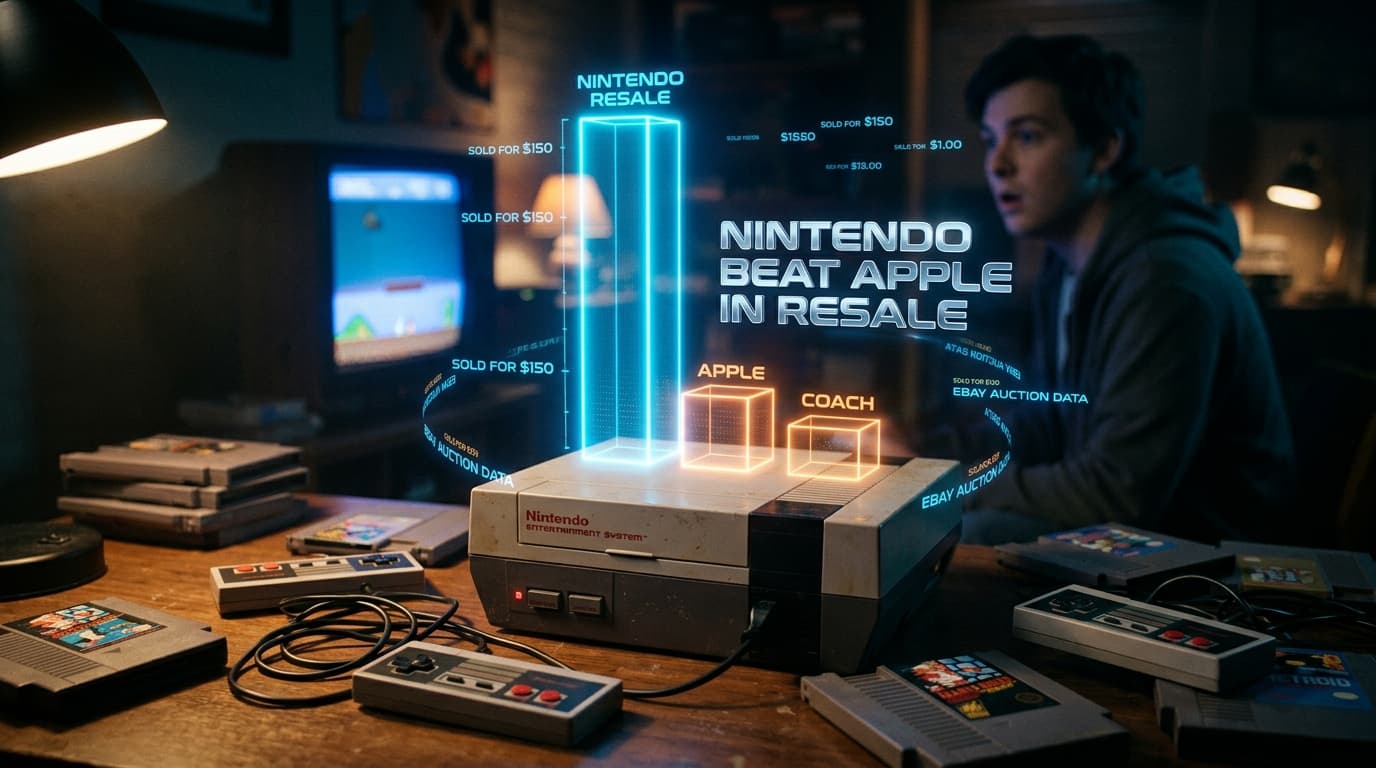
Not Apple. Not Tiffany. Not Nike. Nintendo, the company best known for a plumber who jumps on mushrooms, was the single top-performing brand in secondhand revenue and units sold across every resale category in 2025. Retro consoles and classic cartridges generated $7.75 million from over 158,000 units, at an average price of $49 per item that held steady even as volume grew 53% year over year. If that surprises you, it should. It means the mental model most sellers carry into resale, the one that says "premium brand equals most profitable," is wrong in ways that are costing them real money.
The broader numbers are staggering enough to reframe the whole conversation. The global C2C e-commerce market sat at $3.1 trillion in 2025 and is projected to reach $11.2 trillion by 2033, growing at a 24.8% compound annual rate. Upright Labs processed 20 million secondhand orders in 2025, with the clothing, shoes, and accessories category alone generating nearly $60 million in revenue from 2.5 million items sold. These are not projections or surveys. They are transaction records. The resale opportunity is not coming. It is already here, and the sellers capturing the most of it are the ones following the data, not their assumptions.
Where the Money Actually Is: Category-by-Category Breakdown
Electronics is the most obvious resale category, and the data confirms it has real scale, but the brand hierarchy will surprise you. Apple came in at number two with $7.9 million in revenue and 29% unit growth. Sony generated $5.76 million with a remarkable 60.7% unit growth over 2024. And if you think Sony's resale story is just about smartphones and headphones, consider this: Walkman-branded devices made a genuine comeback in 2025, described by Upright Labs analysts as a small but notable nostalgia play. Nostalgia, it turns out, is a pricing driver, not just a marketing trope.
Apparel tells a more counterintuitive story. Nike moved 157,000 units in 2025, a 73.8% increase over 2024, making it a volume play. Coach operated differently: $5.48 million in revenue with an average price per item of $38, up nearly $10 from the prior year. Analysts attributed this to either higher-quality pieces entering the market or better recognition of premium Coach items by experienced resellers. The lesson is that seller knowledge directly affects realized prices, independent of supply and demand. The most overlooked data point in the apparel category, though, is this: unbranded items generated $24.3 million in revenue. Sellers who assume they need recognizable labels to compete are leaving substantial money on the table.
Jewelry is quietly one of the highest-margin opportunities in resale right now. Gold hitting a historic $4,000 per ounce in October 2025 pushed the average jewelry price per item up 13.5%, from $61 to nearly $70. Tiffany led the category with $1.26 million in total revenue, with fine bracelets and earrings averaging $985 and men's bracelets averaging $2,400 in top-tier segments. Seiko watches came in second at $775,000, with a 17.8% increase in average price per item. Collectibles round out the picture: LEGO nearly doubled its unit sales (98% growth) to reach $5 million in revenue, and Magic: The Gathering generated $445,000 at an average of $86 per item. Sports and trading cards averaged $91 per item, outperforming many apparel sub-categories on a per-unit basis while requiring minimal storage space.
Why Demand Is Structurally Growing, Not Just Trending
The demand side of resale is being reinforced by three forces that are not going away. The first is macroeconomic. In a survey conducted alongside the 2025 resale data, 59% of shoppers said they would choose secondhand if new clothing prices rise due to tariffs. That is not a niche preference. That is a majority consumer behavior shift driven by real purchasing pressure.
The second force is generational. Sixty-nine percent of Millennials and Gen Z consumers actively pivot toward resale for sustainability reasons. This is not a passing trend for a demographic that will age out of it. These buyers are forming lifelong purchasing habits right now, and resale is part of them.
The third force is structural scale. A market growing at 24.8% annually from a $3.1 trillion base does not behave like a fad. It behaves like a category rewrite. Upright Labs framed it directly: organizations that use data-driven strategies, standardized brand naming, category mapping, structured attributes, and KPI-driven sourcing will capture the most value in 2026. The sellers who treat resale as a side hustle governed by intuition are competing against sellers who treat it as a data problem.
The AI Discovery Channel Most Sellers Are Ignoring
Here is a number that should change how you think about listing quality: AI platform-driven ecommerce, through tools like ChatGPT, Google AI, and Perplexity, will exceed $20 billion in 2026 and surpass $144 billion by 2029, representing 8.8% of total retail ecommerce. That is nearly one in eleven online retail dollars flowing through AI platforms within three years.
The critical nuance, from eMarketer analyst Carina Lamb's January 2026 report, is that AI is currently a discovery channel, not a checkout channel. Most AI-driven transactions are still completed on retailer websites. What this means practically is that a buyer asks an AI assistant for recommendations, gets a list, and then clicks through to complete the purchase on a platform. If your listing is not structured in a way that AI can read and surface, you are invisible to a channel that is growing faster than any other in retail. Structured attributes, accurate brand naming, and clean category mapping are not just good listing hygiene. They are the foundation of AI discoverability, and the sellers who build that foundation now will have a compounding advantage as the channel matures.
The Platform Fee Problem: Why Your Margins Are Smaller Than They Should Be
The resale opportunity is real. The fee structures on the platforms most sellers default to are quietly eating it. eBay charges sellers 10 to 15%. Amazon charges 15 to 45%. Etsy charges 6.5% plus additional transaction and payment processing fees. Fiverr and Upwork charge freelancers 20%. Facebook Marketplace and Craigslist are free, but they offer zero transaction protection, which is a different kind of cost.
Consider what fees do to the Coach story. At $38 average per item, a 15% eBay fee takes $5.70 off every sale before you account for shipping, packaging, or sourcing costs. That $10 year-over-year price improvement Coach sellers earned in 2025 gets almost entirely absorbed by platform fees before it reaches the seller's pocket. At scale, this is not a minor inconvenience. It is a structural tax on resale economics. Fisheez charges sellers 0%, with buyers paying a tiered service fee that starts at 8% on transactions under $50 and scales down to 0.5% on transactions over $10 million. The fee burden shifts to the buyer side, which means sellers keep more of what the market is willing to pay.
The Trust Problem Is Real, and the FTC Has the Receipts
The resale and e-commerce opportunity space has a documented fraud problem, and it is not abstract. In October 2024, the FTC filed suit against Steven J. Mayer and his company Ecom Genie Consulting for promising consumers they could earn "$100K+ per month" selling on Amazon and Walmart through "done-for-you" store operations. By July 2025, Mayer faced a nearly $14 million judgment and a permanent ban from business opportunity sales. Defendants were required to surrender commercial real estate in Canada worth more than $300,000, and roughly $1.7 million in cash. Co-defendants Profitable Automation and Lunar Capital Ventures, two other entities operating the same scheme under different names, were also permanently banned. Profitable Automation was required to turn over $73,000 in cash.
Christopher Mufarrige, Director of the FTC Bureau of Consumer Protection, was direct: "These defendants took advantage of people looking to provide for their families and obtain financial security. The FTC will take action against those who promise big returns that they can't back up." The red flag pattern here is worth memorizing: multiple operating entities, "done-for-you" promises, claims of million-dollar store operations, and income projections that require no skill or effort from the buyer. The scam did not just exploit naive people. It exploited the credibility of Amazon and Walmart's brand names to create false legitimacy.
The trust problem extends beyond outright fraud. Facebook Marketplace and Craigslist offer no escrow and no payment protection. Platform-mediated disputes on eBay and Amazon are resolved by corporate support agents whose incentives are not necessarily aligned with yours. The C2C market's own research identifies fraud prevention and establishing trust between unknown buyers and sellers as its number one structural challenge. SmartShell Escrow on Fisheez addresses this directly: buyer funds lock in a USDC smart contract on the BASE blockchain at payment and release only on timer expiry, early buyer release, or dispute outcome. No bank, no middleman, no platform agent making a judgment call.
How to Sell Smarter in 2026: Platform, Protection, and Positioning
The data in this article points toward three concrete decisions. Source into the categories the transaction records confirm, not the ones that feel obvious. Nintendo, unbranded apparel, LEGO, jewelry, and trading cards are all generating documented revenue at scale. Structure your listings for AI discoverability now, with accurate brand names, clean category mapping, and complete attributes, because the $144 billion AI commerce channel rewards sellers who do the work before their competitors do. Choose a platform where the fee structure does not compound against you every time the market moves in your favor.
Fisheez was built for exactly this moment. Sellers pay 0%, full stop. Buyers pay a tiered service fee that scales with transaction size, which means the platform's economics align with closing deals rather than extracting margin from sellers. SmartShell Escrow solves the trust problem the C2C market identifies as its biggest structural challenge: funds lock at payment and release only when the deal is genuinely done, with no bank or platform intermediary in the middle. Disputes go to Peacemakers, trained community volunteers who are eligible for prize pools but are not paid per dispute, which means their incentive is resolution quality, not case volume.
For high-volume buyers, TideTurner NFTs offer tiered fee discounts up to 100% at the Whale level, and the NFTs are resellable, so the discount itself has market value. Sellers who want to expand reach without upfront ad costs can open listings to the Promoter Program, where promoters earn automatic commission via smart contract. The platform also supports services and milestone-based contracts through nested SmartShell Escrow, which means it is not limited to physical goods resale.
The resale market in 2026 is generating real, documented money in categories most sellers overlook. The sellers who capture the most of it will be the ones who follow the transaction data, choose platforms that do not eat their margin, and build trust into every transaction from the start, not as an afterthought.