

The Numbers Behind the Surge
99% of U.S. counties experienced a flooding event between 1996 and 2019. Not 99% of flood-zone counties. Not 99% of coastal counties. All of them. That single statistic reframes every conversation about mold remediation demand, because it means the question for property managers was never whether water damage would happen, but when. And the "when" is accelerating fast enough that the $1.23 billion global mold remediation market is now projected to hit $1.52 billion by 2030, growing at a steady 3% annually regardless of whether any single hurricane season is above average.
2023 was the worst year on record for U.S. billion-dollar weather disasters: 28 events, minimum $92.9 billion in losses, surpassing the previous record of 22 events set in 2020. The total U.S. weather disaster bill over the past five years cleared $603 billion. These are not anomalies being smoothed out in a long-run average. They are the new baseline, and mold removal service trends are tracking directly alongside them. North America already holds 39% of global remediation market share, and the Eastern U.S. is experiencing 70% more heavy downpours annually than it was a generation ago.
Why Demand Isn't Going Back Down
Here is the part most property managers get wrong: flooding is not the primary driver of mold. Internal plumbing failures are. Leaking pipes, failing water heaters, slow toilet seals, roof penetrations that go unnoticed for months. These are the sources behind water damage being the second most common home insurance claim in the country. 98% of basements will experience water damage over their lifetime, and the vast majority of those events have nothing to do with a named storm.
This matters because it means flood-zone thinking is incomplete risk assessment. If your exposure model is built around storm probability, you are underestimating your actual mold exposure by a wide margin. Grand View Research specifically cites aging infrastructure as a structural demand driver, noting that aging pipes and inadequate ventilation create ideal mold conditions in buildings that have never flooded once. Natural disasters have surged fivefold over 50 years according to WMO data, but the baseline internal-failure risk was already climbing before climate acceleration added fuel. Mold removal service trends are not cyclical. They are structural, and the infrastructure driving them is only getting older.
Who's Actually Showing Up to Do the Work
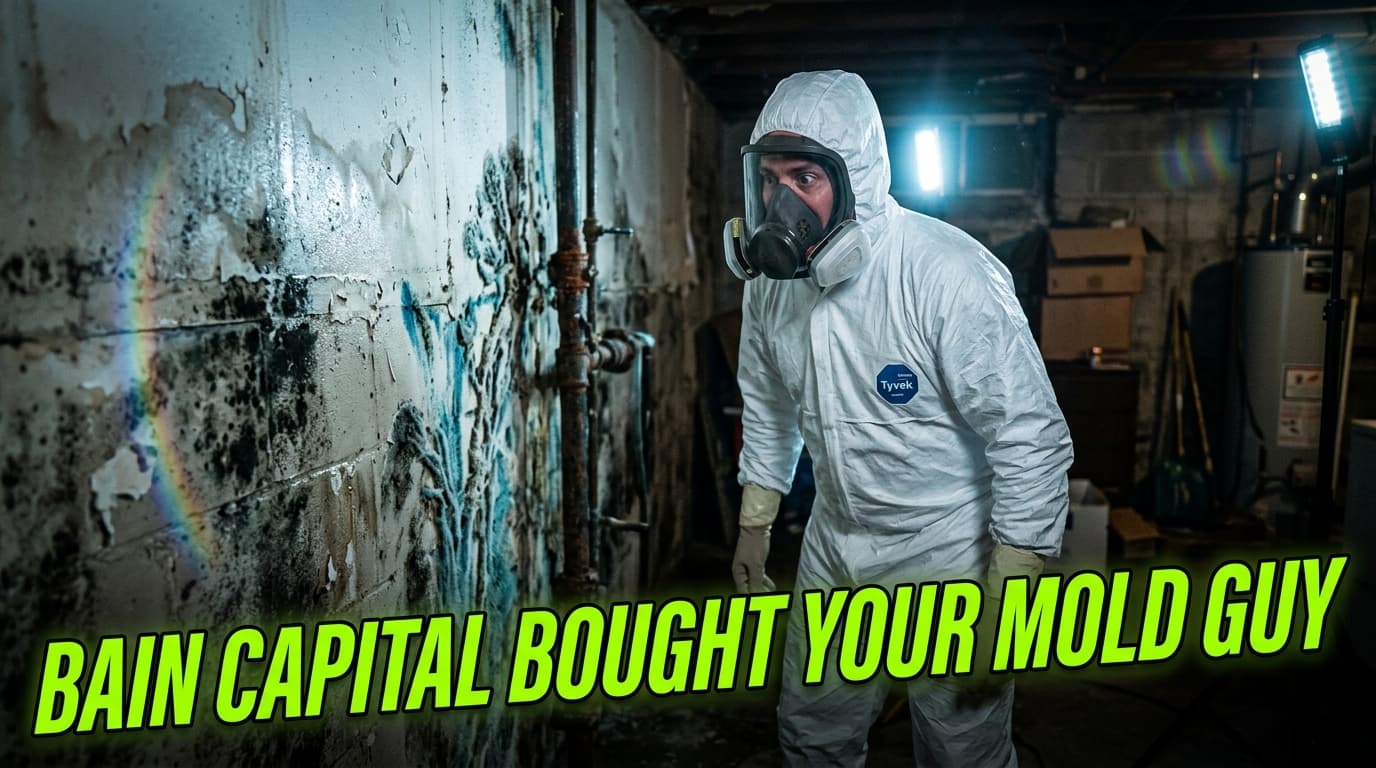
The contractor who shows up at your property after the next water event may be wearing a local company shirt. The check you write may go to Bain Capital. In June 2023, Bain acquired ServiceMaster Restore, one of the largest restoration franchises in the U.S. In February 2024, Summit Partners acquired Insurcomm, a multi-service remediation firm covering mold, fire, and asbestos. On January 31, 2024, DryMaster Restoration was absorbed by Blackmon Mooring, itself backed by AEA Investors, a firm managing over $10 billion in assets. Then on April 8, 2024, Alpine Investors' platform company Guardian Restoration Partners acquired two separate mold and water damage companies in a single day.
Private equity is rolling up the local mold contractor market at a pace most property managers have not registered yet. Hyde Park Capital noted in their Spring 2024 market report that restoration repairs are work most individuals are unwilling to attempt themselves, making the sector uniquely resistant to DIY displacement. That is exactly the kind of defensible margin PE firms chase. The global disaster restoration market is projected to grow from $70 billion in 2024 to $92.2 billion by 2029. Institutional capital has already decided this market is permanent. The question is whether your vetting process has caught up.
The Credential Trap Property Managers Fall Into
The BBB has published guidance that most property managers have never read, and the headline finding is a genuine problem: the federal government does not certify mold remediation contractors. There is no such thing as a "nationally certified" mold remediator. Any contractor leading with that credential is displaying a fraud red flag, not a trust signal. Property managers have been trained to treat certification as a proxy for competence. In mold remediation, it is sometimes the opposite.
The fraud pattern is well-documented. Storm chasers knock on doors after disasters, offer deals contingent on hiring on the spot, and disappear after collecting upfront payment. The subtler trap, though, is the one that plays out in the credential conversation itself. A contractor who promises to make your building "mold free" is also flagging themselves, because the BBB is explicit that no building can be made mold-free. Remediation is the accurate term. Eradication is the sales pitch. The most credible pros in this market are the ones making smaller promises, and the property managers who understand mold removal service trends well enough to know that are the ones selecting for honesty rather than marketing. State certifications do exist in some jurisdictions, but they vary, and verifying them is your responsibility, not the contractor's.
How to Vet in a Market This Chaotic
Credentials are unreliable. Consolidation means you may not know who you're actually hiring. Demand pressure after every major storm floods the market with actors of varying quality. In this environment, the most useful vetting tool is not a certificate check. It is payment structure, because how a contractor is willing to be paid reveals exactly how confident they are in their own work.
A legitimate mold remediation job has natural phases: inspection and assessment, containment, active remediation, and clearance testing. Each phase has a verifiable outcome. That structure maps directly onto milestone-based payment, where funds are released as each phase is confirmed complete rather than handed over at the start. FEMA data puts the cost of one inch of water in a small home above $11,000 before mold remediation even begins. The stakes of a bad hire are not abstract. Platforms like Fisheez support SmartShell milestone escrow, where buyer funds are locked in a smart contract and released against verified project phases, which means a property manager can structure a multi-phase mold job with payment tied to confirmed progress rather than contractor assurances. That is a structural solution to a vetting problem that credentials cannot solve.
Where the Demand Is Hottest Right Now
Geography matters for calibrating how much contractor availability pressure you are likely to face. North America dominates global mold remediation volume at 39% of the market, but within the continent, the Eastern U.S. is carrying disproportionate load given the 70% increase in heavy downpour frequency. The top ten most significant NFIP flood events by payout since 1978 have all occurred in the past 23 years, which means the worst of the insured flood history is entirely a modern problem, not a historical baseline.
On the demand composition side, residential properties account for 58.7% of the remediation market, but commercial is growing at 3.9% annually, which is meaningful for property managers running mixed or commercial portfolios. Drywall drives 35.7% of remediation work by surface type, a reflection of how widely the material is used in moisture-prone environments. Carpet and upholstery remediation is the fastest-growing surface segment at 4.3% annually, signaling where specialist scarcity may emerge first. Mold removal service trends at the regional and material level are already telling you where to expect contractor shortages and inflated quotes after the next major event in your area.
The Hire That Protects Itself
The convergence of factors in this market creates a specific kind of exposure for property managers still running the old playbook. Credentials are unreliable, sometimes fraudulent. Consolidation means the "local shop" may be a PE-backed roll-up with different incentive structures than the owner-operator you thought you were hiring. Demand spikes after every major storm, and bad actors multiply in direct proportion to urgency. In that environment, the durable protection is not a better checklist. It is a payment structure that withholds funds until work is verified.
That is the direction the market is moving. Fisheez SmartShell escrow locks buyer funds in a smart contract in USDC on the BASE network, releasing only on confirmed completion, timer expiry, or dispute resolution. No bank holds the money. No contractor can disappear with an upfront payment. For a multi-phase mold job, nested milestone contracts mean each phase of the project, from inspection and containment through remediation and clearance testing, can carry its own release condition, so payment tracks verified progress rather than contractor promises. When something goes wrong, Peacemakers handle disputes as trained community volunteers who are eligible for prize pools through their participation, not paid arbitrators with an incentive to split every claim down the middle.
The fee structure also addresses a specific distortion in the current market. Fiverr and Upwork take 20% from service providers. A remediation pro earning $2,000 per job on those platforms loses $400 before expenses. That margin pressure flows directly into quoted prices, and property managers absorb it without knowing. Fisheez charges sellers 0%, which means vetted mold remediation pros on the platform are not inflating quotes to recover platform costs. High-reputation contractors can also build referral networks through the Promoter Program, where commissions come from seller proceeds, not from additional buyer fees. Mold removal service trends point toward a market that is larger, more institutionalized, and more fraud-prone than it was five years ago. The payment infrastructure you use to hire into that market is no longer a back-office detail. It is the vetting mechanism.