
The Listing That Almost Got Away
She almost scrolled past it. A 1970s Rider-Waite-Smith deck, $150, listed by a seller with a dozen reviews and three photos shot in natural light. The cards looked worn in the right places. The price felt fair. But she stopped on one question she couldn't shake: how do you actually know it's real?
It's a question more people are asking. Tarot has quietly crossed from fringe to mainstream, showing up in wellness studios, self-improvement circles, and yes, gyms. The global tarot market is forecast to grow by nearly $210 million between 2025 and 2029, and e-commerce platforms are the primary engine driving that growth. More listings means more volume, and more volume means more opportunity for things to go wrong. Buying metaphysical religious items online has never been more popular, or more complicated.
Why "Safe" Platforms Are Not Actually Safe
The first instinct most buyers have is to stick to a recognizable platform. Amazon, eBay, somewhere with a logo they trust. The data does not support that instinct. A survey of 1,300 secondhand buyers found that 32% had been scammed on a marketplace in the two years to January 2024. Nearly one in three. And the brand name on the platform barely moves that number: Amazon Marketplace posted a 35% buyer scam rate, eBay came in at 29%, and Depop hit 57%. The platform you trust is not the protection you think it is.
In the first six months of 2023 alone, 77,000 purchase scam cases were reported to UK banks, accounting for £41 million in losses. Across all of 2024, consumers lost more than $3 billion to scams that started online, compared to roughly $1.9 billion lost through phone calls, texts, and emails. The risk has migrated to the same channels where you shop. Rocio Concha, Director of Policy and Advocacy at Which?, put it plainly: properly checking a seller's reviews and profile is the minimum anyone should do before buying. The platform's reputation is not a substitute for doing that work yourself.
The Counterintuitive Authenticity Signals
Here is the thing that trips up almost every buyer of vintage or collectible tarot decks: you are looking for the wrong thing. Pristine condition is not a green flag. For genuinely old decks, slight asymmetry, uneven wear, and irregular tool marks are the signals that confirm authenticity. A vintage deck in suspiciously perfect condition should raise your suspicion, not your confidence. The fakes are often the beautiful ones.
This inverted logic extends to the deck's origin story. Twisted Thistle Apothecary, a specialist metaphysical retailer, frames creator research as a core authentication step, not just a matter of personal taste. Researching the deck artist's background, their approach to symbolism, and their spiritual philosophy tells you whether the work is coherent and intentional, which is exactly what a mass-produced counterfeit cannot replicate. Price works the same way: if a deck feels unusually cheap for what it claims to be, it probably is. When you are buying metaphysical religious items with genuine provenance, the price reflects the craftsmanship and the care behind it.
The $50 Toolkit That Protects a $150 Purchase
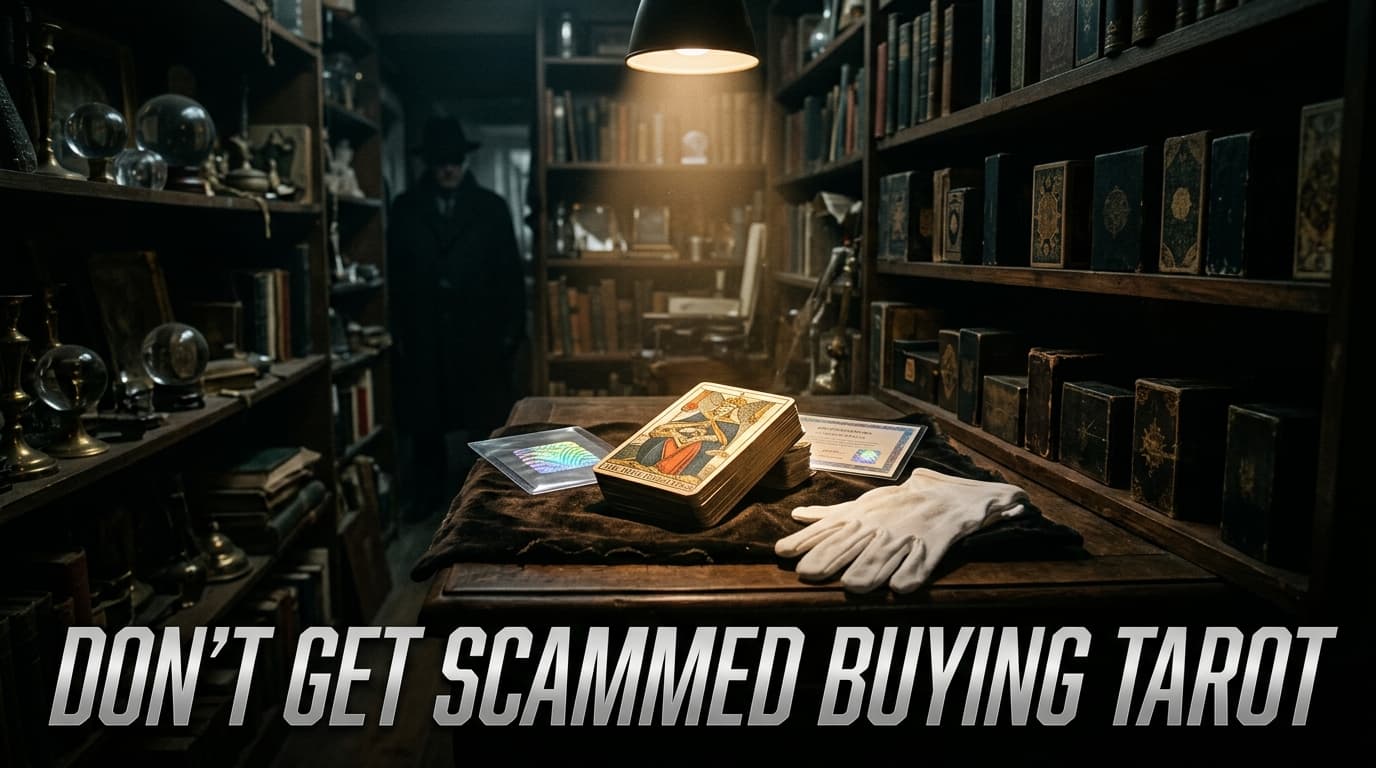
A 10x loupe costs less than $20 and is, according to authentication experts, the single most indispensable tool for examining print quality, card stock consistency, and edge finishing. A UV flashlight, which runs $20 to $100, reveals something even more useful: modern glues, overpainting, and synthetic fibers glow unnaturally bright under UV light, while genuine antique materials show dull or minimal fluorescence. A "vintage" deck with components that light up like a concert stage is almost certainly not what the listing claims.
A complete home toolkit, including a loupe, UV light, reference app, and digital microscope, costs between $30 and $150. That is the same price as the deck you are trying to authenticate. As AntiqueSmart puts it, no single test is perfect, but together they build a strong case for authenticity. If you are spending $150 on a collectible, spending $50 on the means to verify it is not excessive. It is the actual cost of the transaction. For higher-value purchases, professional lab services can run a few hundred dollars using XRF spectrometry, which determines elemental composition without damaging the item. For most buyers, though, the loupe and the UV light are where to start.
Vetting the Seller Before You Vet the Deck
Before you look at the cards, look at the account. How old is the seller profile? What does the review history actually say, not just the star rating but the written comments? How quickly do they respond to questions, and how specifically? Thin profiles, vague answers, and recently created accounts are all signals worth noting. An international investigation by The Guardian, Die Zeit, and Le Monde exposed a vast network of fake shops, linked to organized operations, that collected payment and personal details from buyers who received nothing. Individual bad actors are not the only threat; sophisticated networks operate on the same platforms where you shop.
One detail most buyers miss: sellers are fraud victims too. In the same Which? survey, 22% of sellers reported being scammed on secondhand marketplaces. That means even a well-intentioned seller may be operating a compromised account without knowing it. The structural answer to this is payment escrow, where funds are held by a neutral party until both sides confirm the deal is complete. Fisheez, a peer-to-peer marketplace built on blockchain escrow, handles this with a specific mechanic: when a buyer funds a transaction, the seller has a 72-hour window to acknowledge it. If the seller goes silent, SmartShell automatically refunds the buyer. Not a helpdesk ticket. An automatic refund.
How She Locked In the Deal, and What Happened Next
She did the work. She researched the deck's creator, read about the original print run, and confirmed that the wear patterns in the photos were consistent with genuine age rather than artificial distressing. She ran a UV flashlight over the cards when they arrived. She checked the seller's profile history before she paid a cent. The deck was real. The readings that followed were, by her account, the most accurate she had ever done.
None of those steps felt natural the first time. Checking a seller's profile history before buying metaphysical religious items feels like bringing a spreadsheet to a spiritual experience. Using a UV light on tarot cards feels like overkill. It is not. These are exactly the moves that the data supports, and exactly the moves that most buyers skip.
The payment side of her transaction was handled through Fisheez, where the buyer service fee on a $150 purchase sits at 7.00%, which works out to $10.50. Sellers pay nothing. Her funds were held in escrow until she confirmed receipt and condition, and the 21-day return window with automatic refund was there if she needed it. She did not. Knowing it existed, though, changed how she felt about the whole transaction.
One platform detail worth knowing: if the seller holds a Whale TideTurner NFT membership, the buyer's fee drops to zero entirely, because the best available discount is always passed to the buyer. That is a platform mechanic worth keeping in mind when you are comparing your options.
The vetting moves that feel excessive are the ones that actually work. That is the whole story. Buying metaphysical religious items secondhand is not inherently risky; it is risky when buyers skip the steps that feel like too much. The $150 deck, the $50 toolkit, the seller profile check, the escrow payment: none of it is overkill. All of it is the job.