

The Income Gap Nobody Talks About
Creative freelancers make up 22% of the independent workforce but generate only 16% of revenues. That's the worst revenue-to-headcount ratio of any freelance category, and it has nothing to do with talent or demand. The buyers are there. The copywriting services market hit $25.29 billion in 2023 and is growing at 7.6% annually. U.S. businesses have increased freelance hiring by 260% in recent years. The problem isn't that companies stopped buying words.
The problem is structural, and most copywriters never diagnose it. More than half of freelance writers earn under $30,000 a year, and nearly three-quarters stay below $50,000. Only 9% reach six figures. The $5,000 per month target sits at roughly $60,000 annually, which is meaningfully above the median but well below the ceiling. Six-figure writers exist, their habits are documented, and the gap between where most copywriters land and where the top tier operates is almost entirely explained by pricing behavior and platform economics, not skill.
Why Most Copywriters Cap Out Before $3K
The first structural problem is per-word pricing. It sounds professional, especially to someone just starting out, but 84% of freelancers charging per word are in their first year of business. Experienced writers abandon it because it makes invisible labor invisible. As one surveyed writer put it: "Per project factors in research, thinking time, writing, editing and procrastination. It's easier to quote what you're worth. With per-hour and per-word, anything other than the actual writing of the words becomes harder to justify." Sixty-three percent of freelance writers use flat-fee project pricing. That's not a coincidence.
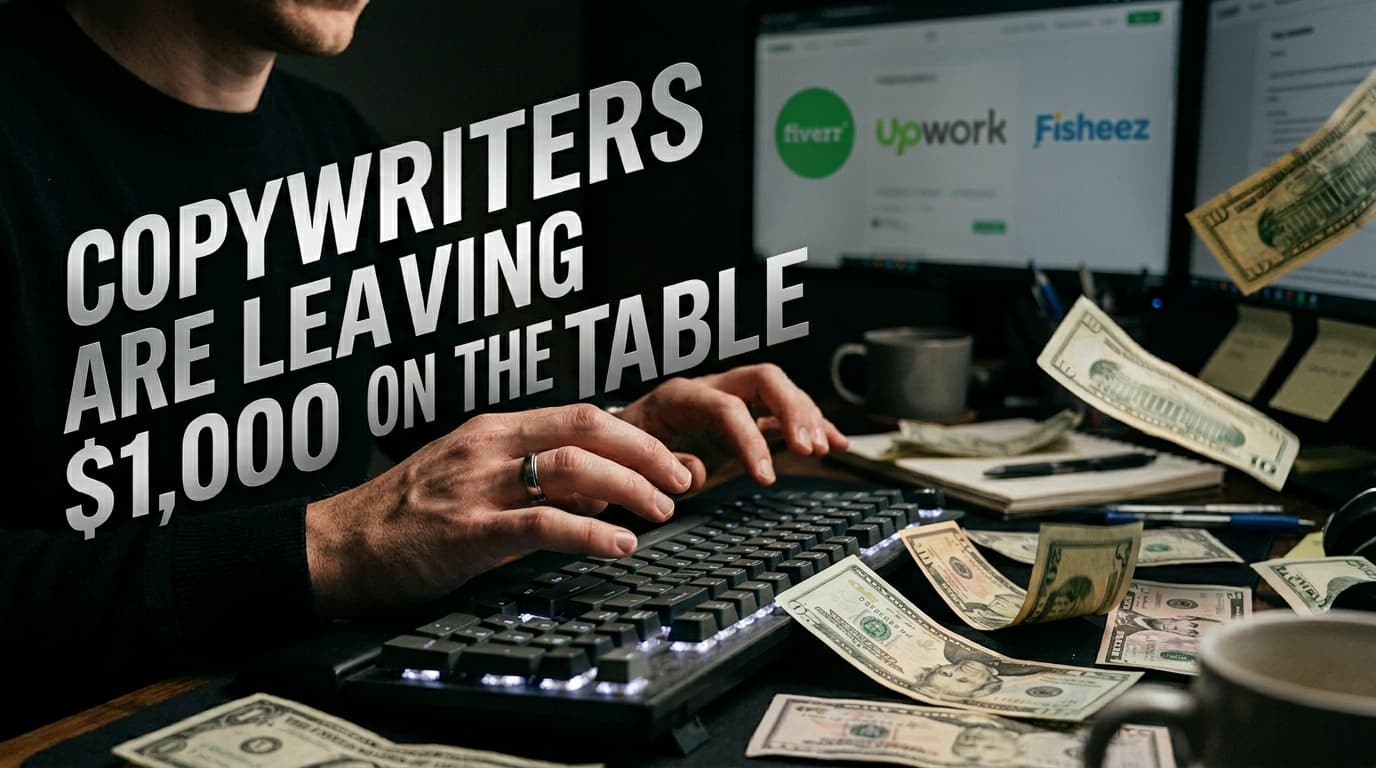
The second structural problem is platform fees, and this one is worth doing the math on explicitly. A copywriter selling sales copy services at $5,000 gross volume on a platform charging 20% seller fees, which is the standard rate on Fiverr and Upwork, takes home $4,000. The same copywriter, doing the same volume on a platform charging sellers nothing, takes home $5,000. That's the entire gap between missing the monthly goal and hitting it, before a single rate increase, before a single new client. Fisheez charges sellers 0%, with the buyer paying a tiered fee instead. The arithmetic is that direct.
What the $100K Writers Actually Charge
The pricing data for six-figure writers is specific enough to build a real model from. Half of writers earning over $100,000 per year charge at least $1,000 per blog post. Twenty-five percent charge more than $1,500 for a single 1,500-word article. Only 10% of six-figure writers charge under $399 per post. Compare that to the overall market, where the most popular rate for a 1,500-word post is $250 to $399, and you can see exactly where the income gap lives.
Running the monthly math makes the path concrete. At $500 per post, you need 10 projects to hit $5,000. At $1,000 per post, you need five. At $1,500, you need four, with $1,000 left over. The lever isn't working more hours; it's moving up the pricing tier. Whitepapers accelerate this further: 55% of writers charge over $1,000 per whitepaper, and 17% charge more than $3,000. Adding one whitepaper per month to a mid-tier blog post practice can close the $5K target with fewer total projects. The ProCopywriters survey pegs the professional benchmark day rate at roughly $555 USD, which means a writer hitting that rate consistently needs fewer than ten billable days a month to reach the goal.
How to Structure Your Marketplace Listing to Close B2B Buyers
B2B buyers represent over 45% of the copywriting market, and they are the segment worth targeting when selling sales copy services on a marketplace. They have longer engagements, higher budgets, and less price sensitivity than consumer-facing content buyers. They also respond to specific listing signals that most freelancers skip entirely.
Seventy-five percent of freelance writers don't publish their rates anywhere. Writers who do report a consistent outcome: fewer ghosted proposals, better-qualified leads, and faster conversions because the buyer already knows the approximate cost before the first message. One writer described it plainly: "Publishing guide rates on my site has filtered out the low-end clients, so the ones I end up speaking to know my approximate cost and are more likely to convert." The same logic applies to marketplace listings. A starting rate is a filter, and it works in your favor.
For high-value projects in the $2,000 to $5,000 range, structuring the work as milestone contracts reduces buyer risk significantly. Fisheez's SmartShell Escrow supports nested contracts where each milestone is locked and released independently, which matters to a B2B buyer committing to a full sales funnel or a multi-part email sequence. The FTC has noted that many online marketplaces leave disputes entirely to the parties involved, with no operator protection. Escrow-backed milestones are how you close large contracts with buyers who have never worked with you before.
The Compounding Asset: Reviews, Referrals, and Repeat Buyers
The referral gap between income tiers is one of the clearest signals in the data. For writers earning over $100,000 per year, 85% of their work comes through referrals and word of mouth. For writers earning under $30,000, that number is 64%. The difference isn't that high earners know more people; it's that their reputation compounds over time in a way that low-price, high-volume work never does. On a marketplace, reviews and repeat buyer relationships are the structural equivalent of referrals.
The rate escalation strategy that works in practice is incremental and consistent. One writer described their approach: "My first retainer gig with a content agency was $300 per post. Using that as a baseline anytime I took on a new client, I've added 10 to 20% to my rate, maybe a little more if it's right in my niche." Elise Dopson, founder of Peak Freelance, built her writing business to six figures over three years using a similar compounding approach. The timeline data confirms this isn't a shortcut game: every writer earning over $100,000 has been at it for at least two years, and 65% have been writing professionally for more than six years. The Fisheez Promoter Program functions as a passive distribution channel in this same vein, letting third parties market your listings and earn automatic commission through SmartShell when a sale closes. It's the marketplace equivalent of a referral network, without the manual follow-up.
Run the Math Before You Pick a Platform
The platform fee is a hidden income ceiling, and most copywriters calculate it only after they've already been paying it for months. The math is worth stating one more time with full clarity. At $5,000 gross volume, a 20% seller fee costs you $1,000. That's not a rounding error. That's the difference between a $4,000 month and a $5,000 month, at identical workload, identical rates, and identical client quality. Choosing a platform where sellers keep 100% of their rate is not a minor preference; it's a structural decision that determines whether the $5K target is reachable at your current volume or requires adding more projects you don't have time for.
The full roadmap, run in sequence, looks like this. Switch to flat-fee project pricing immediately, because per-word pricing is a beginner behavior that caps earnings before you've even set your rate. Target B2B buyers, because they represent 45% of the copywriting market and have the budgets to match. Publish a starting rate on your listing, because it filters out the clients who will ghost you and converts the ones who won't. Structure large projects as milestone contracts, because escrow-backed milestones are how you close $3,000 to $5,000 engagements with buyers who don't know you yet. Build reviews as a compounding asset, because the referral gap between income tiers is real and marketplace reputation is how you close it. Choose a platform where 100% of your rate is yours, because the direction the market is moving is toward seller-friendly economics, not away from them.
The industry is projected to reach $42.22 billion by 2030. The buyers are growing faster than the supply of well-positioned sellers. Fisheez offers a free Shorefront 1 entry tier with no listing fees and no seller commission taken at any point. The structural advantages are already built in. The only remaining variable is whether you run the math before or after you've been leaving money on the table.