
The Guys Saying EV Kills Resto Are Leaving Money on the Table
The custom restoration market was supposed to be collateral damage in the EV transition. That was the conventional wisdom heading into the mid-2020s, and plenty of shop owners bought it. They watched EV adoption numbers climb and quietly started bracing for the slow death of traditional restoration revenue. Here is what actually happened instead: the collector vehicle market held firm, EV conversion demand started outpacing available skilled fabricators, and a new category of high-ticket work opened up that most shops were completely unprepared to capture. The mechanics who called EV a threat are still waiting for the floor to drop out. The ones who called it an opportunity are already stacking gigs.
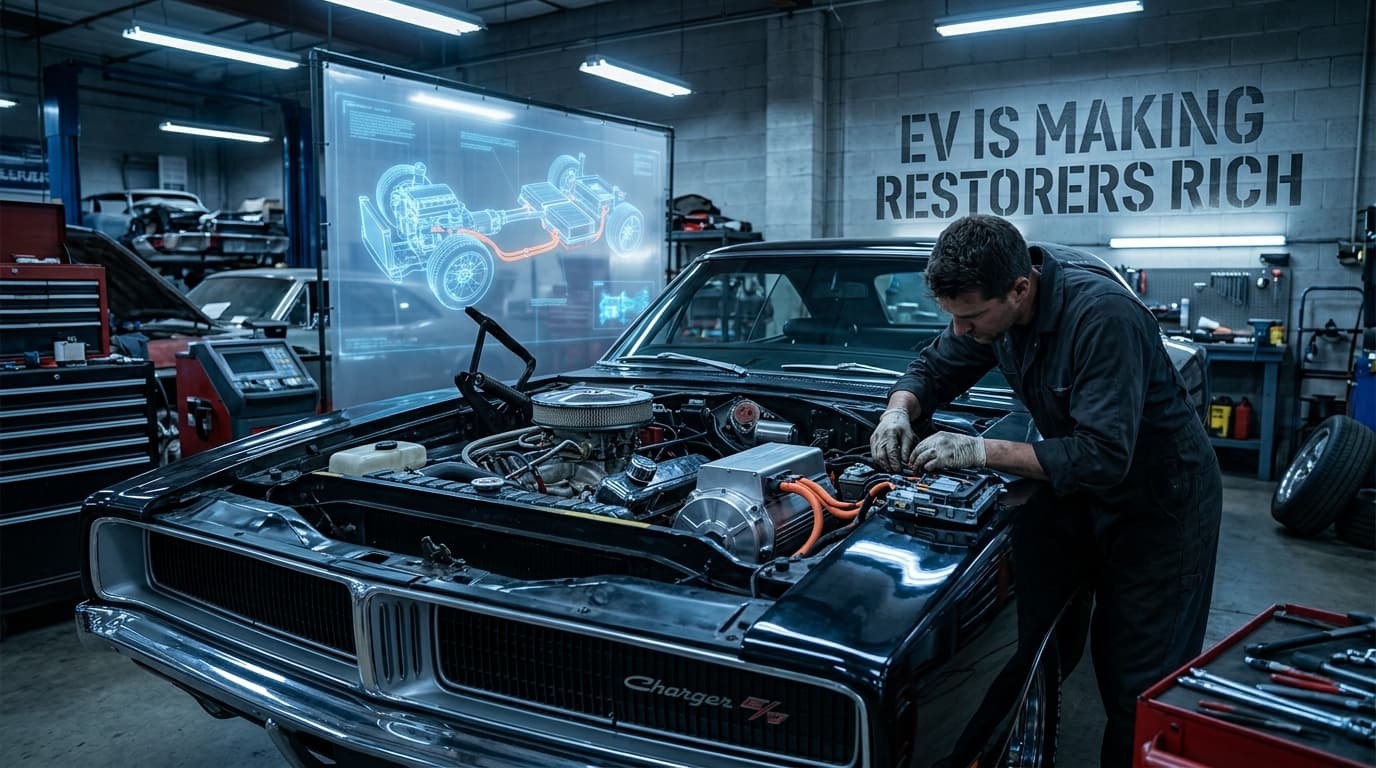
The fabrication services market has been expanding steadily through the mid-2020s, with specialty automotive work driving a meaningful share of that growth. EV restomod conversions, where a classic body gets a modern electric drivetrain installed with full custom fabrication work, have moved from curiosity to legitimate market segment. Collector buyers have not abandoned their 1969 Camaros or their vintage Land Rovers; they have started asking whether those vehicles can run on a modern drivetrain without sacrificing the aesthetic. That question is worth real money to the fabricator who can answer it credibly. The auto restoration selling trends that matter right now are not pointing toward decline; they are pointing toward a bifurcation, where generalist shops struggle and specialists with the right positioning clean up.
Understanding the Three-Gig Stack
The opportunity here is not one revenue stream, it is three, and the smart play is running all of them simultaneously. First stream: full EV restomod conversions, where you take a classic vehicle and do the complete fabrication and integration work to accommodate a modern electric drivetrain. Second stream: subcontract fabrication for EV specialty shops that have the electrical and software expertise but cannot weld a battery tray mount to save their lives. Third stream: component sourcing as a specialist intermediary, where your knowledge of both legacy fabrication and EV hardware lets you procure and mark up parts that generalist buyers cannot evaluate independently.
What makes this stack powerful is that each gig feeds the others. Your restomod conversion work builds your reputation and your component supplier relationships. Those supplier relationships make you a credible sourcing partner for subcontract clients. The subcontract volume keeps your shop busy between larger conversion projects and introduces you to EV shops that might eventually send you restomod referrals. You are not juggling three unrelated businesses; you are running one integrated positioning strategy with three revenue expressions. That is a fundamentally different thing, and it is where the current auto restoration selling trends are creating the most durable advantage for shops willing to commit to it.
Hack #1: Niche Down to Scale Up with EV Restomod Positioning
Your metalwork skills are not less valuable in an EV world; they are more valuable, because the number of fabricators who understand both classic vehicle construction and EV drivetrain integration requirements is genuinely small. The positioning move is to stop presenting yourself as a restoration shop that can do EV work and start presenting yourself as an EV restomod specialist who happens to have deep restoration roots. That reframe changes your price ceiling immediately.
Vehicle category selection matters here. American muscle cars, specifically late 1960s and early 1970s platforms, are commanding strong conversion premiums because the collector base is large, the bodies are relatively straightforward to work with, and buyers in that segment have disposable income. Classic trucks, particularly domestic half-tons from the same era, are running close behind. European classics, especially British sports cars and early German touring cars, represent a smaller but extremely high-value segment where buyers will pay serious premiums for tasteful electrification. According to Hagerty's collector market reporting, buyer interest in drivable, modernized classics has remained resilient even as broader automotive markets have shifted. Restructure your service menu to lead with these categories by name, price the EV restomod tier at a clear premium above traditional restoration work, and make the justification explicit: the integration complexity, the fabrication precision required, and the long-term value retention of a properly converted collector vehicle all support a higher rate. Buyers in this segment understand value; they do not need you to apologize for your pricing.
Hack #2: Become the Fabrication Backbone for EV Shops That Can't Weld
EV specialty shops have proliferated fast, and most of them share the same structural weakness: they are built around drivetrain expertise and software capability, and their fabrication bench is thin. Battery enclosure mounting, custom motor adapter plates, modified subframes, cooling system integration into legacy engine bays, this is precision metalwork that requires real skill, and a lot of EV shops are either turning away projects or doing mediocre fab work because they do not have your background. That is your entry point.
The pitch to these shops is simple and should be delivered in person if possible. You are not trying to take their customers; you are offering to be their fabrication department on a per-project basis. You handle the metalwork, they handle the drivetrain and electrical, the client relationship stays with them. Charge a shop rate that reflects your specialty positioning, not your general labor rate, because this is not general labor. Structure the workflow with clear scope documentation upfront so there is no ambiguity about where their work ends and yours begins. The Electric Vehicle Association's shop directory is one starting point for identifying EV specialty operations in your region worth approaching. One or two solid subcontract relationships can generate consistent volume with zero customer acquisition cost, which is a meaningful operational advantage when you are also managing larger conversion projects.
Hack #3: Control the Parts Conversation to Capture Margin
Most clients doing high-ticket EV restomod work are not equipped to evaluate component quality independently. They know what they want the finished vehicle to feel like; they do not know the difference between battery management systems, or which motor controller is appropriate for their target power output, or which adapter plate manufacturer has the tightest tolerances. That knowledge gap is where you capture margin, legitimately, by providing genuine expertise alongside the procurement service.
Build direct relationships with two or three suppliers in the key component categories: battery systems, motor and controller packages, and custom mounting hardware. Understand their product lines well enough to make defensible recommendations, and mark up accordingly for the sourcing and vetting work you are doing. Present this to clients not as a parts markup but as a curated specification service; you are taking liability off their plate and ensuring component compatibility before anything gets ordered. The auto restoration selling trends in high-ticket custom work consistently show that buyers at this level trust the specialist's judgment and will pay for it. The margin on components can rival your labor margin on some projects, which makes it a revenue stream worth building deliberately rather than leaving on the table.
Stacking the Gigs: How to Run All Three Without Burning Out
Running three concurrent revenue streams in a custom shop is a scheduling problem before it is anything else. The failure mode is not taking on too much work; it is taking on work without a system that lets you see your actual capacity across all three streams at once. Conversion projects run long and require focused blocks of fabrication time. Subcontract jobs tend to come in with tighter timelines because the EV shop has already made commitments to their client. Parts sourcing has its own lead time variables that can cascade into project delays if you are not tracking them separately.
This is where Fisheez becomes genuinely useful for a multi-stream operation. The platform handles quoting, client communication, and payment milestones through SmartShell Escrow, which locks buyer funds in a smart contract on the BASE network and releases them against completed milestones rather than on faith. Funds are held in USDC, with no bank or middleman involved. For a shop running a restomod conversion alongside two subcontract fab jobs, having payment tied to verifiable project milestones removes a significant amount of the cash flow uncertainty that makes multi-stream operations feel risky. When to bring on help is a separate question, but the answer is almost always earlier than feels comfortable; a second fabricator at 60 percent capacity is more valuable than a solo operation that is turning down subcontract volume because the bench is full.
Start This Week: Your First Move Into the EV Resto Market
The practical starting point is an audit of your current service menu. Look at every offering and ask honestly whether it has an EV-adjacent version that you could be charging a premium for but are not. If you are doing custom metalwork on any vehicle built before 1990, you are already one conversation away from being in the EV restomod business. Pick one vehicle category to specialize in publicly, add it to how you describe your shop, and start talking about it in the places where collectors and EV enthusiasts overlap online.
The second move is identifying one EV specialty shop within a reasonable distance and initiating a conversation about subcontract fabrication. Do not pitch it as a formal proposal on the first contact; ask about their current projects and listen for the fabrication pain points. They will surface quickly. The third move is locking in one supplier relationship in a high-margin component category so you have something concrete to offer clients on the sourcing side. The auto restoration selling trends shaping this market in 2026 are still early enough that positioning now as an EV restomod specialist gives you a real first-mover window. That window does not stay open indefinitely; the shops that move this year will have the case studies, the supplier relationships, and the subcontract partnerships that make it much harder for late entrants to compete on anything other than price.
Running all three gigs without adding administrative chaos is exactly the kind of problem Fisheez was built to solve. Milestone-based SmartShell Escrow, zero seller fees, and a structure that keeps client communication and payment tied together in one place rather than scattered across texts, invoices, and handshakes, these are operational advantages that compound over time. Buyers pay a tiered transaction fee starting at 8 percent for smaller transactions and scaling down to 0.5 percent on larger deals, while sellers pay nothing. If you want to go deeper on structuring service agreements for high-ticket custom work, the Fisheez guide to milestone-based service listings covers the mechanics in detail. The market is moving toward structured, verifiable transactions in specialty services. Getting your operation aligned with that direction now is not just a tool choice; it is a positioning choice.