
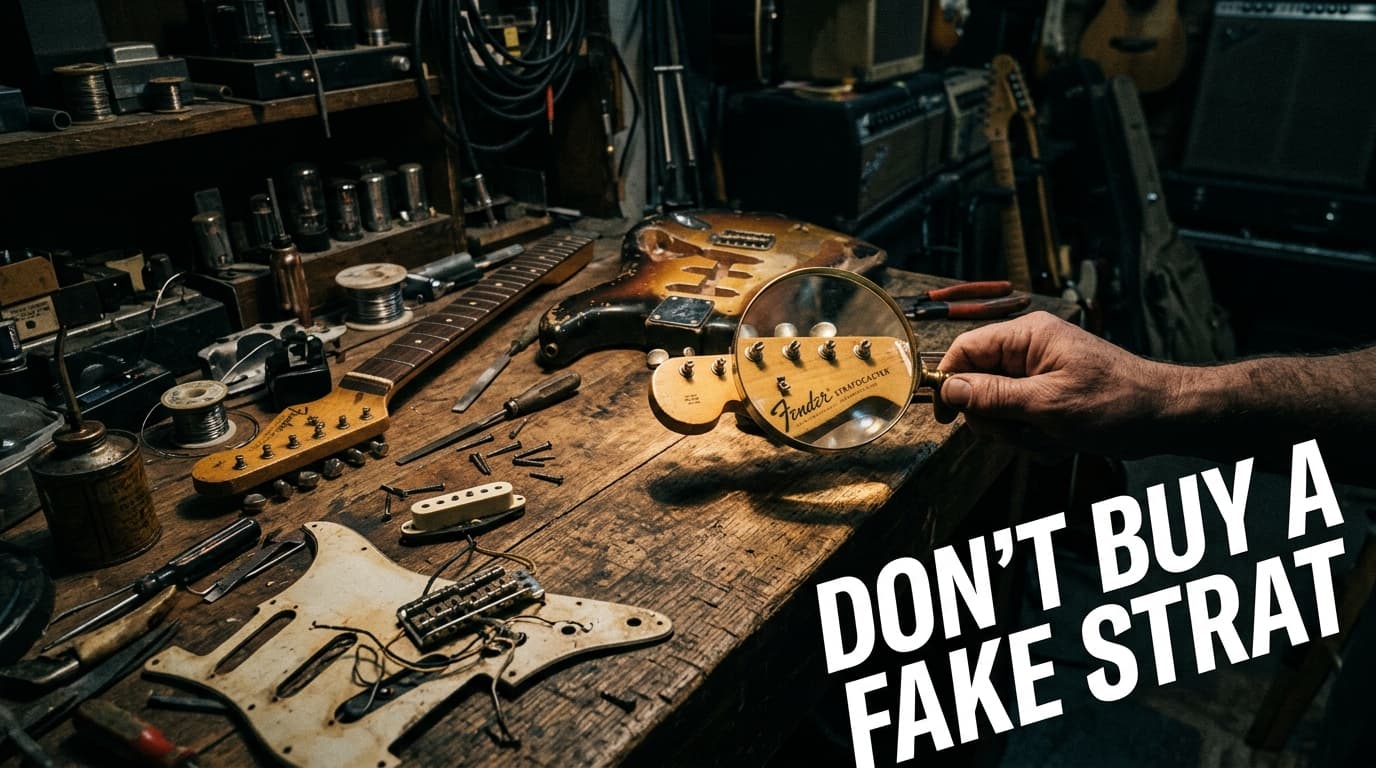

The Guitar That Wasn't: A $1,500 Lesson You Don't Need to Pay For
A collector walked into a deal on a 1965 Fender Stratocaster. The price was steep, the seller was confident, and the guitar looked right. He paid vintage money. Then a tech got hold of it. Only the neck was original. Everything else had been swapped out over the decades, a parts-bin Frankenstein wearing a legitimate serial number like a costume. "There was nothing original in there, it was all shonky," as Matt Gleeson of Monty's Guitars put it. The collector had paid for a museum piece and received a puzzle assembled from someone else's leftovers.
That story isn't a horror story about vintage guitars specifically. It's a horror story about buying without knowledge. The used market in 2026 is full of genuine deals, but it's also full of sellers who price from wishful thinking, guitars with problems a ten-minute inspection would catch, and listings that look like bargains because you're comparing them to the wrong number. Used electric guitar prices are still roughly 20% above their 2019 levels even after pulling back from pandemic highs. The deals aren't as obvious as they look.
This guide is your buying guitars and amps guide for building a first rig under $1,200. It covers what your money actually buys right now, how to price-check a listing without getting fooled, what to look for in person, how to spot a fake, where to buy, and how to protect yourself when you pull the trigger.
What $1,200 Actually Buys You Right Now
A sensible split for a first rig is roughly $700 on the guitar, $400 on the amp, and $100 on the essentials: a cable, a strap, a clip-on tuner, and maybe a basic overdrive pedal if there's anything left. That's not a compromise rig. At those price points, the used market has genuinely excellent gear.
For the guitar, $700 gets you into used Gibson SG Standard territory. The 1991 to 2012 era SGs average around $1,096 on Reverb's price index in 2025, but patient buyers regularly find them in the $650 to $750 range with cosmetic wear. Gibson Les Paul Customs from the same era are running about 19% above their 2019 prices, so they're tighter at this budget, but they're not impossible. If you want something with real upside, the discontinued Fender Road Worn '50s Telecaster has climbed 80% since it left production in 2019 and keeps climbing. A clean used example in the $550 to $650 range is a guitar you'll likely sell for more than you paid. Fender MIJ reissues tell a similar story: the ST-62 Stratocaster Reissue is up 90% since 2019, and the TL-62 Telecaster Custom Reissue is up 43%. These are guitars worth hunting.
For the amp, $400 used is plenty. A used Fender Blues Junior, a Vox AC15, or a Marshall DSL20 all live in this range and cover most of what a first player needs. Buy used, buy from someone local if you can, and test every channel.
How to Price-Check a Listing Without Getting Fooled
Here is the single most useful thing in this entire buying guitars and amps guide: when you look at sold listings on Reverb to benchmark a price, the number you're seeing is the list price, not the actual transaction price. The seller asked that amount. Whether the buyer paid it is a different question entirely, and the answer is usually no. Buyers who use Reverb sold listings as their comp data are systematically overestimating market value, which means they negotiate from a ceiling instead of a floor.
For real comps, use eBay's sold listings filter. It shows what people actually paid, not what sellers hoped for. Greg Olwell, editor-at-large of Acoustic Guitar magazine, flagged this directly: many sellers are setting asking prices based on Reverb's listed prices, which are already inflated above actual sale prices. When you walk into a negotiation knowing this and the seller doesn't, you have a real edge.
Also watch out for hype-driven models. The Squier Hello Kitty Stratocaster tripled in value between 2019 and 2024 after going viral, then slumped 27% in a single year. Competition-stripe Fender Mustangs from 1969 to 1973 more than doubled, then fell 22% in twelve months. Buying at the peak of a trend is just paying someone else's exit price.
The 10-Minute Physical Inspection That Separates Smart Buyers From Everyone Else
Before you play a single note, run through this quickly. Check the neck relief by pressing the low E string at the first and last fret simultaneously and looking at the gap at the seventh fret. A slight bow is normal; a dramatic curve or a back-bow means a potential truss rod issue. Look at the frets: flat spots indicate heavy wear, and on vintage Gibsons especially, worn frets affect intonation in ways that can cost several hundred dollars to fix. Check the tuners by turning each one. They should move smoothly with no slop. Look at the headstock under good light for repaired cracks, which are common and not necessarily dealbreakers but matter for price. Check the body for checking (fine hairline cracks in the finish) on older guitars.
Then plug in. Turn every pot slowly while listening for crackle. Here's the counterintuitive part: a crackling pot that starts clearing up as you turn it is almost certainly just dirty, which is a $5 fix. Gleeson is direct about this: point out the crackle to the seller and use it to negotiate the price down. It's a free bargaining chip most buyers treat as a dealbreaker.
One more thing. Don't reflexively avoid cosmetically rough guitars. The ones with buckle rash and worn finishes often play better than the pristine examples, because they've actually been played. You won't know until you hold it.
How to Spot a Fake (Including the Serial Number Trick That Fools Everyone)
Fake Gibson Les Pauls are the highest-risk counterfeit category for first-time buyers, and the most dangerous thing you can do is check the serial number and feel confident. Counterfeiters use stolen serial numbers from real guitars. A lookup on Guitar Dater Project will show a fake as genuine. A call to Gibson customer service will confirm it. The serial number tells you nothing.
What does tell you something is the physical guitar. Look at the weight: real Les Pauls are heavy. Check the binding quality on the body and headstock; fakes tend to have uneven or plastic-looking binding. The headstock angle on a real Gibson is a specific 17 degrees, and the volute behind the nut is a detail counterfeiters often get wrong. Look at the hardware finish under light; cheap plating has a different quality than the real thing. The Geartalk editorial team puts it plainly: "If it is too good to be true, it is. End of." Counterfeiters are constantly improving, which means any list of tells has a shelf life.
For any remote purchase of a guitar over $500, send photos to a trusted tech before you commit. Gleeson recommends exactly this, even just via Instagram. George Gruhn's Guide to Vintage Guitars is also worth having if you're shopping vintage; it covers serial numbers, pot codes, and the kind of detail work that separates a real instrument from a copy.
Where to Buy and What Each Platform Actually Costs You
Craigslist and Facebook Marketplace are free. That's the whole pitch. There is no buyer protection, no dispute process, and no recourse if the seller disappears after you hand over cash. Craigslist's own guidelines acknowledge that in-person-only meetups avoid 99% of scam attempts, which tells you something about what happens when you don't follow that rule. Facebook Marketplace has the same structural problem: free to use, nothing protecting you.
eBay and Reverb charge sellers 10 to 15%, which sellers account for in their asking prices. You get some buyer protection, though disputes can be slow and outcomes are inconsistent. The workaround many buyers use on unprotected platforms is PayPal Goods and Services, which adds roughly 1.5 to 1.8% for basic protection. It's a patch on a platform that wasn't designed for it.
Fisheez is built differently. Sellers pay nothing. Buyers pay a tiered fee: 6.00% on a $500 to $1,000 transaction, which is $42 on a $700 guitar. What that buys you is SmartShell escrow built into every transaction by default. Your funds lock in a smart contract when you pay and don't release until you confirm the deal is done. If a seller doesn't respond to your order within 72 hours, SmartShell automatically triggers a refund. No chasing, no dispute filing, no waiting. One important warning: if you voluntarily release escrow early, you waive all dispute rights immediately. Don't do it until you've physically inspected the guitar and you're satisfied.
Pull the Trigger: Your First Rig Checklist
Here is what you take with you. Check sold listings on eBay, not active listings on Reverb, before you agree to any price. Run the neck, fret, tuner, and electronics check before you play. Treat crackle as a negotiating chip. Avoid hype-driven models at their peak. On any Gibson over $400, verify the headstock angle, binding quality, and weight rather than relying on the serial number.
For platform choice: local cash meetups in a public place are fine for anything under $300. Above that, or for any remote transaction, use a platform with structural protection. Fisheez's SmartShell escrow is the right layer for any deal you can't inspect in person. If you want to understand exactly how SmartShell works before your first transaction, the complete SmartShell escrow guide walks through every step.
On models worth targeting right now: PRS has been the most value-stable brand through the entire post-pandemic cycle, making it a smart buy if you care about what you can sell it for later. Discontinued Fenders and Fender MIJ reissues have the strongest upside trajectory. The Epiphone Joe Bonamassa Signature Firebird I jumped 34% in the last twelve months alone, which shows that budget-tier signature models can move fast when demand catches up to supply.
The core principle in any buying guitars and amps guide is this: knowledge is the negotiating weapon. Gleeson says the most important thing is that the guitar resonates with you when you pick it up, and that everything else is generally fixable. He's right. But you have to get to the point of picking it up without getting burned first. That's what this is for.