
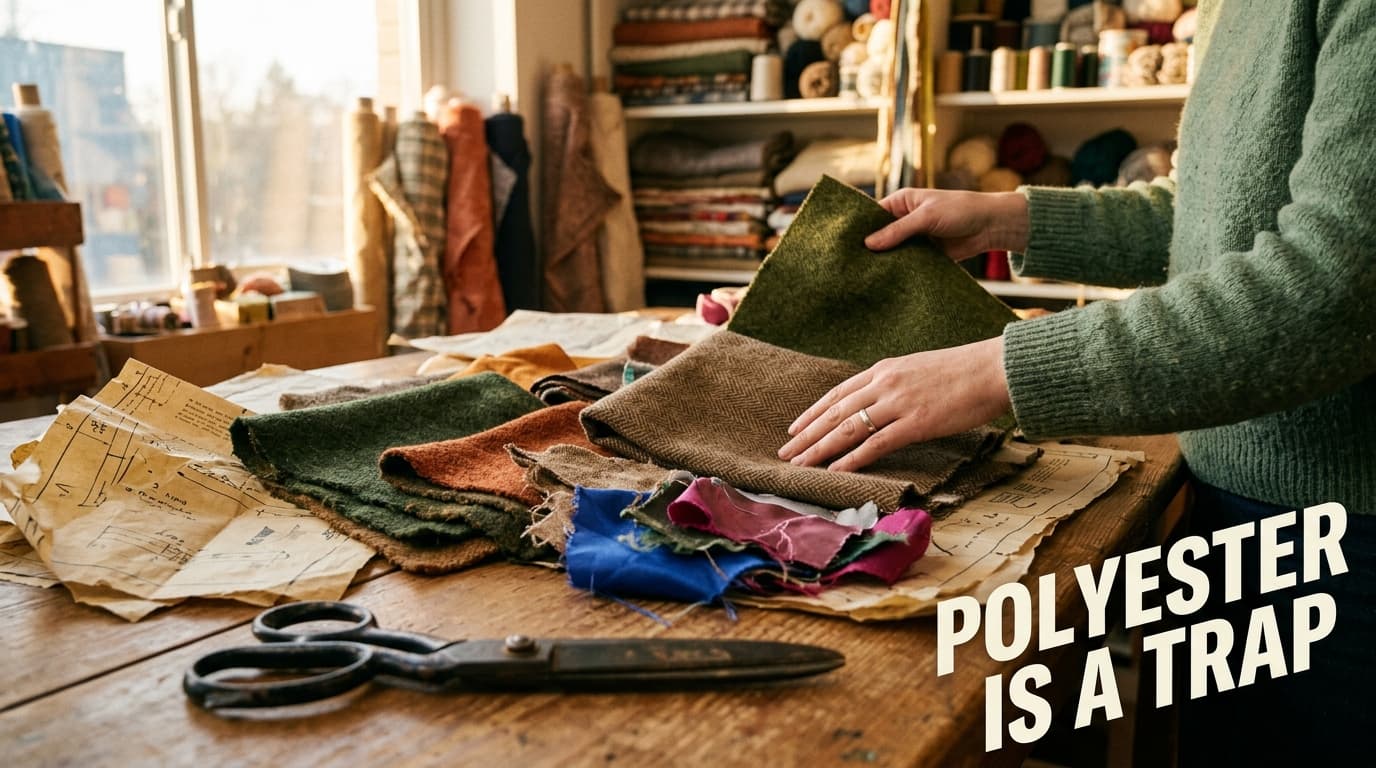

The Cheap Fabric That Costs You More
Here is the thing nobody tells you when you're standing in a craft store with a $20 bill: that $3-per-yard polyester is not a deal. It is the default price for the world's most mass-produced material, and it will stay that price forever, because it costs almost nothing to make. Polyester alone accounts for 57% of all global fiber production. Virgin fossil-based synthetic fiber hit 75 million tonnes in 2023. The shelves are full because the factories never stop running, not because someone is doing you a favor.
The real sewing crafting supplies comparison you should be making is not polyester versus retail wool. Retail wool at $15 to $25 per yard is genuinely out of reach on a $20 budget, and that is not going to change. The comparison that actually matters is polyester versus vintage wool sourced the way smart crafters have always sourced it: through thrift stores, estate sales, and peer-to-peer marketplaces. That comparison has a clear winner, and it is not the one flooding the craft store shelves.
Why Wool Costs What It Costs (And Why That's Not Going to Change)
Wool is expensive at retail for reasons that have nothing to do with trend or markup. Around 200 million people are involved in natural fiber production globally, from farmers to seasonal labor to processors. Sheep need land, care, and annual shearing. Fiber crops cover roughly 34.2 million hectares worldwide. None of that is going away, and none of it gets cheaper when demand ticks up slightly.
Synthetics, by contrast, require no land, no harvest cycle, and minimal human labor. The cost gap between polyester and wool is not a market condition you can wait out. It is baked into the physics of how each material is made. Natural fibers account for about 31% of global production, with cotton taking up most of that at around 19%. Wool is a fraction of what remains, which is exactly why it commands a premium at retail and exactly why you will not find it on sale at a craft chain store.
Stop waiting for that to change. It will not.
Head-to-Head: Durability, Feel, and Workability
Let's be honest about both sides, because a fair sewing crafting supplies comparison requires it. Synthetics have real advantages. They are wrinkle-free, strong, water-resistant, and nearly impossible to destroy in a washing machine. For a project that needs to survive hard use or outdoor conditions, polyester earns its place.
Wool, however, wins on feel, longevity, and breathability in ways that polyester simply cannot replicate. It does not shed microplastics into the water supply with every wash. It biodegrades at end of life instead of persisting for hundreds of years in a landfill. For garments and home goods that you want to last and feel good wearing, wool is not the sentimental choice. It is the practical one.
The workability trade-off is real, though, and you should know it going in. Wool requires more care: pre-washing before cutting, the right needle, and attention to edges. A crafter who used heavy Pendleton wool for appliqué on denim jacket plackets ran into a specific problem: the wool pulled away from stitching on vertical edges. The fix is lightweight fusible interfacing applied to the wool before you sew, or twill tape along the edges. Not a dealbreaker, but it is a step synthetics do not require. Know it ahead of time and it is a five-minute solution.
The $20 Budget Math: Retail vs. Thrift vs. Peer-to-Peer
At retail, $20 buys you roughly four to six yards of polyester or a small amount of something you will not love working with. It buys you essentially nothing in wool. That is the retail math, and it is why most crafters default to synthetics without ever questioning the choice.
The thrift store math is completely different. One crafter found a partial bolt of 100% Italian cotton at a charity shop for $10, enough fabric for the backs of two baby quilts. Another pulled roughly three yards of high-quality red knit from a bundle at a thrift store for a fraction of retail cost. Wool shows up in these places too, particularly vintage yardage from decades when wool was a standard household fabric. The key is knowing where to look.
Avoid large franchise secondhand chains. Goodwill and similar operations reportedly do not keep fabric that comes in; it gets discarded. The inventory you want lives at small church-run thrift stores, charity shops, and estate sales, where someone's sewing room gets donated intact. FabScrap, a non-profit with locations in Brooklyn and Philadelphia and an online virtual shopping option, diverts new fabric discarded by the fashion industry and sells it to the public at reduced prices. That is a named, real resource worth bookmarking for any crafter doing a sewing crafting supplies comparison on a tight budget. Some smaller thrift shops will also give you a 3 to 5% discount for paying cash. Always wash thrifted fabric immediately when you get home; as one experienced thrift shopper puts it, you want to know ahead of time if it cannot survive one wash.
The Sustainability Angle (You Don't Have to Care, But You Should Know)
If environmental impact is not your primary concern, skip ahead. But if you are curious about where the industry is actually heading, the answer is not where most people assume.
Recycled polyester lost market share in 2023, dropping from 13.6% to 12.5%, even as production volumes slightly increased. Virgin synthetic growth simply outpaced it. Less than 1% of the global fiber market currently comes from recycled textiles. Certified wool, under standards like the Responsible Wool Standard, grew from 4.2% to 4.8% of total wool production, which is movement in the right direction but still tiny. Global fiber production is on track to hit 160 million tonnes by 2030, and synthetics are driving nearly all of that growth. Textile Exchange, the leading authority on fiber sustainability data, has warned that this trajectory threatens to undermine the industry's climate commitments entirely.
Buying vintage wool from a thrift store or a peer seller is genuinely countercultural in that context. You are not buying into a new production cycle at all. That is a real environmental benefit, even if it is just a bonus on top of the cost and quality arguments.
Your $20 Fabric Strategy, Settled
Here is the decision framework, kept simple. Choose synthetics when you need water resistance, zero-fuss machine washing, or a quick project where longevity does not matter. Choose vintage wool when you want something that will last, feel good, and hold up to real use over time. The sewing crafting supplies comparison only favors polyester if you refuse to source wool anywhere except a retail shelf.
For a $20 budget, the sourcing strategy is: small thrift stores first, estate sales when you can find them, and peer-to-peer marketplaces for specific finds. The peer-to-peer route gives you access to exactly the kind of vintage wool yardage that no longer shows up at retail, often from sellers clearing out inherited fabric collections or downsizing sewing rooms. The problem with Facebook Marketplace and Craigslist for fabric deals has always been the same: no recourse if the fabric arrives nothing like the listing described.
That is where Fisheez solves a specific, practical problem. It is a peer-to-peer marketplace with SmartShell Escrow built in, which means your payment locks in a smart contract when you pay and only releases when you confirm the fabric arrived as described. For a $20 fabric purchase, the buyer fee is 8%, so $1.60. The seller keeps 100% of the sale price, which means sellers are not inflating prices to cover platform fees the way they do on eBay or Etsy. If there is a dispute, trained community volunteers called Peacemakers handle resolution through a structured process. Peacemakers are not paid per dispute; they are community volunteers who earn eligibility for prize pools through their participation. It is the trust layer that makes peer-to-peer vintage wool sourcing actually work, instead of just being a gamble.
The cheap fabric is not always the cheap choice. You already knew that. Now you know where to find the good stuff without paying retail for it.