
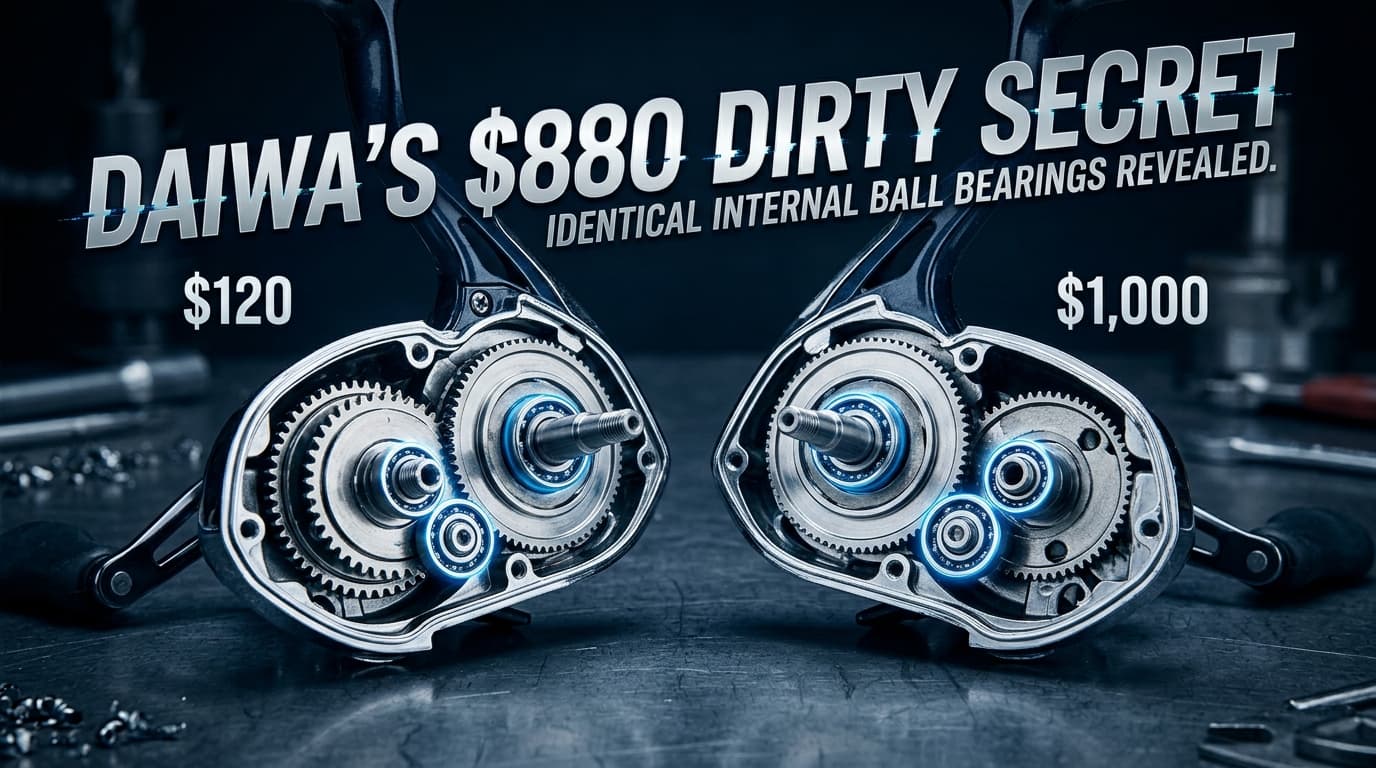

The $1,000 Reel Has a $120 Twin
Crack open a $120 Daiwa BG and a $1,000 Daiwa Saltiga offshore reel, and you'll find the exact same Minebea ball bearings inside both. Not similar bearings. Not comparable bearings. The same ones. That single fact, confirmed by Wirecutter's physical teardown and independently validated by reel reviewer Alan Hawk, is the most honest thing anyone in the fishing industry has said in years. Charter captain John McMurray runs tuna charters out of New York City and almost exclusively uses Saltiga reels on his boat. His clients are paying for the full offshore package. But the component that keeps the line smooth? It's sitting in a reel you can buy for a hundred and twenty dollars.
Alan Hawk went further. He argued that the BG's 2016 release is the single reason the entire sub-$200 spinning reel market improved so dramatically over the past decade. When one reel at that price point proved it could carry premium internals, every manufacturer had to respond. The hunting fishing gear myths that keep anglers reaching for their wallets don't survive this kind of teardown.
58 Million Anglers Can't All Afford $300 Reels
In 2024, 57.9 million Americans went fishing, the highest number ever recorded since tracking began in 2007. The national participation rate hit 19 percent, also an all-time high. Women now represent 37 percent of all fishing participants. Hispanic participation has grown by 45 percent over the past decade. These are not tournament pros with $500 reel budgets and a sponsor covering the difference. These are families, first-timers, weekend anglers, and people who discovered the water during the last few years and decided to stay.
The "buy expensive or suffer" message that dominates gear coverage isn't just wrong. It's exclusionary in a way that's increasingly hard to justify given who is actually fishing. Field and Stream's Shaye Baker put it plainly after field-testing a full bracket of sub-$100 reels: "For the vast majority of us, there's no need to spend $300 to $500 on a spinning reel." That conclusion came from actual fishing, not spec sheets.
What's Actually Inside a $120 Reel vs. a $300 One
The BG's drag disc polymer is the same material used in the Penn Slammer IV, a reel that typically runs north of $300. The gears in the BG are cast zinc, which sounds like a downgrade until you realize that cast zinc is the industry standard for virtually every reel under $300. The real material upgrade, machined aluminum gears, doesn't begin until you cross that threshold. The quality ladder most anglers assume exists between a $120 reel and a $250 reel is largely a marketing construct. The Wirecutter teardown found the BG "has more in common with $200-plus reels than with others in its price category." That's not a compliment dressed up as a review. That's a component audit.
Brand name doesn't insulate you from failure, either. During Wirecutter's testing, previous Penn Battle models had parts fall off and drags give way. The Penn Battle is not a no-name budget reel. It's a respected mid-range product from one of the most recognized brands in fishing, and it still failed under professional testing conditions. Price and pedigree are not the same thing as reliability.
The Numbers Don't Lie: Field Test Scores Across Price Points
Outdoor Gear Lab ran a 12-reel comparison and published scored results. The Okuma Aria A at $20 earned a Best Buy designation and scored 71 overall. The Okuma Ceymar A at $69 scored 80. The Daiwa BG at $150 scored 84. The Abu Garcia Revo SX at $190 scored 88. You are spending 9.5 times more money for a 24 percent improvement in tested performance. That is the diminishing returns curve made visible, and it's one of the clearest examples of hunting fishing gear myths colliding with real data.
The same pattern holds within a single brand. The Shimano Sedona FJ runs between $75 and $85 and performs "pretty close" to the Shimano Stradic Ci4+, which costs roughly three times as much. When the cheaper reel and the expensive reel wear the same logo and the field tester still can't find a meaningful gap, the price premium stops being an engineering argument and becomes a marketing one. Field and Stream named the Daiwa Regal LT their Best Overall pick at $69.99. Outdoor Gear Lab tester Chris Maxcer described the $69 Ceymar A as "super smooth" and "sturdy yet precise" after fishing it across multiple environments. These are not consolation prizes for people who couldn't afford better. They are the top picks.
The Honest Caveat: Where Cheap Reels Actually Fail
None of this means every reel is equally good. Outdoor Gear Lab is direct about the floor: below $25, build quality takes a steep dive. The Okuma Aria A at $20 earns its Best Buy status, but it sits right at the edge of where things start to fall apart. If you're buying for a child's first rod or a single afternoon on a dock, that range is fine. For anything more serious, the $25 floor is real and worth respecting.
Saltwater fishing adds another genuine constraint. John McMurray's warning is specific: salt will destroy a standard BG. The reel lacks a sealed drag, which means corrosion is a real threat in marine environments. If you're fishing saltwater regularly, the sealed drag is not a luxury feature. It's a functional requirement regardless of what you spend. Technique matching matters just as much as price. Mud Hole's Chris Adams describes a scenario where a rod blank costing roughly half the price of the premium option outperforms it for a specific application, because the cheaper blank suits the technique and the expensive one doesn't. His conclusion cuts through the hunting fishing gear myths cleanly: "Price can influence performance, but it does not define it." Buying the right gear for your actual fishing is always a better investment than buying the most expensive gear for someone else's fishing.
The Sweet Spot, and How to Work It
After nearly a decade of professional field testing across multiple independent outlets, the $70 to $150 range is where the consensus keeps landing. The Daiwa Regal LT at $69.99. The Okuma Ceymar A at $69. The Shimano Sedona FJ at $75 to $85. The Daiwa BG at $120, the same unit Wirecutter has been testing since 2016 with one cleaning and zero mechanical failures. These aren't budget picks hedged with asterisks. They are the top picks, full stop.
One more move worth knowing: model cycles create value. The Penn Battle III was a strong runner-up to the BG for years. Since the Battle IV launched at $145, the Battle III has dropped well below $100. Near-identical performance, meaningfully lower price, simply because a new version exists. Angling author John Skinner described the ideal reel price as "when you don't have to worry about breaking it," and Wirecutter's testing put that threshold at $100 to $120. The model-cycle strategy gets you there for even less.
Once you know what gear is actually worth, the next question is where to buy and sell it without getting taken. The same logic that exposes hunting fishing gear myths applies to marketplace fees. Fisheez is a peer-to-peer marketplace built specifically for this problem. Sellers pay zero percent in fees, compared to eBay's 10 to 15 percent and Amazon's 15 to 45 percent. Buyers get SmartShell Escrow, which locks funds in a smart contract in USDC on the BASE network and releases them only when the deal is complete, so a $120 reel bought used doesn't become a $120 lesson in getting scammed. Disputes are handled by Peacemakers, trained community volunteers who are eligible for prize pools through their participation. If the whole argument of this article is that you shouldn't have to overpay for good gear, that principle extends to where you transact. Fisheez is where it holds.