
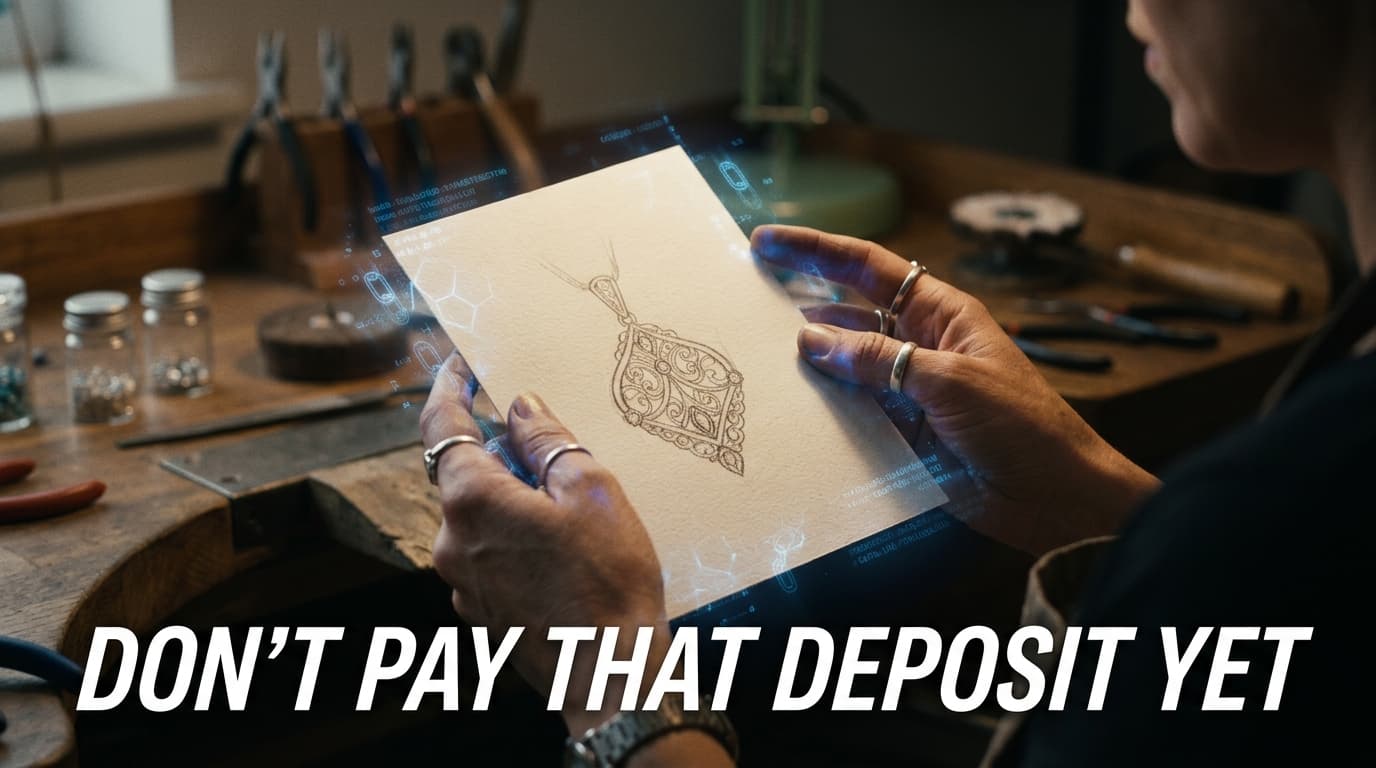

That Necklace You've Been Picturing Has a Price Tag and a Risk Tag
You've been thinking about a custom necklace for months. Maybe it's a piece with a birthstone for your daughter, initials intertwined with a partner's, or a pendant design you've never seen in any store. You find a jeweler on Instagram whose work looks exactly right. You send a message. They respond quickly. You're excited.
Then they ask for a deposit to get started, and you realize: you have no idea how any of this actually works.
Commissioning a custom necklace from an independent jeweler is one of the most personal purchases you can make. It's also one where buyers lose money most often, not because jewelers are dishonest by default, but because the process has no standard playbook and the relationship starts with trust before it earns it. This guide gives you a five-step process for hiring a custom jewelry creator the right way, so you get the piece you want and your money stays protected throughout.
Step 1: Find Jewelers Whose Portfolio Shows Work Like Yours
The first thing to understand is that jewelry artists specialize. A jeweler known for minimalist gold stackables may not be the right fit for an intricate gemstone-set statement piece. Before reaching out to anyone, spend time reviewing their actual portfolio, not just their most viral posts.
Look for finished custom pieces specifically, not just production items or studio shots. Ask yourself whether the style, material complexity, and scale of their past work matches what you are trying to create. Strong portfolios include in-progress shots and CAD renderings alongside finished results, which tells you the jeweler is methodical, not just lucky with outcomes.
Red flags at this stage: accounts with very few posts, portfolios that look too polished and consistent (stock photography is a real problem in the jewelry space), and sellers who cannot point you to reviews or previous clients. A newly created social media page with no commission history is a serious reason to keep looking.
Step 2: Vet the Jeweler Before You Fall in Love with the Design
Once you have a shortlist, treat the vetting process like a job interview, because you are hiring someone to hold your money and your creative brief at the same time.
Ask these five questions before committing to anyone: What does your step-by-step process look like? Can I see past custom work specifically? Where do you source your materials? What happens if I am not satisfied with the result? How do you handle budget conversations and changes?
Pay attention to how they communicate as much as what they say. A jeweler who takes days to answer basic questions before you have paid will not suddenly become responsive once the deposit clears. Slow or vague communication is one of the most common complaints in custom commission disputes. Look for someone who answers specifically, sets clear expectations, and seems genuinely interested in understanding your vision rather than just moving toward payment.
Check reviews on independent platforms like Google, Etsy, or the Better Business Bureau. A few negative reviews handled professionally are far less concerning than a seller with no review history at all.
Step 3: Lock in the Specs Before Any Money Changes Hands
This step is where most commission relationships go wrong, and it costs buyers hundreds or thousands of dollars. Before you discuss payment, you need a written agreement that covers four things: the exact design specifications (materials, dimensions, stone details, finish), the timeline with milestones, the payment structure, and the revision policy.
Most jewelers work with a deposit model, typically 50 percent upfront and the remainder on completion. That is a reasonable structure. What is not reasonable is paying that deposit before you have a written record of what you are paying for. Custom jewelry purchase agreements should include the scope of work, the final quote broken out by materials and labor, and explicit terms around what happens if you are unhappy with the result.
If a jeweler resists putting anything in writing, that is your answer. Walk away.
Step 4: Protect Your Payment with Escrow
Here is where a lot of first-time custom necklace buyers make a costly assumption: they think sending money via PayPal, Venmo, or a bank transfer gives them some kind of protection. It usually does not.
Escrow services for jewelry purchases work by holding your funds with a neutral third party until the conditions of the deal are met. You pay in, the jeweler gets notified to begin work, and the money is only released when you confirm receipt and satisfaction. If the jeweler disappears or the piece does not match the agreement, the funds do not go anywhere.
This matters because custom commissions are one of the highest-risk transaction types in the handmade goods world. You are paying for something that does not exist yet, from someone you found online, often with no platform enforcement behind the transaction. Escrow is not overcautious for this type of purchase. It is the appropriate tool.
Step 5: Manage the Process and Accept Delivery Carefully
Once work begins, maintain regular communication. Most professional jewelers will send progress updates, and you should feel comfortable asking for them at each milestone: after the initial sketch or CAD rendering, after any wax model or prototype stage, and before final finishing. Each checkpoint is an opportunity to catch a misunderstanding before it becomes a finished mistake.
When the custom necklace arrives, inspect it against your written specs before releasing any final payment. Check the metal type and finish, stone quality and placement, dimensions, and any personalization details like engraving or birthstone accuracy. If something does not match, you have more leverage to address it before the transaction is closed than after.
Document everything throughout the process. Save all messages, photos, and agreements in one place. This record is what protects you if a dispute ever arises.
The Safer Way to Commission a Custom Necklace Online
The five steps above can protect you with any jewelry artist, but the process only works if you actually have tools to enforce it. That is the core problem with most online commission transactions: the protection depends entirely on the seller's goodwill.
Fisheez is built differently. It's a peer-to-peer marketplace where SmartShell Escrow is built into every transaction by default. When you commission a custom necklace through Fisheez, your payment is locked in a smart contract on the BASE blockchain, held in USDC, and only released when you confirm the deal is complete. No bank middleman, no hoping the seller honors their word.
If something goes wrong, Fisheez has Peacemakers, trained community volunteers who step in to resolve disputes fairly. Unlike Facebook Marketplace or a cash handoff through Craigslist, you are not on your own the moment payment leaves your account. The protection is structural, not optional.
Sellers on Fisheez pay nothing in fees, which means the artists you commission there have no financial incentive to route you to riskier payment channels. Buyers pay a tiered service fee that scales down as the purchase value rises. The whole system is designed to make handmade and custom transactions work the way they should: with the creator focused on the craft and you focused on getting exactly what you paid for.
Your custom necklace should be a piece you love for years. Start the process right, and it will be.