
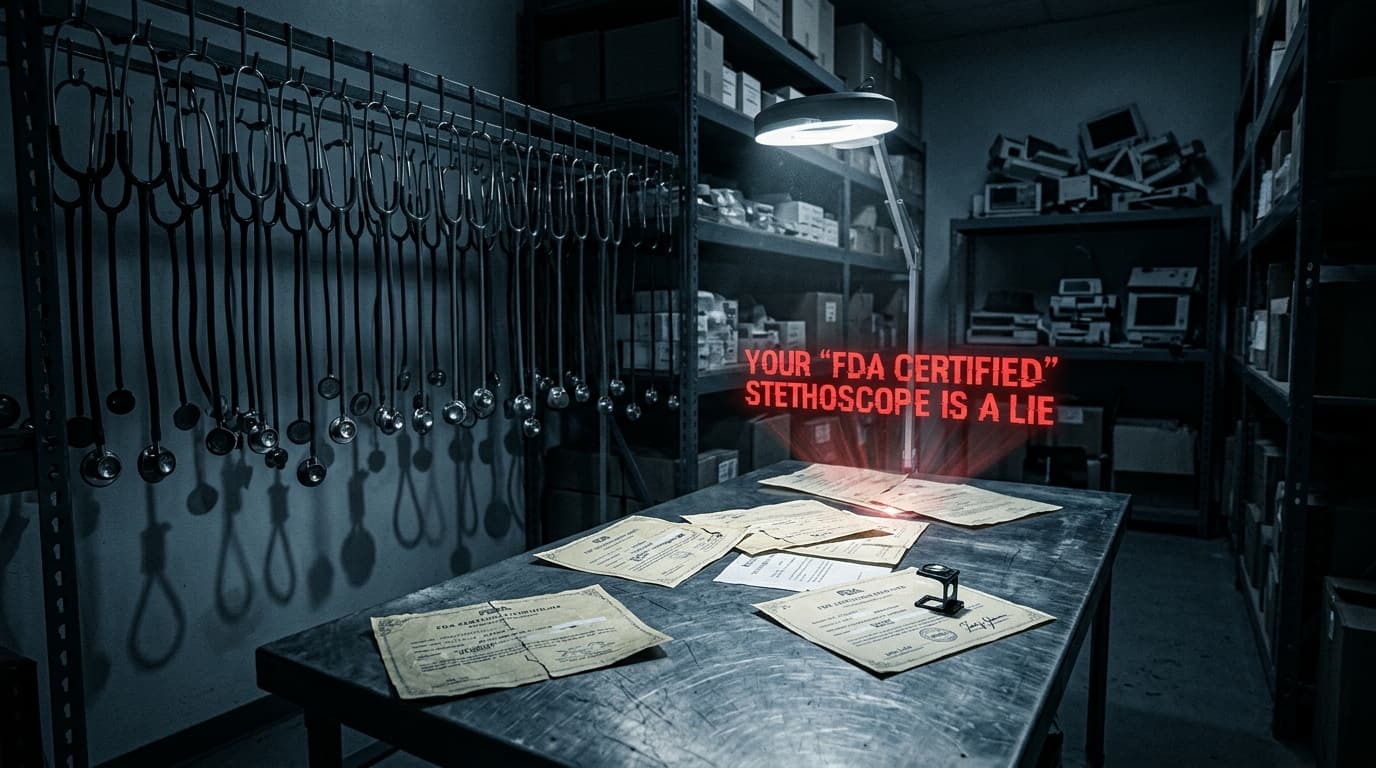

That "Certified" Label Is Not What You Think
When was the last time you actually looked up what "certified stethoscope" means on the product listing you bought from? Not the badge. Not the marketing copy. The actual regulatory status.
For most stethoscopes sold in the United States, FDA classification is Class I, which means they are subject to general controls only. There is no pre-market approval process, no independent acoustic testing, and no performance threshold the manufacturer has to clear before stamping a certification claim on the box. The FDA's role is registration, not endorsement. A device sitting in a database at the FDA is not the same as a device the FDA has evaluated and vouched for. When a supplier tells you a stethoscope is "FDA certified," they are counting on you not knowing the difference.
This is not a fringe concern. In March 2021, the FDA issued a formal statement confirming that it does not issue registration certificates for medical device manufacturers. It sent demand letters to 25 entities producing fake FDA certificates, many of which proliferated during the pandemic. The certificates looked convincing: FDA logo, eagle imagery, registration dates, and signatures. They were designed to look official.
How the Markup Machine Works Against Small Clinics
A 2024 report from the Patient Rights Advocate found that 60% of hospital bills included overcharges on equipment or supplies. A Medicare audit from 2016 to 2018 uncovered $34 million in improper payments to device suppliers for repairs alone. A single Illinois clinic discovered a 32% markup on disposable gloves once it requested itemized invoices.
The numbers get more extreme with specific categories. Blood pressure cuffs sold at 175% to 300% above market rate. CPAP machines invoiced at $1,412 when the market rate was $189. These markups are not accidents. They are the product of a supply chain built on habit, opacity, and the assumption that clinic buyers will not check.
Stethoscopes follow the same pattern. When a sales rep leads with brand prestige and certification language, the markup conversation never happens. Certified stethoscopes carry a premium that is often about positioning, not performance, and the distributor knows it.
Fake Certification Papers Are a Real Problem
The FDA's 2021 warning was not hypothetical. Entities were actively producing documents designed to look like official federal authorizations. These papers circulated in the medical supply market, and small clinic owners without dedicated procurement teams were the most likely targets.
Fraudulent certificates display the manufacturer's name, device descriptions, the FDA logo, and fabricated registration dates. What they never contain is an actual FDA official's signature, because the FDA does not sign or issue registration certificates.
If you want to verify whether a device has genuine FDA clearance, the process is free and takes two minutes. Use the FDA's 510(k) database or the device establishment registration search at FDA.gov. If the only evidence of FDA status is a printed certificate from a distributor, that is not evidence.
What Actually Predicts Stethoscope Performance
Strip away the branding and you are left with a short list of factors that actually matter. Acoustic sensitivity and frequency range are the core metrics. Tubing quality affects both signal fidelity and durability. Ear tip fit matters more than most buyers realize: a poorly fitted ear tip degrades acoustic performance regardless of what the chestpiece costs.
Warranty terms are a reliable proxy for manufacturer confidence. ADC, one of the two dominant stethoscope manufacturers worldwide, provides lifetime warranties on select models and complimentary replacement parts. That support structure tells you more about product quality than any certification badge does.
Clinical professionals consistently report that the performance gap between premium-branded and mid-range stethoscopes is real but narrow for general practice. For a general or urgent care clinic, the choice comes down to comfort and durability, not prestige. Do not let the certified stethoscope label override your own performance criteria.
The Brands Worth Considering Beyond the Market Leader
ADC and MDF Instruments are the most validated alternatives to Littmann in clinical settings. ADC offers a broader product range, comparable acoustic performance, and warranty terms that frequently exceed what premium brands provide at equivalent price points. MDF Instruments, with its lifetime warranty and included accessory kits, suits clinics outfitting multiple staff members on a budget.
The price gap is not trivial. A mid-range Littmann runs $150 to $250. Comparable ADC or MDF models run $60 to $120. For a clinic buying ten units, that is $900 to $1,300 in savings with no meaningful diagnostic trade-off for standard use. Clinical practitioner comparisons consistently show both brands meet professional standards for general auscultation.
Vetting Suppliers the Way Regulators Cannot
Regulators are not your procurement team. Start with itemized invoices. Any supplier that resists providing per-unit pricing with line-item detail is worth questioning. Benchmark prices against CMS transparency data, public since 2021. Run quarterly audits on vendor contracts; price drift is one of the most common ways clinics overpay for medical equipment year after year.
For any device where certification is claimed, verify it directly using the FDA's device database. Check serial numbers on the manufacturer's website. A missing or invalid serial number is a significant red flag. Prioritize direct manufacturer relationships or distributors with verifiable track records over marketplace sellers with no contact information or return policy.
When You Buy Through Secondary Channels, Protection Has to Be Built In
The secondary market for medical equipment can be genuinely useful for cost-conscious clinics. Refurbished equipment from verifiable sources can reduce costs by 10% to 40%. But the same counterfeiting risk that applies to new certified stethoscopes is amplified in secondhand transactions. You are buying without the manufacturer's chain of custody, from a seller you often cannot independently verify before money changes hands.
On platforms like Craigslist or Facebook Marketplace, cash changes hands before you can inspect what you received. There is no mechanism to hold payment while you run your verification process.
Fisheez is built around a different model. SmartShell Escrow locks your funds in a smart contract in USDC on the BASE network. The money does not move until you confirm the transaction is complete. If the deal falls through or the item does not match the listing, the smart contract structure supports auto-refund, and disputes go to Peacemakers, trained community volunteers who arbitrate independently. Sellers pay nothing to list. Buyers pay a tiered fee starting at 8% for transactions under $50, scaling down to 0.5% above $10,000. It is a structure that gives you time and leverage to verify what you are buying before funds leave your hands, which is exactly what secondhand equipment purchasing requires.